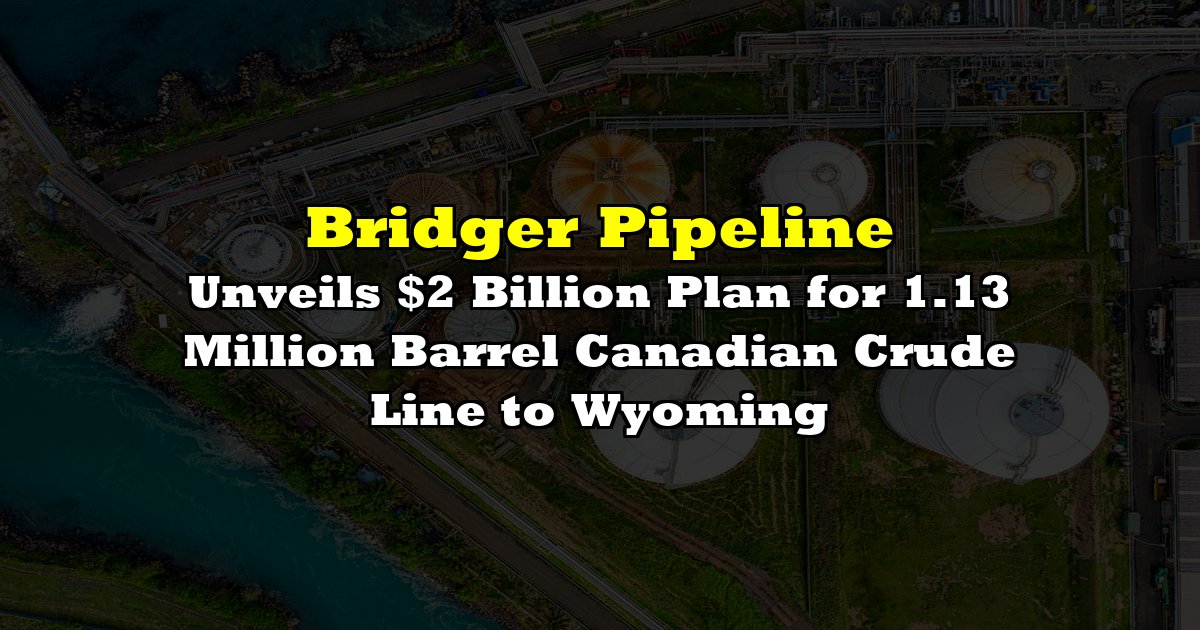

Bridger Pipeline has revealed plans for a $1.96 billion project to transport Canadian crude from the U.S.-Canada border in Phillips County, Montana, to Guernsey, Wyoming, with a capacity of up to 1.13 million barrels per day. The 36-inch pipeline, spanning nearly 650 miles, marks a significant step in expanding North American oil infrastructure.
Initially, Bridger expects the pipeline to operate at 550,000 barrels per day, though the design allows for substantial scalability. By batching light crude oil at maximum capacity, volumes could exceed the typical 800,000 barrels per day ceiling for heavy oil service on a line of this size, according to Plainview Energy Analytics. The project aims to largely follow existing pipeline corridors to minimize new land disturbance, a move that could ease environmental concerns.
Bridger Pipeline's $2B Canada-Wyoming crude line targets 1M+ barrels per day capacity, moving Canadian oil from the U.S.-Canada border to Wyoming.
— The Dive Feed (@TheDeepDiveFeed) April 6, 2026
Beyond Canadian crude, the pipeline’s route offers potential tie-ins to the Bakken shale oil field in North Dakota. Detailed maps in Bridger’s application highlight access points to most of the company’s North Dakota gathering network, creating flexibility for future expansion. Matthew Lewis, founder of Plainview, noted the strategic value of this optionality, suggesting it could provide a competitive egress option for Bakken shippers.
Bridger’s ambitions may also align with broader cross-border oil strategies. The company is viewed as a potential U.S. partner for Canadian firm South Bow, which is working to revive segments of the cancelled Keystone XL pipeline. If approved by U.S. President Donald Trump and paired with additional infrastructure, this collaboration could boost Canada’s crude exports to the U.S. by more than 12%.
A key challenge remains, however, as Guernsey is not a final market for crude oil. Additional links would be required to connect the pipeline to major refining hubs like Cushing, Oklahoma, Patoka, Illinois, or the U.S. Gulf Coast. Without these downstream connections, the project’s full economic impact could be constrained.
Information for this story was found via the sources and companies mentioned. The author has no securities or affiliations related to the organizations discussed. Not a recommendation to buy or sell. Always do additional research and consult a professional before purchasing a security. The author holds no licenses.