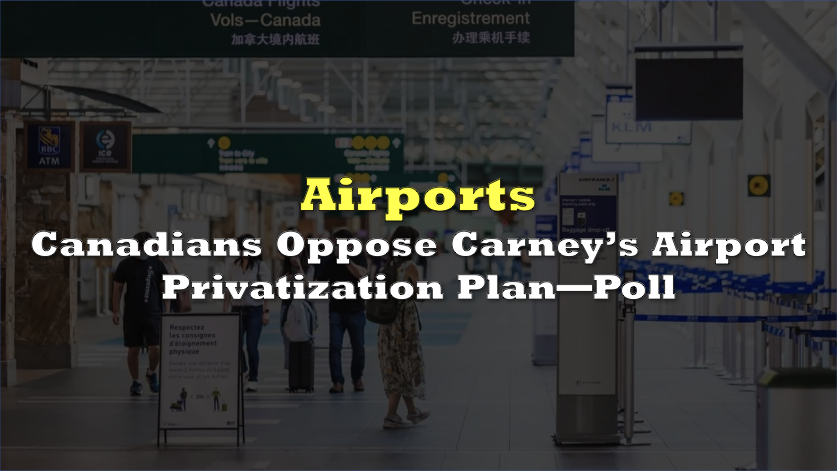

Canadians may like the idea of faster nation-building projects, but a slim majority oppose letting private investors into the country’s airports, Bloomberg reported.
A Nanos Research poll for Bloomberg found 53% of respondents oppose or somewhat oppose the government proposal, while 32.4% support or somewhat support it. Another 14.6% were unsure.
The survey covered 1,051 Canadian adults by phone and online from June 26 to 28, with a margin of error of plus or minus 3.0 percentage points.
 Sponsored · Selkirk Copper Mines
The regional split is politically useful and awkward at the same time. BC showed the strongest resistance, with 60.6% opposed or somewhat opposed. Ontario followed at 55%. Quebec was the least opposed at 47.8%, but support there still reached only 36.2%.
That makes airports an unusually visible test case for Carney’s investment agenda. Ottawa wants to mobilize public and private capital for major projects, but airports sit at the intersection of infrastructure finance, passenger fees, public ownership and regional connectivity.
The government has not announced a sale. It has, however, moved the idea from policy fringe to active review. The 2026 Spring Economic Update said Ottawa is considering reforms to airport governance, reviewing airport rent frameworks and examining ways to increase airport capacity for economic development and reinvestment. It also said the government is assessing opportunities to “unlock the full value of airports” through “alternative models of ownership,” with input from airport authorities, airlines and local governments.
The airport case
Airports generate recurring revenue, control valuable land and carry strategic importance for trade, tourism and regional access. They are also one of the few federal infrastructure asset classes that could attract pension funds, infrastructure funds and potentially foreign investors at scale.
 Sponsored · Silver47 Exploration Inc.
Carney has already tied his broader economic strategy to mobilizing capital. Reuters reported in April that Canada would create the Canada Strong Fund with an initial $25 billion endowment to invest in major domestic projects alongside private capital, with growth through asset recycling and reinvestment.
Bloomberg reported that Carney wants to spur $1 trillion in private and public investment over a decade, including ports, pipelines and trade-enabling infrastructure.
Toronto Pearson shows why the subject keeps returning. The Greater Toronto Airports Authority reported 2025 revenue of $2.08 billion, up 5.5%, and EBITDA of $990.2 million, also up 5.5%. Its EBITDA margin was 47.5%, while free cash flow reached $402.7 million.
But the public argument against airport privatization is not abstract. It is about who captures the cash flow and who pays for returns.
Bloomberg reported that roughly 20% of Canadian airfares already consist of airport fees. If private investors buy stakes, critics argue they will expect returns from the same system that passengers and airlines already fund.
Transport Minister Steven MacKinnon told Bloomberg that Ottawa is studying ownership models and lessons from other countries. He said the government needs to examine the value of the assets and ask whether they “would do better in another ownership model.” He also said Canadians may want to deploy that capital in ways that produce broader benefits.
Global News reported that MacKinnon said no decision had been made on whether airport investment proceeds would flow into the new sovereign wealth fund. The outlet also cited the Spring Economic Update’s language on alternative ownership models and stakeholder consultations.
Current model
Canada’s airports are not run as ordinary federal departments. Airport land is federally owned and leased to not-for-profit airport authorities, which operate facilities and reinvest revenue. Bloomberg described Canada as an outlier among advanced economies because most allow some degree of private airport investment.
The current model was designed to keep airport revenues inside the system while maintaining public ownership of land. Privatization would alter that bargain by bringing in investors whose mandate is return.
The Union of Canadian Transportation Employees said it wants to meet with MacKinnon over the proposal and warned that the current local airport authority model keeps revenues reinvested in airports and communities. Its national president, Teresa Eschuk, said safety and security should remain the priority “rather than the pursuit of profit for private investors.”
The Public Service Alliance of Canada was more blunt, saying private investors are interested in profit rather than running airports for the public good.
Bloomberg noted in 2017 that former Prime Minister Justin Trudeau examined selling all or part of Canada’s airports to fund infrastructure, but shelved the idea after opposition from airport authorities, airlines, consumer advocates and labour groups.
The Nanos numbers show the first obstacle is not investor appetite. Bloomberg reported that Canadian pension funds are in active talks with Ottawa and are interested in domestic airport investments after years of putting capital into international airports such as London Heathrow and other European assets.
Canadians may accept the case for bigger infrastructure, more trade capacity and less reliance on the US market. The poll suggests they are less ready to accept airports as the funding lever.