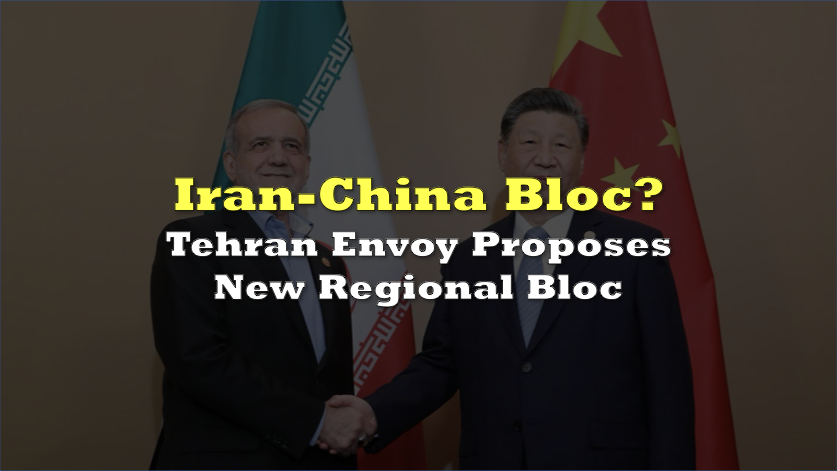

Mohammad Bagher Ghalibaf, Iran’s parliament speaker and recently appointed special envoy for China affairs, told a meeting with Iran’s business chamber that Tehran needs new regional blocs and that any future bloc would have Iran and China at its center.
Ghalibaf’s remarks, reported by Iranian state news agency IRNA, came with a revealing operational demand. He called for a dashboard that would let him track the “pulse” of Iran-China economic relations daily, identify problems, and push them back through the system.
Iran already has a 25-year cooperation plan with Beijing. China’s foreign ministry says the two countries signed the plan in March 2021 and launched its implementation in January 2022. Beijing also says bilateral trade reached $13.37 billion in 2024, including $8.93 billion in Chinese exports to Iran and $4.44 billion in Chinese imports from Iran.
 Sponsored · Selkirk Copper Mines
For Tehran, that trade balance is the problem hiding inside the partnership. Iran wants China to behave less like a buyer and more like a co-architect of a regional order. Ghalibaf said China must understand that Iran is not merely a customer or commercial counterpart, but a full strategic partner.
That framing gives the proposal its real consequence. Iran is not just asking for diplomatic cover. It wants Chinese capital, technology transfer, industrial coordination, logistics support, and financial channels that can keep growth alive under sanctions.
China has incentives to listen. Iran gives Beijing discounted crude, geopolitical access, and a foothold across a Gulf economy that Washington has spent years trying to police through sanctions.
But China’s recent behavior shows the limits of Tehran’s pitch. Reuters reported that China’s imports of Iranian crude fell to 1.10 million barrels per day in May, the lowest since January 2025, according to Kpler data. Iran’s own crude exports collapsed to 260,000 barrels per day in May, less than one-fifth of the 2025 average of 1.67 million barrels per day, according to Kpler. OilX put May exports at 350,000 barrels per day versus a 2025 average of 1.7 million barrels per day.
 Sponsored · Altamira Gold Corp.
The price action was just as blunt. Iranian Light crude cargoes for delivery to Shandong were being offered at a discount of $0.50 to $1 per barrel to ICE Brent in June, down from premiums of $1 to $2 in the prior two months, Reuters reported, citing traders. Shandong’s independent refiners are the core buyers of sanctioned crude, and their appetite weakened as high input costs and weak fuel demand hit margins.
In other words, China’s refiners did not respond to tighter Iranian supply by chasing barrels at any price. They pushed for better economics.
Beijing’s oil behavior during the Iran shock reinforces that point. Reuters reported that China’s crude imports fell to 7.79 million barrels per day in May, while domestic output stood at 4.37 million barrels per day. Refiners processed 12.66 million barrels per day, the lowest since August 2022. The gap implied a draw of about 500,000 barrels per day from inventories, even as imports fell by more than 4 million barrels per day from the first-quarter average.
China had options. It cut imports, reduced refinery runs, and used only part of its estimated 1.2 billion-barrel strategic and commercial stockpile.
That matters for Iran because it shows Beijing can absorb disruption without giving Tehran blank-check support. China wants supply security, not necessarily alignment on Iran’s preferred terms.
Washington is trying to exploit that gap. In May, the US announced sanctions on three people and nine companies, including four based in Hong Kong and four in the United Arab Emirates, for allegedly helping Iran ship oil to China. The Treasury said the network helped the Islamic Revolutionary Guard Corps sell and move Iranian oil through front companies.
China rejects unilateral sanctions and defends its Iran trade as legitimate, Reuters reported. But the mechanics of the trade show the risk. Reuters reported that Iranian oil imported by China is often labeled by traders as coming from other countries, including Malaysia and Indonesia, and that Chinese customs data has not shown oil shipped from Iran since July 2022.
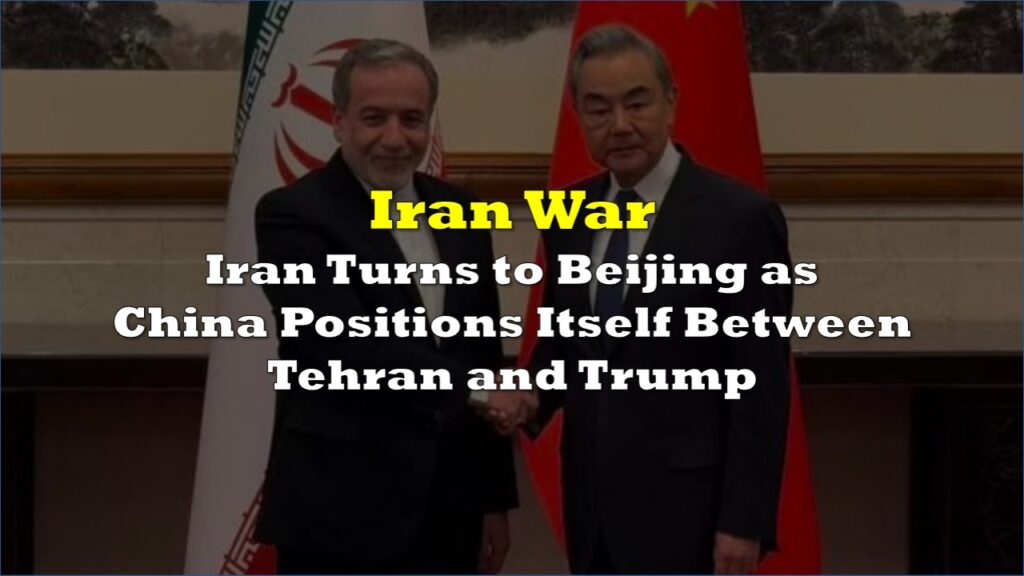
For Iran, Ghalibaf’s appointment signals that China relations have moved above ordinary ministry channels. ISNA reported in May that he was appointed after a proposal by President Masoud Pezeshkian and approval by the Supreme Leader, with informed sources describing the role as broader than previous China-related envoys.
The concentration of authority is the domestic part of the story. Iran appears to be trying to solve a coordination problem inside its own system. Ghalibaf’s meeting brought together economic, industrial, oil, banking, planning, and business figures. The ask from private-sector and industrial representatives was not ideological. It was practical: stable rules, institutional follow-through, Chinese investment, and a shift from imports toward technology transfer and joint production.
The pitch is also defensive. Ghalibaf explicitly rejected the idea that sanctions are meaningless, saying he is not among those who call sanctions a scrap of paper.
The problem is that routing around sanctions through China does not eliminate dependency. It changes the counterparty.
A bloc implies political commitment. A buyer relationship implies a discount. Iran’s challenge is that China may be willing to take the discount long before it accepts the commitment.
Information for this story was found via the sources and companies mentioned. The author has no securities or affiliations related to the organizations discussed. Not a recommendation to buy or sell. Always do additional research and consult a professional before purchasing a security. The author holds no licenses.