



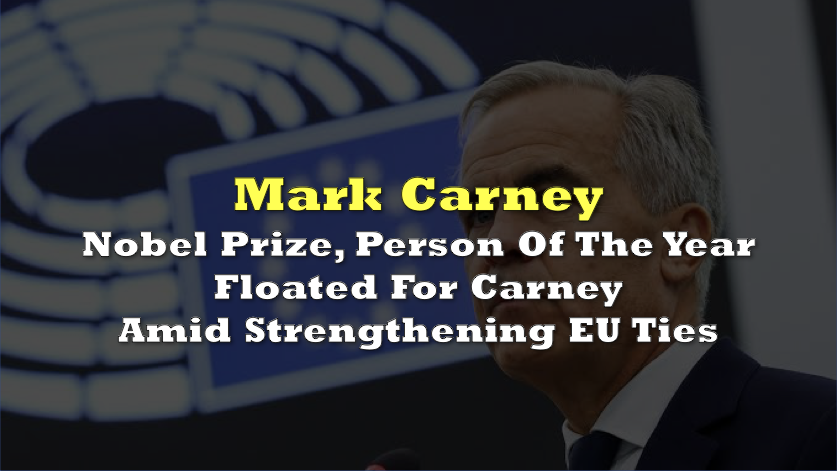
Prime Minister Mark Carney is denying that Canada wants to join the European Union, hours after the Wall Street Journal reported he was exploring “associate membership” in the bloc. Carney told reporters at the Toronto International Film Festival Sunday evening that “We’re not looking to become a member of the European Union,” calling what Ottawa wants a closer, one-of-a-kind partnership with Europe.
No such category currently exists under EU law, though officials cited by the paper say Brussels could be willing to invent one. The European Commission has not responded to press inquiries about the report.
‘Associate member’?
The label is not Carney’s own coinage. Earlier this year, German Chancellor Friedrich Merz put forward a similar concept with Ukraine in mind, envisioning a status that would pull a partner country much closer to Brussels short of full accession.
 Sponsored · Selkirk Copper Mines
Brussels has long resisted flexible membership tiers under its strict enlargement rules, but tariff fights with the Trump administration have nonetheless made EU leaders more open to arrangements they’d have rejected a few years ago.
Geneviève Tuts, the EU’s ambassador to Canada, says Brussels envisions a relationship that would not resemble its existing arrangements with Switzerland, Norway or the United Kingdom.
Achim Hurrelmann, co-director of the Centre for European Studies at Carleton University, said, “I’m not really sure if the substance will actually justify the new label.”
An unnamed senior official pushed back hours before Carney’s own remarks, calling the Journal’s account overblown and saying Ottawa’s outreach to Brussels simply extends a partnership the two sides agreed to a year earlier.
 Sponsored · Silver47 Exploration Inc.
Read: Carney to Launch Intense Canada-EU Talks on Economic, Security Ties
What’s already been built
Canada and the EU have built several agreements since Carney took office, so this isn’t a cold start.
At the 20th Canada-EU Summit in Brussels in June 2025, the two sides launched the New EU-Canada Strategic Partnership of the Future alongside a Security and Defence Partnership, layering on top of the Comprehensive Economic and Trade Agreement that has governed most tariff-free trade between them since September 2017.
The EU admitted Canada in February 2026 as the first non-European country into its €150 billion Security Action for Europe defence procurement fund, joining alongside the Munich Security Conference. Canada’s participation fee also landed well below the rate the EU had set for the UK in December 2025.
Read: Canada Joins EU Defense Procurement Fund as First Non-European Partner
So far, that fund has produced one Canadian contract. Carney announced the C$10 million deal at the G7 summit in Évian in June 2026, under which Marconi Technologies, a Montreal defence firm, will build tactical radios for Poland’s Cyber Command.
In May, Carney became the first non-European leader to attend a European Political Community summit in Yerevan, Armenia, where he pledged roughly $270 million toward NATO’s Ukraine procurement list and touted $18 billion in critical minerals agreements struck with European partners over the prior year.
Read: Carney says international order “will be rebuilt out of Europe”
The outreach comes as Ottawa’s relationship with Washington deteriorates. Trump banned a range of Canadian imports last week, including dairy and alcohol, and has threatened to shut Bombardier, the Canadian planemaker, out of the US market for aircraft it builds abroad. He has also repeatedly floated the idea of Canada becoming the “51st state.”
Carney recalled Canada’s trade negotiators from Washington entirely in August, and the tariff fight between the two countries shows no sign of resolution.
What happens next
European Commission President Ursula von der Leyen delivers her annual State of the Union address in Strasbourg on Wednesday, September 16. Carney takes the same stage less than a day later, addressing 720 members of the European Parliament as the centerpiece of a three-day trip to Strasbourg and Liverpool his office announced last week.
Later in the week, Carney and French President Emmanuel Macron head to Saint-Pierre-et-Miquelon, the French territory off Newfoundland’s coast, marking the first time a sitting Canadian prime minister has traveled there. The Élysée Palace has cast the stop as a statement of shared democratic values, coming after Trump circulated a Truth Social map that placed the US flag over several French holdings in the region.
The bigger test is the next Canada-EU Summit, set for October 29 and 30 in Canada, though the host city hasn’t been settled. Before any new framework becomes official, Brussels has to sign off with its 27 member states, and Ottawa has to clear it with the provinces.
What to watch
Whatever label the two sides settle on, the topics on the table look concrete — critical minerals, energy exports, artificial intelligence, defence procurement, and joint digital infrastructure spanning satellite networks, cloud infrastructure, data centers and undersea cables.
Hurrelmann’s broader critique is about follow-through. Past rounds of Canada-EU announcements, he noted, have generated bigger headlines than results.

2 Responses
I hope that Canada can at least join the Schengen Area and formalize new military alliances that mitigate the risks currently associated with NATO which has been undermined by America.
Many think Brexit was a big mistake. I do not. Yes it caused a crisis, not dissimilar to Canada’s crisis of finding our we put too much faith in the US being a stable country. But the UK regained their sovereignty from Brussels, including the unwise forced immigration. That tide seems to have (finally) turned in the EU, but who know what crazy schemes (economic policy based on gas from Russia, shuttering nuclear reactors only to have to burn coal for power…) the EU will come up with and force on member countries and semi members such as those in the European Economic Area. Good for CArney for keeping a warm but guarded approach to the EU.