

Copper prices are holding firm despite a series of macroeconomic pressures that would normally weigh on industrial metals, with traders increasingly focused on a physical market signal: China’s shrinking copper inventories.
Visible copper cathode stocks in China have fallen to the bottom end of their historical seasonal range, according to data presented in a Goldman Sachs Global Investment Research exhibit using Wind and Shanghai Metals Market data. The decline suggests that available refined copper supplies in the world’s largest copper-consuming market are becoming increasingly limited relative to recent years.
Robert Friedland, founder and executive chairman of Ivanhoe Mines, highlighted the Goldman Sachs research in a social media post, pointing to falling Chinese inventories and rising cancelled warrants in London Metal Exchange warehouses as signs of tightening physical availability.
Cancelled warrants refer to metal that has been earmarked for withdrawal from LME warehouses, reducing the amount immediately available for trading. Rising cancelled warrants can indicate that consumers or traders are preparing to take physical delivery.
 Sponsored · PTX Metals Inc.
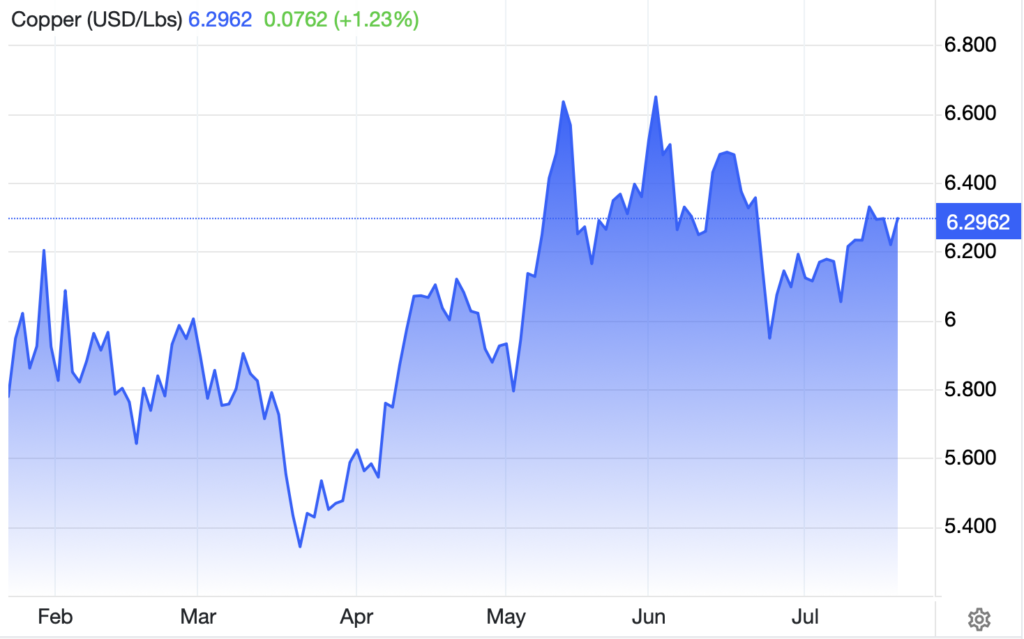
Copper traded around $6.26 per pound on COMEX at the end of the previous week, according to Friedland’s post, before reaching $6.31 per pound the following morning. The metal has remained supported even as markets dealt with geopolitical uncertainty, more cautious Federal Reserve commentary, and weakness in artificial intelligence-related equities.
China’s role in copper markets makes domestic stock movements particularly important. The country accounts for roughly half of global copper demand growth expected through the end of the decade, according to Goldman Sachs research.
Goldman Sachs has previously warned that copper prices face competing forces. The bank has pointed to structural demand from electricity grids, power infrastructure, artificial intelligence data centres, and defence investment, while also noting that short-term market balances can still shift because of China demand trends and new supply.
Artificial intelligence has become one of copper’s most frequently cited future demand drivers, but the immediate impact remains relatively small compared with traditional uses such as power networks, construction, manufacturing, and electrification.
The longer-term investment argument rests on the amount of copper required to expand electricity infrastructure. Data centres, renewable energy projects, and grid upgrades all require significant amounts of conductive materials.
Goldman Sachs has said power infrastructure could represent more than 60% of copper demand growth through 2030 in its longer-term outlook.
Copper’s supply challenge is not only about mine production. New projects often require years of permitting, construction, and capital investment before producing meaningful volumes.
Goldman Sachs has highlighted a market becoming tighter outside the US due to supply disruptions and slower mine recovery. The bank has also identified risks from production inputs and geopolitical disruptions that could affect output.
For now, falling Chinese inventories provide a visible measure of the market’s physical balance.
The key question for copper investors is whether declining stocks represent temporary seasonal movement or a sign that available supply is becoming structurally constrained.