
China’s latest attempt to undermine the Philippines’ legal victory in the West Philippine Sea has instead opened a new diplomatic dispute after an AI-generated video published by state-run China Daily prompted Manila to file a formal protest over what it described as racist and dehumanizing content.
Philippine officials argue the controversy demonstrates that the information battle surrounding the West Philippine Sea is becoming increasingly consequential for bilateral relations, particularly when official Chinese media become involved.
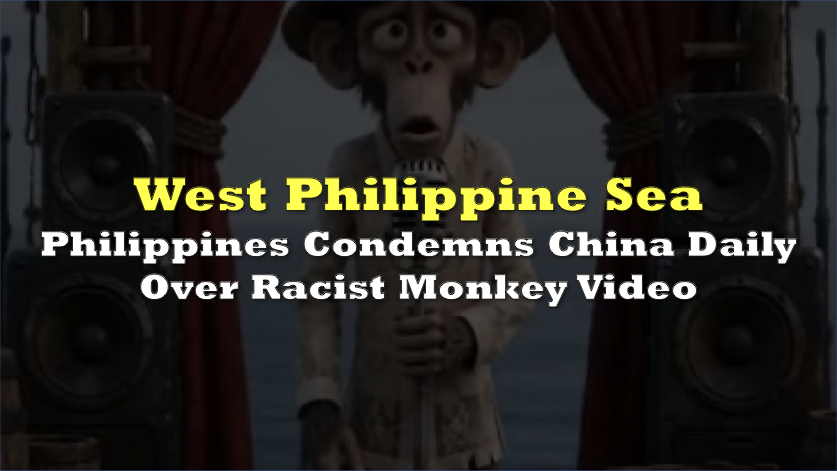
The Philippine Department of Foreign Affairs announced it had lodged a formal diplomatic protest after China Daily published an AI-generated animation on July 10 depicting Filipinos as monkeys while mocking the landmark 2016 hth China Sea arbitral award.
 Sponsored · Selkirk Copper Mines
According to the DFA, the publication crossed the line from political commentary into racist imagery. The department demanded that the material be removed and said disagreements over legal and territorial issues cannot justify demeaning depictions of another nation’s people.
The video portrayed a monkey wearing Filipino attire that appeared to be manipulated by symbolic representations of the US and Japan before being ridiculed, thrown into the sea, and struck by water cannon fire. The animation referenced the arbitration ruling that invalidated China’s sweeping maritime claims under international law, according to Reuters.
China’s Foreign Ministry declined to defend the content directly, stating that the video does not represent the Chinese government’s official position. China Daily is a state-run media organization.
The diplomatic protest was accompanied by sharp criticism from senior Philippine officials. Defense Secretary Gilberto Teodoro Jr. described the imagery as evidence that China’s propaganda apparatus had resorted to racism after failing to justify its West Philippine Sea claims through legal arguments. Other Philippine lawmakers similarly characterized the material as racist and inconsistent with international norms governing relations between states.
The incident comes during the tenth anniversary of the Permanent Court of Arbitration ruling that overwhelmingly rejected China’s expansive “nine-dash line” claims in the West Philippine Sea.
The monkey-themed animation was not an isolated release. Among them was an earlier AI animation that portrayed the Philippines as a turtle and China as a crab while ridiculing the arbitration award as illegitimate.
The latest controversy also follows a broader pattern of increasingly expansive narratives tied to Philippine territory. In early 2025, Chinese social media accounts circulated false claims that the Philippine region Palawan had historically belonged to China and was once called “Zheng He Island,” assertions that Philippine historians and the National Historical Commission of the Philippines rejected as fabricated and unsupported by historical evidence.
More recently, a group of Chinese academics argued at a symposium in Guangzhou that Philippine’s northmost region Batanes is a “natural geographical extension” of Taiwan and therefore falls under China’s sovereignty. Philippine officials, including the Department of Foreign Affairs, the National Historical Commission, and Teodoro Jr., dismissed the claim as baseless, emphasizing that Philippine sovereignty over Batanes is settled and not subject to debate.
Military confrontations, water cannon incidents, sanctions, and diplomatic protests have dominated recent years. This episode instead places state media messaging at the center of the dispute, demonstrating how AI-generated content has become another instrument in geopolitical competition.