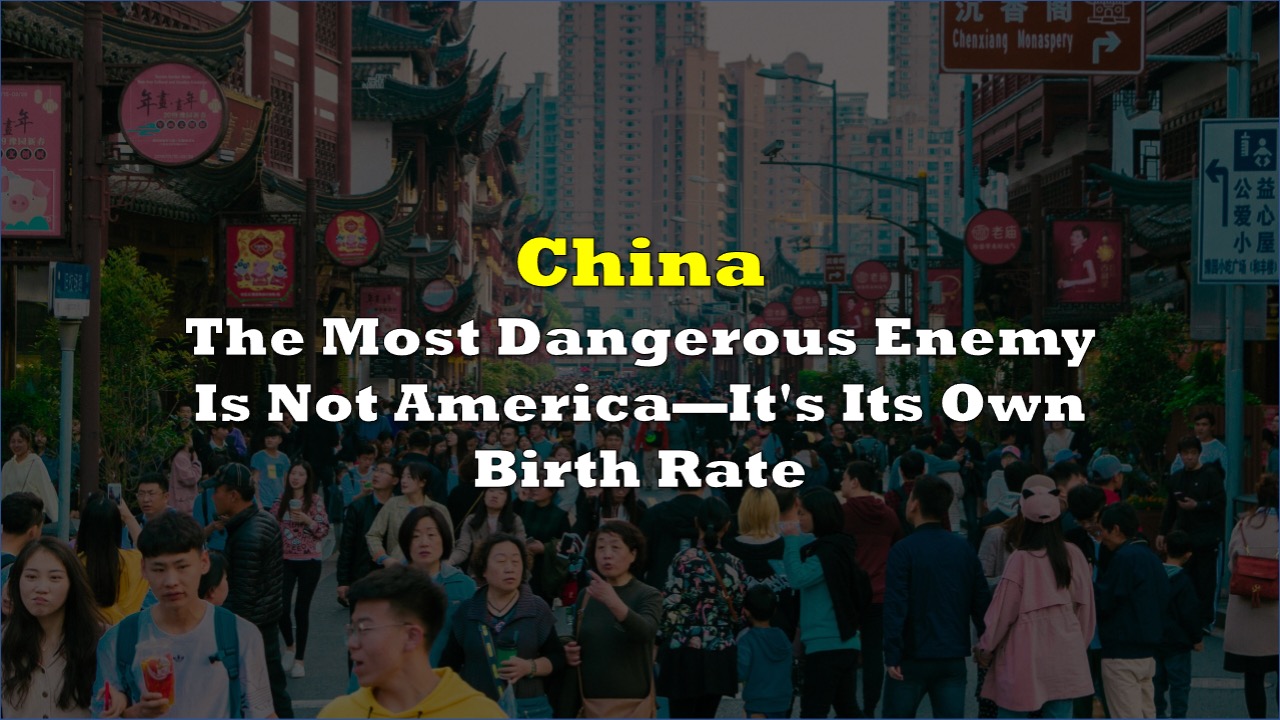

China posted its lowest birth rate since the founding of the People’s Republic in 1949, with 2025 data showing the country lost 3.39 million people as deaths far outstripped births for the fourth consecutive year.
Just 7.92 million births were recorded last year — less than half the total from a decade ago — while 11.31 million deaths drove the crude birth rate to 5.63 per 1,000 people. China’s total fertility rate now sits near 1.0, though estimates vary: the United Nations puts the 2024 figure at 1.2, while independent demographic trackers place it as low as 1.02. All figures fall well below the 2.1 replacement level needed to sustain a stable population.
The decline is sharpest in China’s northeastern rust belt, where Heilongjiang province posts a fertility rate of just 0.56, Jilin 0.60, and Liaoning 0.68 — regions hollowed out by decades of industrial contraction and youth outmigration. Western provinces with larger ethnic minority populations show significantly higher rates: Tibet at 1.49, Xinjiang at 1.37.
 Sponsored · Selkirk Copper Mines
China’s most productive coastal provinces are also recording natural population losses, with migration masking the true scale of the drop. Zhejiang logged a net population gain of 430,000 in 2024, but posted a natural decline of 24,000 — the entire headline gain driven by migration inflows.
In July last year, Beijing announced a 3,600-yuan annual childcare subsidy per child under three, backed by a 90-billion-yuan central budget allocation. It is unlikely to reverse the trend. Singapore has run the world’s most aggressive pro-natalist program for decades — its total fertility rate still fell to a record low of 0.87 in 2025.
Demographic projections put China’s cumulative population loss at nearly 60 million over the next decade — roughly the size of France — with the annual decline forecast to hit 7.6 million by 2035. A shrinking working-age population will compress domestic consumption, strain public finances, and erode the economic and military capacity underpinning Beijing’s global ambitions.
Information for this story was found via the sources and companies mentioned. The author has no securities or affiliations related to the organizations discussed. Not a recommendation to buy or sell. Always do additional research and consult a professional before purchasing a security. The author holds no licenses.