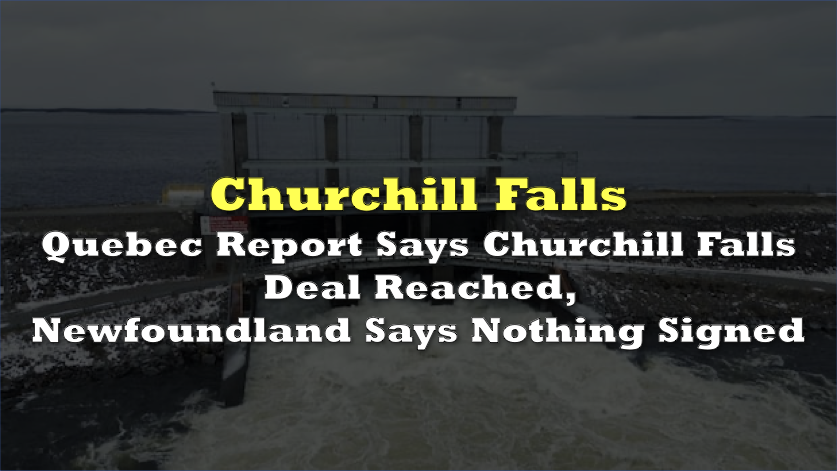

The status of one of Canada’s largest prospective electricity agreements has become a political issue before its terms have even been released, with Quebec media reporting a deal on Churchill Falls has been reached while Newfoundland and Labrador Premier Tony Wakeham’s office insists there is still nothing final to sign off on.
La Presse reported that Newfoundland and Labrador and Quebec had reached a replacement agreement covering Churchill Falls and the proposed Gull Island development. Newfoundland broadcaster NTV separately reported that it had learned an agreement was reached, with an announcement expected early next week.
However, Newfoundland and Labrador Premier Tony Wakeham’s office stopped short of confirming either report.
 Sponsored · Altamira Gold Corp.
“We can confirm that in recent days we have made significant progress in our negotiations with both Quebec and the Government of Canada as it relates to replacing the 2024 MOU with a new deal for Churchill Falls and Gull Island,” the Wakeham’s office said in a statement carried by VOCM.
“As of right now, no final deal has been signed,” he added.
That distinction has opened a transparency fight in Newfoundland and Labrador, where the agreement has been politically contentious since before Wakeham’s Progressive Conservatives took office.
Opposition Leader John Hogan criticized the government after details again emerged through Quebec media rather than from Newfoundland and Labrador. NDP Leader Jim Dinn similarly questioned whether the government had shifted its negotiating position as pressure mounted to complete the agreement.
 Sponsored · Selkirk Copper Mines
Quebec Premier Christine Fréchette said in July that she expected negotiations to be wrapped up within weeks, The Canadian Press reported. The province is approaching an election, increasing the incentive for the governing Coalition Avenir Québec to secure a long-term source of electricity before campaigning begins.
According to La Presse reporting, Ottawa has also pushed both provinces toward an agreement and played a facilitating role. The report said federal incentives could include access connected to the Clean Electricity Investment Tax Credit, which provides a refundable credit of up to 15% of eligible capital costs for clean electricity generation, storage, and interprovincial transmission, including qualifying investments by provincial Crown corporations.
The negotiations follow Wakeham’s rejection of simply proceeding with the framework negotiated by the previous Liberal government in December 2024. An independent review commissioned after the PCs took office concluded in May that the MOU, while containing significant benefits, was “not in the overall best long-term interest” of Newfoundland and Labrador as configured. It identified concerns including pricing, access to electricity for domestic development, transmission rights, and governance.
The earlier framework contemplated more than $30 billion of hydroelectric development, including a 550-megawatt Churchill Falls upgrade, a new 1,100-megawatt powerhouse, and the proposed 2,250-megawatt Gull Island project. Quebec would gain long-term access to additional Labrador electricity through 2075.
Wakeham has repeatedly rejected what he called artificial negotiating deadlines. His government also told the legislature in April that it would recognize no Churchill Falls revenue in its fiscal projections “until a deal is signed.”
For now, that threshold has not officially been crossed, even as reports from both Quebec and Newfoundland media indicate the negotiations may effectively be at the finish line.