

CPP Investments has published a paper explaining why conventional benchmarks can unfairly judge diversified pension portfolios less than two months after the fund trailed its own benchmark by 5.4 percentage points.
The crown corporation reported a net return of 7.8% for the year ended March 31, 2026 while its benchmark portfolios returned 13.2%. The fund still earned $56.9 billion, and net assets rose to $793.3 billion, but its chosen strategy produced materially less than the reference portfolios used to evaluate it.
Its recent paper now argues that such comparisons can provide an incomplete verdict. The paper, Measuring What Matters: Evaluating the Total Portfolio Approach, says a traditional benchmark can misrepresent a portfolio built around diversification, private assets, liquidity management, leverage, resilience, and several long-term objectives.
 Sponsored · Cambria Gold Mines
“Performance assessment is difficult under a Total Portfolio Approach—not because performance is less measurable, but because the scope of accountability is broader,” the paper said. “Benchmarks remain essential tools for attribution, discipline and accountability, but under TPA they become diagnostic inputs rather than singular verdicts on success or failure.”
CPP Investments does not propose eliminating benchmarks. It says benchmark comparisons “remain essential” but are insufficient on their own when management controls the design of the entire fund rather than merely selecting investments within fixed asset-class allocations.
“As portfolios become more differentiated, comparisons to any single benchmark become less informative,” it added.
The sequence does not establish that the research was designed to excuse the result. CPP Investments had publicly signalled in April that it planned a follow-up study on performance evaluation and the role of benchmarks. But the timing gives an otherwise technical investment paper a sharper public-accountability edge.
 Sponsored · Silver47 Exploration Inc.
CPP Investments instead proposes evaluating performance across six dimensions, including total returns, risk allocation, diversification, investment selection, decision quality, and resilience across market regimes.
Apples to apples
One illustration in the paper compares two hypothetical portfolios. A conventional portfolio is assumed to generate 90 basis points of annual value added, while a more differentiated Total Portfolio Approach portfolio is assumed to generate 100 basis points.
Despite the higher assumed value added, the differentiated portfolio has a calculated 29.8% probability of trailing its benchmark over 10 years. The conventional portfolio’s comparable probability is 6.5%.
That model demonstrates how tracking error can produce false negatives.
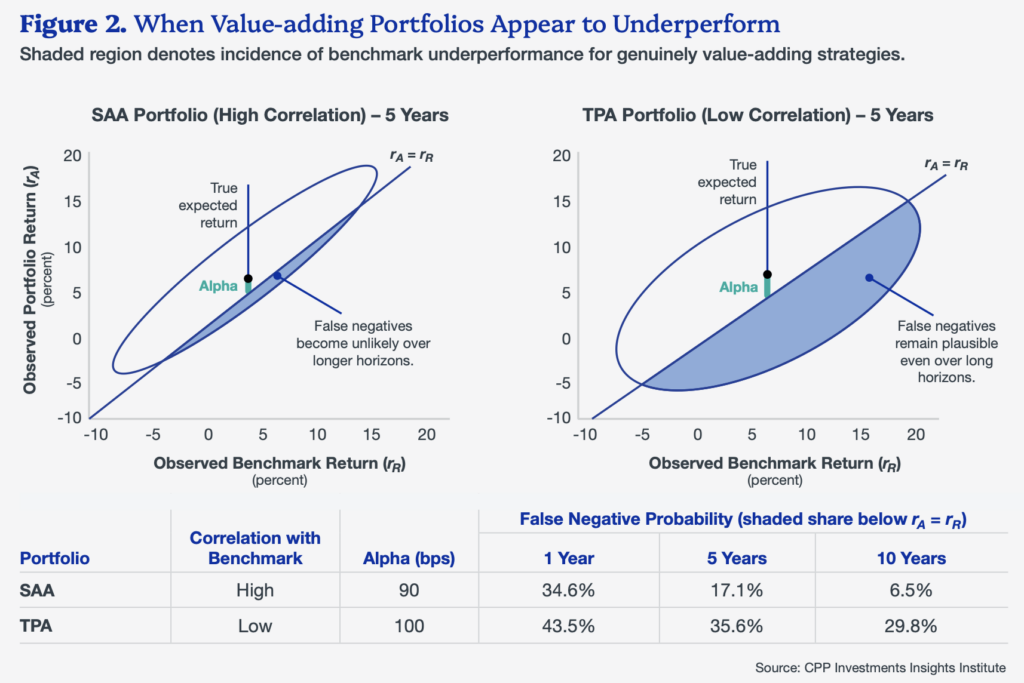
The model begins by assuming both strategies possess positive alpha. The real-world question is whether CPP Investments’ departures from its benchmark will ultimately add value, an outcome that cannot be established by inserting expected outperformance into a hypothetical calculation.
“The question is no longer simply whether a portfolio outperformed a benchmark, but whether all management decisions, including portfolio design and execution, improved the delivery of long-term institutional goals,” it said.
CPP Investments said its fiscal 2026 benchmark benefited from heavy exposure to public equities at a time when returns were concentrated in a relatively narrow group of companies. Its broader portfolio held private assets and diversifying investments that did not keep pace.
The July paper expands that explanation into a general critique of capitalization-weighted benchmarks. As a small group of large companies rises, those companies automatically become a larger part of a market index. A pension manager maintaining broader diversification can then appear to be underperforming precisely because it declined to copy increasing market concentration.
CPP Investments says this can reward concentration when concentration is working and punish diversification intended to protect the fund across different economic environments.
However, that argument is strongest when diversification later protects the portfolio from a reversal. It is weakest when it becomes a standing explanation for returns that repeatedly trail investable alternatives.
A broader framework
The most consequential part of the proposal is not its criticism of market indexes. It is the inclusion of decision quality as a performance measure.
CPP Investments says portfolio decisions should be evaluated according to the information and alternatives available when they were made, not solely through later outcomes.
That approach can prevent hindsight bias. A prudent decision can produce a poor result, while a reckless decision can succeed through luck.
But process-based assessment is harder for contributors to verify than market returns. Unless objectives, thresholds, and evaluation methods are established before results are known, a multidimensional framework can become elastic enough to explain almost any outcome.
Benchmarks are blunt. That is also why they are useful.
CPP Investments can point beyond one year. Its 10-year annualized net return was 8.8% at the end of fiscal 2026, and the Office of the Chief Actuary continues to find the CPP financially sustainable over the long term.
The latest actuarial work also supported a reduction in the base CPP contribution rate from 9.9% to 9.5%, effective in 2027. The federal government said that would save an employee earning $70,000 about $133 annually, with an equivalent saving for the employer.
Those figures show why pension performance cannot sensibly be judged on one year alone.
CPP Investments’ paper is therefore not an argument for no accountability and publishing that case after a substantial benchmark miss does not invalidate it. However, a replacement scorecard must be established in advance, independently testable, consistently reported, and capable of delivering an unambiguous negative verdict when the strategy fails.
Otherwise, moving beyond the benchmark could look less like better measurement and more like moving the goalposts.