
The most revealing test of the artificial intelligence boom may not be whether demand for computing power suddenly disappears. It may be whether data center owners can sell tomorrow’s capacity at today’s scarcity-driven valuations before much of that capacity has been completed.
Netrality Data Centers, DataBank, Edged, and EdgeCore Digital Infrastructure are working with bankers to market majority stakes in their businesses this summer, The Wall Street Journal reported, citing people familiar with the efforts. DataBank could be valued at as much as $25 billion, according to the report.
The four operators are not selling isolated buildings. They are reportedly seeking buyers for controlling interests in the companies that own operating facilities, construction projects, power agreements, land, and multiyear development pipelines.
 Sponsored · Selkirk Copper Mines
That distinction creates the potential bubble question. Existing stakeholders may be able to secure the AI premium immediately. Buyers would still need to finance and execute much of the infrastructure growth supporting that valuation.
Selling the pipeline
DataBank currently lists 76 data centers with approximately 1 gigawatt of critical IT load. A significant part of its growth case, however, remains prospective.
The company raised approximately $2.00 billion of equity in October 2024, including $1.50 billion from AustralianSuper, to fund more than 850 megawatts of additional capacity. The expansion was expected to more than triple the company’s deployed power capacity at the time.
The company then closed another $1.45 billion of financing in June 2026, consisting of an $800 million revolving credit facility and a $650 million increase to construction financing for its Red Oak, Texas, campus.
 Sponsored · Cambria Gold Mines
The reported $25 billion valuation would therefore price not only DataBank’s existing facilities and customer contracts, but also the expected returns from capacity that still requires construction spending, equipment, grid access, and tenant demand.
A January 2025 secondary transaction provides an imperfect reference point. DigitalBridge Group said its remaining 7.8% DataBank stake was valued at $486 million, implying an equity value of approximately $6.23 billion through a simple proportional calculation.
This figure cannot be directly compared with the reported $25 billion because the basis of the proposed valuation is unknown. The larger amount may include debt, capital raised since 2025, completed expansion, or the value of newly secured development capacity.
The difference nevertheless illustrates the central uncertainty. DataBank’s potential price appears to depend on substantial value creation occurring after the sale.
EdgeCore presents an even clearer example. The company entered 2026 with 1.8 gigawatts of capacity described as either delivered or under development. EdgeCore had committed more than $5.90 billion of equity and debt, while identifying another $16.10 billion of planned investment to develop additional hyperscale and AI-ready campuses.
Edged similarly says it has more than a dozen data centers operating or under construction across North America and Europe, alongside a gigawatt-scale project pipeline. One Iowa project that broke ground in May 2025 was expected to take approximately 24 months to complete.
A buyer acquiring control of either business would therefore be purchasing a combination of current revenue and anticipated infrastructure.
Capturing the premium
The sale wave could have risen from budding development costs that may require owners to bring in investors with larger balance sheets.
Construction delays, power shortages, permitting disputes, equipment backlogs, and limited skilled labor are slowing the industry’s ability to convert announced capacity into operating facilities. A JPMorgan analysis cited by The Wall Street Journal found that more than 60% of US data center capacity scheduled for completion in 2027 had not entered construction, while another 7% was already delayed.
Those constraints can increase the value of companies that already control suitable land and power. They can also make projected completion schedules more expensive and uncertain.
S&P Global identified power availability, grid-connection timelines, equipment lead times, labor access, and permitting as increasingly important credit variables. It said delays can postpone cash generation even after capital has been deployed.
The financing exposure is expanding with the physical buildout. Approximately $450 billion of data center transactions were completed over the past five years, supported by more than $300 billion of debt, according to Infralogic data cited by S&P Global. About two-thirds of that transaction value was recorded during the most recent two years.
S&P warned that intense investor demand could produce higher leverage, unsustainable asset valuations, aggressive financing structures, and weaker differentiation between high- and low-quality assets. It described those conditions as common ingredients in previous investment busts.
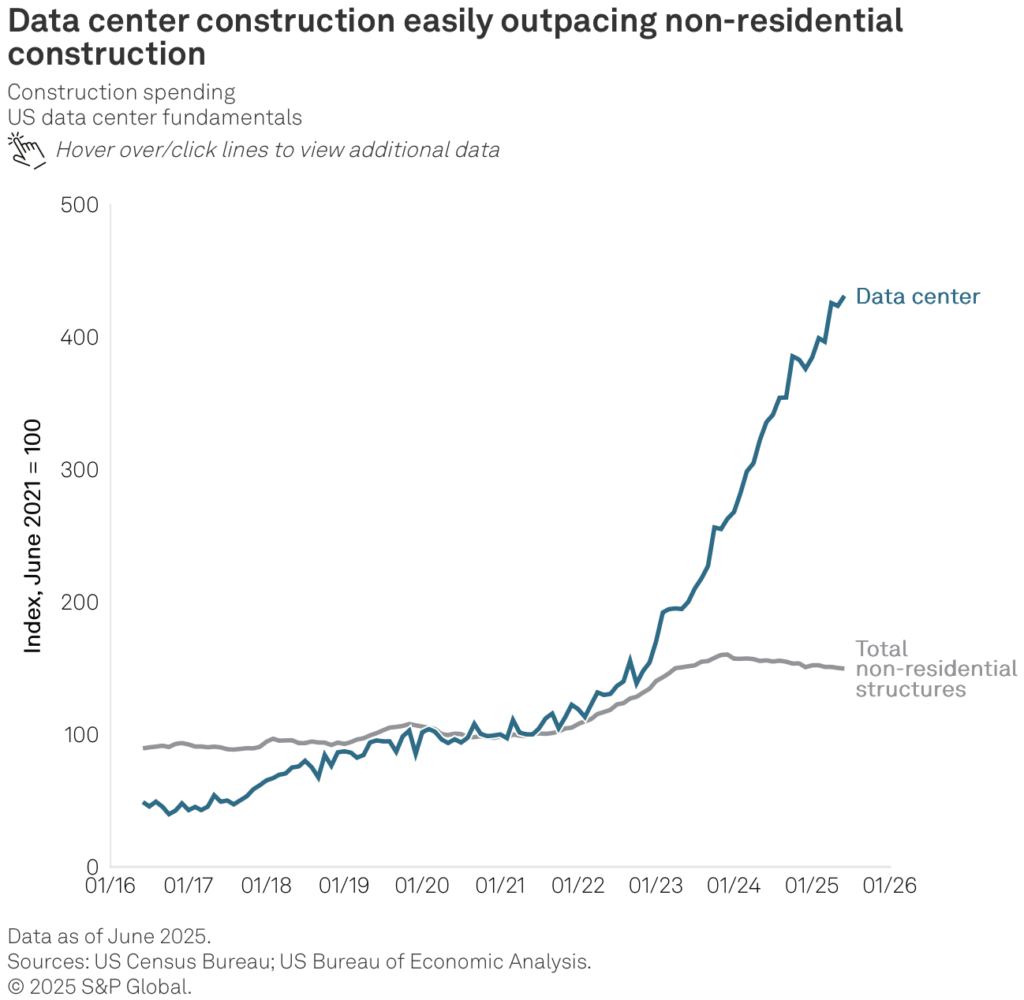
The sector’s capital requirements are also moving beyond conventional corporate borrowing. Reuters reported that a BlackRock and MGX-backed consortium completed its $40 billion acquisition of Aligned Data Centers on July 21 and committed another $5 billion of growth capital. Aligned’s reported 6.4 gigawatts include both operating and planned capacity. The investor group could eventually deploy up to $100 billion, including debt.
Switch is separately considering an initial public offering that could raise up to $10 billion and value the operator at almost $80 billion including debt, Reuters reported, citing unnamed sources. Its valuation and timing remain under discussion.
These figures demonstrate that investors are placing enormous value on access to power and future computing capacity, not only on existing earnings.
Bubble unburst
The comparison with a conventional bubble has limits. S&P said North American data center capacity increased 19% year over year in both 2024 and 2025, while utilization also rose. That combination indicates that demand absorbed new supply rather than leaving facilities empty.
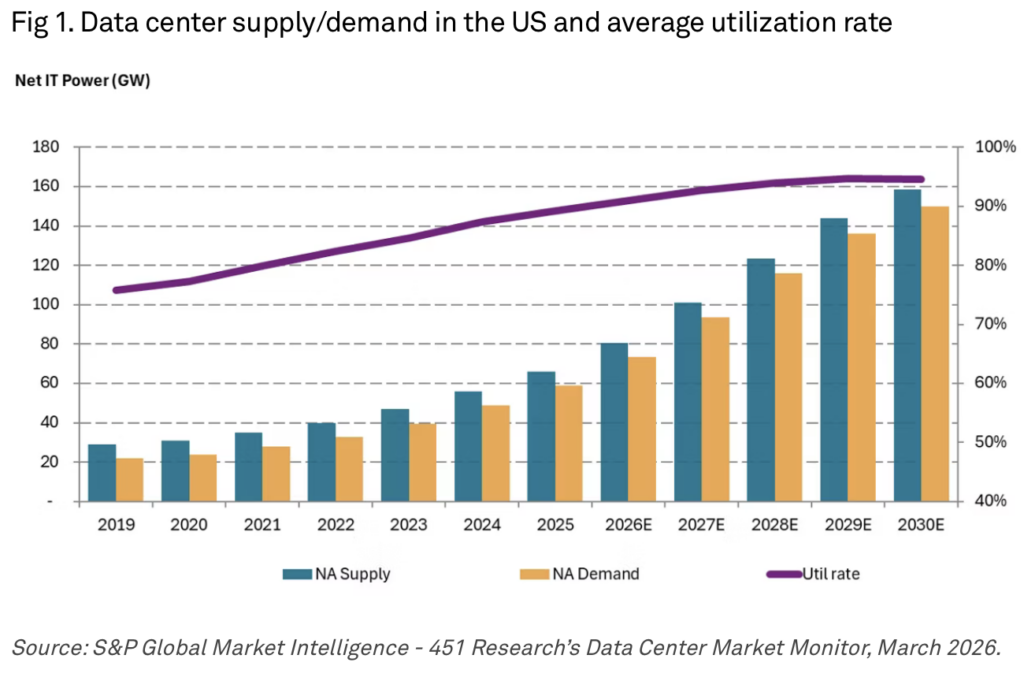
Most major projects are also pre-leased or developed for identified customers, reducing the speculative vacancy risk that damaged the industry after the dot-com boom. Data center vacancy rates reached between 50% and 70% in markets including Northern Virginia, Dallas, and Silicon Valley during the earlier collapse, according to S&P. Current conditions remain materially tighter.
Public investors are nevertheless showing limits to what they will pay. Csquare priced its July initial public offering at $21 per share, below its marketed range of $23 to $27. The stock closed its first session 1.57% lower at $20.67, valuing the company at $3.20 billion. Reuters attributed the weaker pricing partly to concerns about leverage and continuing losses.
That reception suggests that investors still want data center exposure, but are beginning to distinguish between operating demand and the price attached to that demand.
The potential bubble is therefore not based on rows of empty data halls but on sellers capturing valuations that assume unfinished projects will be delivered on schedule, power will become available, construction costs will remain manageable, and hyperscalers will continue spending heavily enough to fill the resulting capacity.