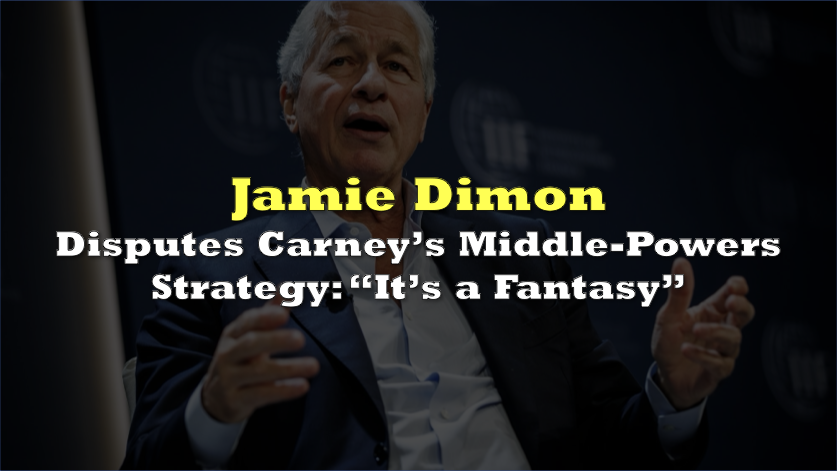

JPMorgan Chase CEO Jamie Dimon challenged the economic logic behind Prime Minister Mark Carney’s middle-power strategy during the Council on Foreign Relations’ CEO Speaker Series in a conversation presided over by CFR President Michael Froman.
“When Mark Carney said the powers should get together, it’s a fantasy,” Dimon said. “They did that. It’s called Europe.”
That line cuts at the center of Carney’s foreign-policy pitch. In his January 2026 address at the World Economic Forum in Davos, Carney argued that middle powers must coordinate more aggressively as the old US-anchored international order fractures. He pointed to issue-specific coalitions across trade, critical minerals, artificial intelligence, supply chains, and security.
 Sponsored · Altamira Gold Corp.
Carney’s version is strategic autonomy through coordination. Dimon’s rebuttal is that coordination without growth becomes bureaucracy with a flag.
READ: What Would The New International Order Look Like, According To Carney
Dimon argued that Europe already ran the experiment Carney is describing and has not kept pace with the US. “The GDP of Europe has gone from 90% of America to 70%,” he said. “And in our view, it will probably continue to erode over time because of high taxes.”
World Bank data show the EU’s GDP at $19.5 trillion in 2024, compared with $28.8 trillion for the US, putting the EU at roughly 68% of US output, close to Dimon’s current comparison.
 Sponsored · Silver47 Exploration Inc.
Froman pushed back lightly during the exchange, saying it had become difficult to attend CFR events without hearing Europe “dumped on.” Dimon replied that his point was serious.
“But Europe, this is a serious problem,” Dimon said.
His critique moved from GDP share to fiscal and capital-market structure. He said he was “not against social safety nets,” but argued that European systems are “high and ineffective.” He added that many countries carry debt near 100% of GDP and said slow growth makes that debt burden more dangerous.
Tax data support part of the contrast he drew. The European Commission said EU-27 member states collected €7.1 trillion in taxes in 2024, up 5.6% from 2023, while the EU tax-to-GDP ratio rose from 39.0% to 39.4%. The OECD put the US tax-to-GDP ratio at 25.6% in 2024, well below the OECD average of 34.1%.
Dimon’s larger argument was about investment. He said Europe has “poor tax structures that stop investment,” and added that capital formation “generally drives growth.”
“Our stock exchange is worth, I think, $60 trillion, maybe $70 trillion today,” Dimon said. He contrasted that with Deutsche Börse at around $3 trillion, the FTSE in the UK at around $4 trillion, and the Euronext Paris at around $3 trillion, according to the chief executive.
For Carney, the middle-power strategy is a response to coercion by larger states. His Davos address argued that middle powers have to build coalitions because countries acting alone can be squeezed by hegemons, tariffs, supply-chain leverage, and financial pressure.
But for Dimon, that argument misses the investor-side risk. A bloc can be large and still lose capital if tax, regulation, market depth, and business policy make it less attractive than the US.
Dimon did not argue that Europe is beyond repair. He pointed to Mario Draghi’s competitiveness report as the right diagnosis. The European Commission says the Draghi report lays out how Europe can no longer rely on many of the growth factors that supported it in the past and proposes recommendations to shift the bloc onto a different trajectory.
The bank executive summarized the remedy as deeper integration, open services trade, a real common market, and policies that drive growth.
“Have a real European Union, open trade services to everyone in there, have a big common market, have a growth strategy and policies that can drive growth,” he said.
Carney is betting that middle powers can gain leverage by acting together. Dimon’s answer is that Europe shows the danger of getting the architecture before the engine.