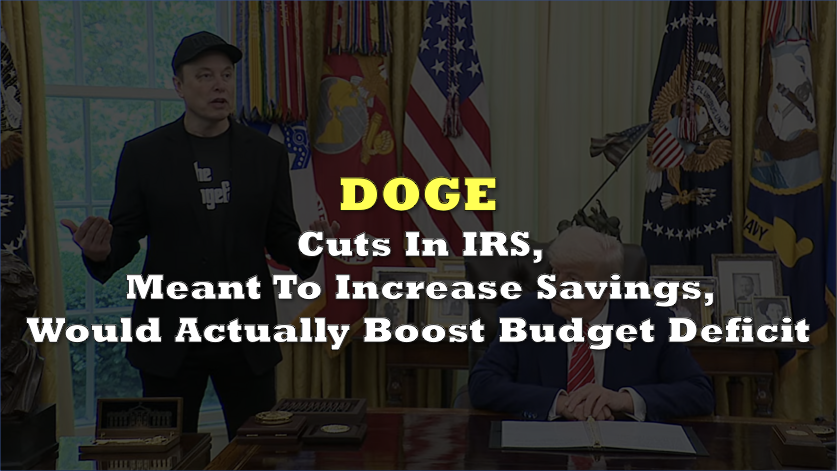

DOGE-linked IRS workforce cuts meant to reduce federal spending could instead increase the deficit by nearly $598 billion over the 2026–2035 budget window, according to a new Budget Lab analysis that says the broader IRS rollback may reduce federal revenue by about $861 billion.
The report estimates that the 2025 reduction of almost 28,000 IRS employees would save $45.5 billion in costs over 10 years, but trigger $643.2 billion in gross deficit increases. Net of savings, the layoffs would raise the deficit by $597.8 billion.
A separate $20 billion reduction in IRS funding would save that same $20 billion over the decade, but generate $282.8 billion in gross deficit increases. Net of savings, the funding clawback would add $262.8 billion to the deficit.
 Sponsored · Altamira Gold Corp.
Together, the two moves would produce $65.5 billion in combined cost savings from 2026 to 2035, but $926.0 billion in gross deficit increases. The net deficit increase lands at $860.6 billion, with the hit growing over time from $34.0 billion in 2026 to $139.9 billion in 2035.
The analysis centers on a basic budget asymmetry: the IRS is not only a cost center, but the collection arm for 96% of federal revenue. Cutting staff saves salaries immediately, but weaker enforcement can reduce collections, lower audit risk, and erode voluntary compliance.
The IRS cuts followed the Inflation Reduction Act’s $79.4 billion supplemental appropriation in 2022, which was designed to rebuild enforcement, taxpayer services, operations support, and business systems modernization. CBO estimated at the time that the nearly $80 billion investment would generate about $204 billion in additional revenue over 10 years, implying roughly $124 billion in net fiscal gains.
That investment has since been heavily reversed. The Budget Lab says the Fiscal Responsibility Act rescinded $1.4 billion, later 2024 and 2025 legislation rescinded $40.4 billion, and the latest budget deal cut another $11.7 billion. In total, just over two-thirds of the original IRA funding has been rescinded.
Beginning in February 2025, about 7,300 probationary IRS employees were terminated, followed by roughly 4,700 workers accepting deferred resignation offers. By year-end, the total staffing reduction reached 27,636 employees, and by mid-2025, the IRS had also lost more than 3,600 revenue agents, equal to about 31% of its auditing staff.
The agency may shrink toward roughly 50,000 employees, a level last seen in the 1960s. However, the workload has changed dramatically: returns filed rose from about 110 million in 1969 to 267 million in 2024.
The potential revenue loss is magnified by the size of the tax gap. The IRS projected the annual gross tax gap for tax year 2022 at $696 billion, near the Budget Lab’s shorthand of about $700 billion per year. Over a decade, that approaches $7 trillion in legally owed but not timely paid taxes.
The Budget Lab also said the estimates may understate the fiscal damage. It flagged added complexity from new tax provisions, including overtime, auto loan, senior deductions, and the revised SALT cap, as well as concerns that IRS data sharing with DHS could discourage tax filing by undocumented immigrants.
Information for this story was found via the sources and companies mentioned. The author has no securities or affiliations related to the organizations discussed. Not a recommendation to buy or sell. Always do additional research and consult a professional before purchasing a security. The author holds no licenses.