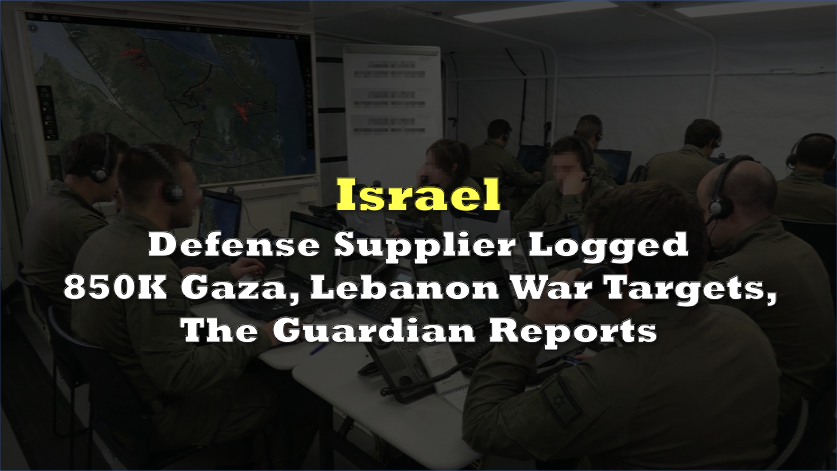

The Israeli defense company Elbit Systems’ Tzayad digital army program reportedly identified or processed an 850,000-item figure during Israel’s wars in Gaza and Lebanon, according to reporting by The Guardian on an Elbit presentation at a recent Royal United Services Institute land warfare conference in London.
The outlet reported that a slide cited more than 20,000 IDF battle plans and 850,000 real-time intelligence targets from October 7, 2023, through the end of 2025.
That number matters because it reframes the Gaza and Lebanon campaigns as a stress test for networked command systems, not only for weapons.
 Sponsored · Altamira Gold Corp.
Elbit disputed The Guardian’s interpretation. The company told the outlet that the 850,000 figure did not represent enemy targets or actual strikes, but “aggregated system activity and operational data” generated by the IDF’s digital army program across operational theaters since October 7, 2023.
Elbit has a direct financial interest in proving that digital command systems can operate at wartime scale. In February 2026, the company said it secured contracts worth more than $100 million from Israel’s Ministry of Defense to advance digital warfare and border-defense capabilities, including development of the fifth generation of the IDF’s Tzayad digital ground army system. Elbit said the program would deliver command-and-control capabilities across headquarters, maneuvering forces and attacking forces, with multi-domain connectivity across air, sea and land.
The company reported 2025 revenue of $7.94 billion, GAAP net income of $534 million and a year-end order backlog of $28.1 billion. By the first quarter of 2026, backlog had risen to $30.2 billion, with quarterly revenue of $2.19 billion and net income of $160.8 million.
Elbit’s US-listed shares were recently trading at $811.01, giving the company a market capitalization of about $36.06 billion.
The wars cited in the presentation were not low-visibility conflicts. Gaza has been under continuous international monitoring since October 2023, with the UN Office for the Coordination of Humanitarian Affairs describing the hostilities as causing unprecedented destruction and suffering, including tens of thousands of Palestinian casualties and displacement affecting nearly all of Gaza’s 2.1 million people.
Lebanon has also drawn legal scrutiny. In June 2026, Al Jazeera reported that UN investigators were expected to assess potential violations of international law by all parties involved in current hostilities in Lebanon.
A number presented to a military audience as evidence of high-tempo capability can become evidence in a different forum of the scale of automated or semi-automated battlefield processing.
The same system can be described in three ways, depending on who is speaking. A military customer may call it operational advantage. A supplier may call it digital warfare capability. A human-rights lawyer may call it a chain-of-command audit trail.