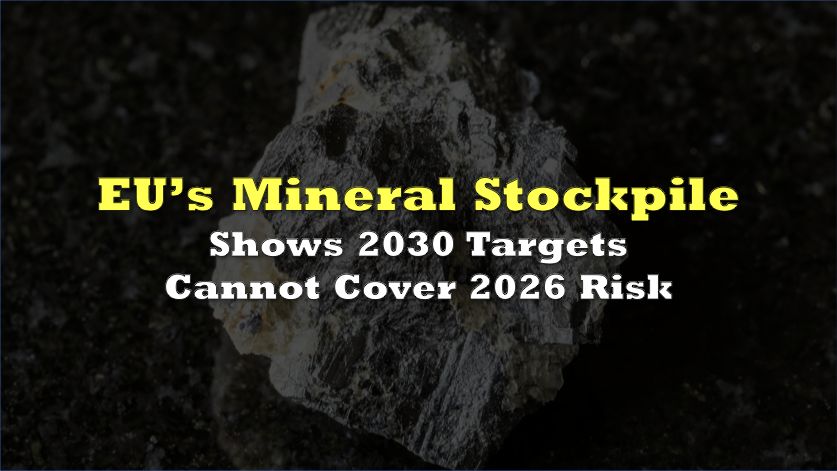

Europe is preparing to put critical minerals into storage because its industrial policy has a timing problem: the bloc’s diversification targets are aimed at 2030, while export restrictions, defense demand, semiconductor needs, and clean-tech supply pressures are already hitting now.
That gap is the real story behind the EU’s emerging pilot reserve. Reuters reported that the initial list is expected to include tungsten, rare earths, and gallium, citing three sources familiar with the plan. Magnesium may also be included, according to two sources by Reuters, although one source said germanium and graphite were expected to be part of the final selection instead.
The list is not final, and the European Commission has not disclosed how much material the EU wants to hold, who would own it, how it would be financed, or what conditions would trigger releases.
 Sponsored · Selkirk Copper Mines
The EU already has a formal plan to reduce this exposure. Under the Critical Raw Materials Act, the bloc wants to meet at least 10% of annual demand through EU extraction, 40% through EU processing, and 25% through recycling by 2030. It also wants to prevent any one outside country from supplying more than 65% of annual EU consumption for each strategic raw material at the relevant processing stage.
But the current dependency math is uglier than the target sheet. The European Court of Auditors found that several materials tied to the energy transition already breach the 65% single-country threshold at the processing stage, including lithium, magnesium, gallium, and rare earth elements. China supplies 97% of the EU’s magnesium, according to the auditors.
That makes the stockpile a bridge policy. It does not replace mines, refineries, recycling capacity, or offtake deals. It buys time when those systems are not yet ready.
Further in the Reuters piece, the EU has reportedly held storage discussions with major ports, including Rotterdam, while Italian ports such as Porto Marghera and Trieste have also been considered. The report said the pilot was announced in December, involves 10 EU countries, and has working groups led by Italy, France, and Germany.
That governance layer may become as important as the minerals themselves. A shared reserve requires rules on procurement, storage costs, access, drawdowns, and replenishment. Without that, the EU risks building an emergency buffer before deciding who is allowed to break the glass.
The timing is also geopolitical as G7 governments have been discussing ways to cut rare earth dependence, improve procurement, expand production, and increase recycling after China’s export controls put supply security back at the center of industrial policy.
A stockpile can reduce the shock of a short-term disruption, but it cannot make Europe structurally independent. The European Court of Auditors warned that EU efforts to diversify raw-material supply have yet to produce enough tangible results, while some strategic projects may not contribute meaningfully by 2030.
Information for this story was found via the sources and companies mentioned. The author has no securities or affiliations related to the organizations discussed. Not a recommendation to buy or sell. Always do additional research and consult a professional before purchasing a security. The author holds no licenses.