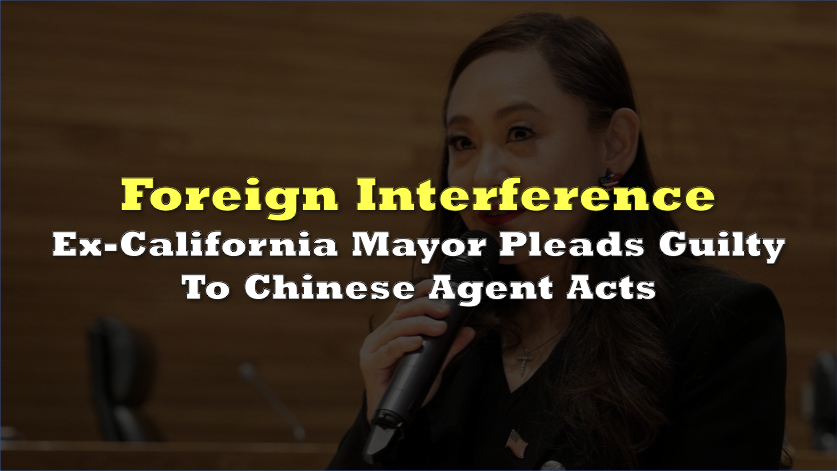

Eileen Wang, the former mayor of Arcadia, California, has agreed to plead guilty to a US felony charge tied to acting for the People’s Republic of China without the required disclosure, according to the Justice Department.
The charge carries a maximum penalty of 10 years in federal prison.
Federal prosecutors said Wang was charged after an investigation into alleged work done for PRC officials before she entered Arcadia municipal office. She won a city council seat in November 2022 followed later by the rotating mayoralty in 2025.
 Sponsored · Selkirk Copper Mines
She recently resigned from the mayor’s office following the guilty plea.
Reuters reported that the plea agreement describes Wang’s role in connection with US News Center, a community-facing website that prosecutors say carried PRC-aligned political material. According to Reuters, the alleged activity included content related to Xinjiang, where Beijing has faced accusations over human-rights abuses.
The legal risk exposed by the Arcadia case is not that foreign governments try to shape opinion abroad, but that public-facing advocacy can allegedly operate under undisclosed foreign direction until prosecutors force the relationship into the open.
Canada: no sleeper agent yet
There is no verified public Canadian case in the available record matching the Arcadia fact pattern: a sitting or former mayor agreeing to plead to a China-agent charge. Canada’s exposure is instead documented at the system level, through election interference, nomination vulnerabilities, diaspora pressure, and covert influence risks identified in public inquiries and national-security reporting.
 Sponsored · Cambria Gold Mines
The Hogue inquiry found that foreign states attempted to interfere in Canadian democratic processes, while also concluding that the country’s institutions remained resilient. It did not find evidence that parliamentarians had acted as “traitors,” an important distinction in a debate where political accusation can move faster than evidence.
China was identified in the inquiry as the most active foreign-interference actor targeting Canada’s democratic institutions, with India also highlighted as a major source of concern. Russia, Pakistan, and Iran were also named as foreign-interference threats.
Ottawa’s main policy response is the Foreign Influence Transparency and Accountability Act, enacted through Bill C-70. The law creates a foreign-influence registry and an independent commissioner to oversee disclosure of certain arrangements involving foreign principals and political or governmental influence activity in Canada.
The registry is designed to separate legal advocacy from hidden agency. Public Safety Canada says people may be required to register when they undertake political or governmental influence activity in association with a foreign principal. The commissioner can issue notices of violation, impose administrative penalties, and refer more serious matters to law enforcement.
Canada also expanded its security-of-information laws to address deceptive or secretive activity aimed at democratic processes. Public Safety Canada says the changes cover foreign interference affecting federal, provincial, territorial, municipal, and Indigenous governments and democratic processes, including nomination contests.
While Canada does not have a confirmed public Arcadia-style situation, it does have the conditions that make such cases a policy concern: foreign-state interest, local political access points, diaspora pressure, online influence channels, and a new legal regime built around disclosure.
Information for this story was found via the sources and companies mentioned. The author has no securities or affiliations related to the organizations discussed. Not a recommendation to buy or sell. Always do additional research and consult a professional before purchasing a security. The author holds no licenses.