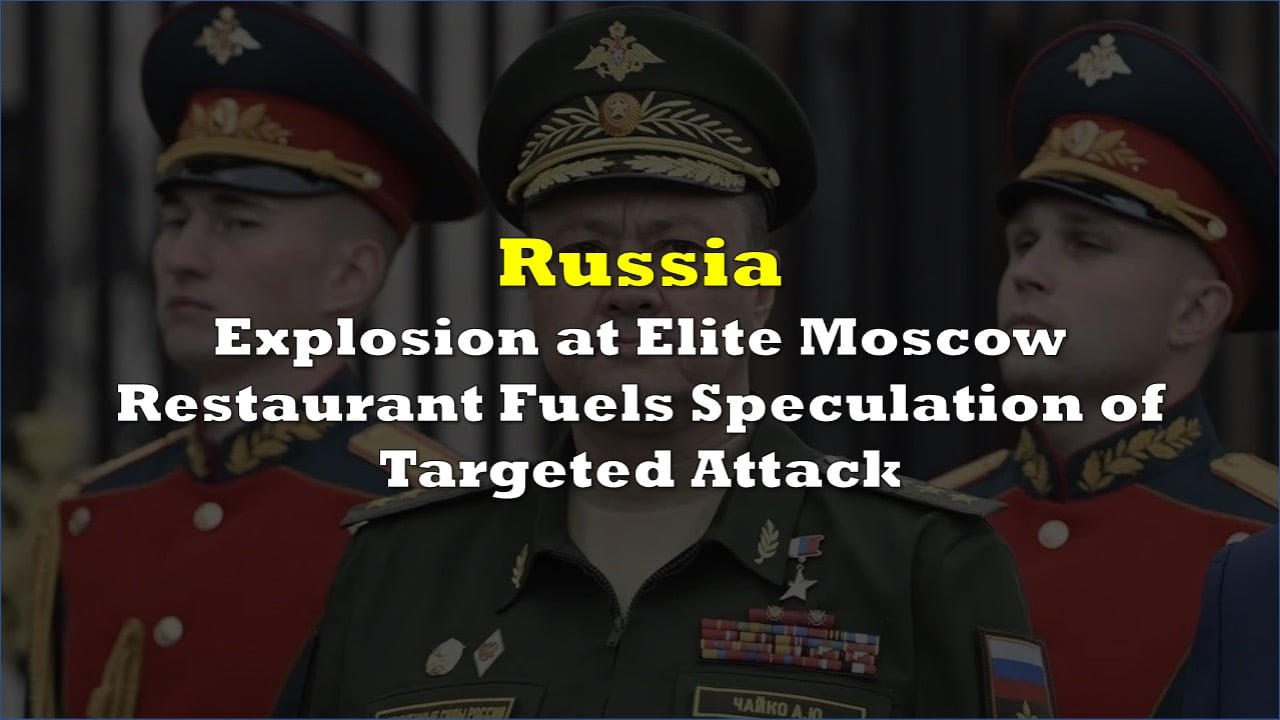

A bomb exploded outside an upscale Moscow restaurant Saturday night during what several independent Russian outlets say was a private birthday party for a senior Russian general accused of war crimes in Ukraine.
A woman carrying a homemade bomb hidden inside a wrapped gift box approached the restaurant. A security guard stopped her to check the package, and the device went off near the entrance moments later, killing the guard, the woman, and a restaurant patron, according to Russia’s National Anti-Terrorism Committee.
Officials initially reported three dead and 15 wounded; by Sunday, Russian outlets were citing a toll of five dead.
The restaurant reportedly closed that evening for the 55th birthday of Alexander Chayko, commander-in-chief of Russia’s Aerospace Forces since May, pointing to a placard visible in pre-blast footage that read “Alexander 55”. Russian authorities have not confirmed Chayko attended or was the intended target, and at least one witness told the independent outlet Astra the event may instead have been a wedding.
 Sponsored · Selkirk Copper Mines
Chayko has faced war crimes accusations since he commanded the Russian force that advanced on Kyiv from the west during the opening weeks of the 2022 invasion. The European Union sanctioned him over the conduct of troops under his command during the occupation of Bucha.
Moscow Mayor Sergei Sobyanin called the blast “a brutal terrorist act.” No group has claimed responsibility, and Russian officials have not said whether they suspect Ukrainian involvement, though it echoes a string of past attacks and killings that have struck deep inside Russia since the war began.
The blast came the same weekend Ukraine’s military struck a Russian strategic bomber base and a major oil refinery in a single overnight operation, part of a deep-strike campaign that has also hit close to a dozen warehouses belonging to Russia’s largest online retailer since mid-July.
Ukraine’s General Staff confirmed hits on the Engels-2 airbase and the nearby Saratov oil refinery in Saratov Oblast, more than 600 kilometers from the front line. Engels-2 hosts the Tu-95MS and Tu-160 bombers Russia uses to launch missile strikes on Ukrainian cities, while the refinery processes roughly 6 to 7 million metric tons of crude a year. Reuters calculations put the cumulative toll of Ukraine’s refinery campaign at a 17% cut to Russian refining capacity, or roughly 1.1 million barrels a day.
The same night, a drone strike set fire to a Wildberries warehouse in Russia’s Samara region. Ukraine accuses the retailer, which controls roughly 45% of the country’s online retail market, of supplying components for the aerial weapons Russia uses against Ukrainian cities.
Russia’s own attacks continued in parallel. A ballistic missile strike on Kyiv overnight killed at least nine people and wounded more than 30, the second major strike on the capital in 48 hours, while Russian forces have also begun using new jet-powered Banderol loitering munitions and Geran-4 Seeker drones against Ukrainian Black Sea ports and rail lines, according to the Institute for the Study of War.