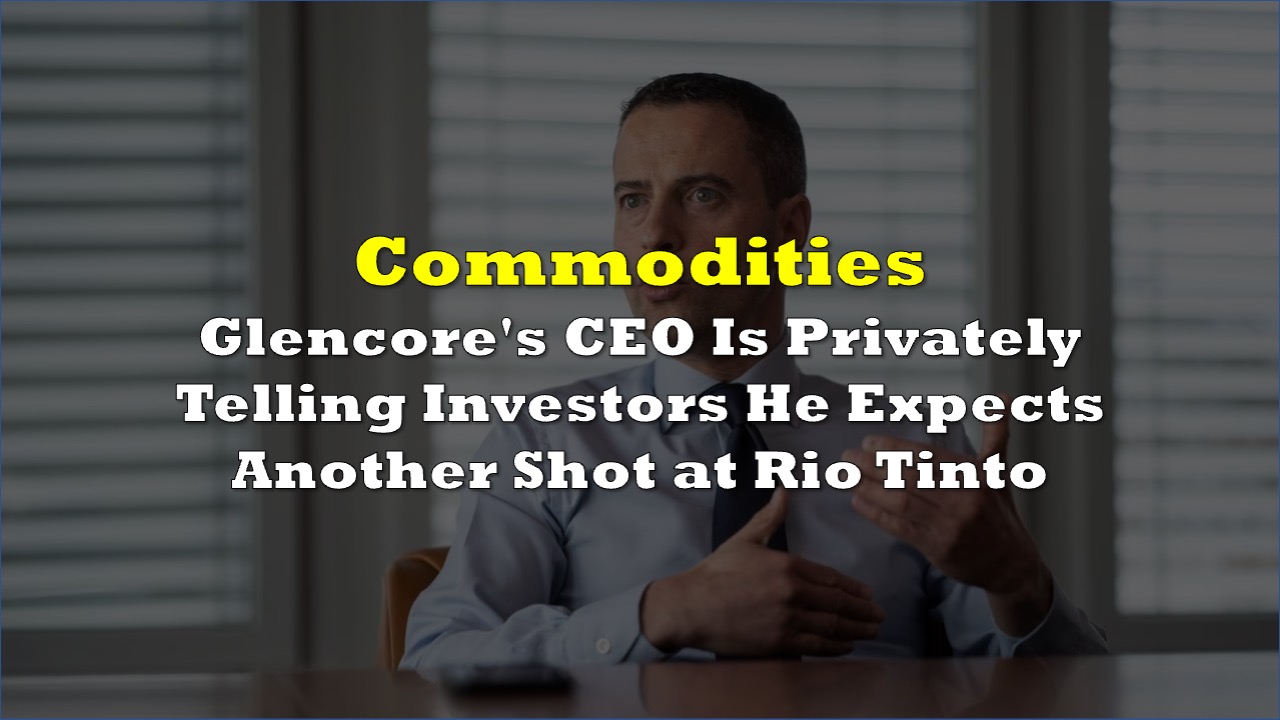

The merger that would create the world’s largest mining company collapsed in February. Glencore‘s (LON: GLEN) CEO is now privately telling investors it’s only a matter of time before the numbers force Rio Tinto back to the table.
Glencore CEO Gary Nagle is hopeful that rising coal prices will revive merger discussions with Rio Tinto (ASX: RIO), according to three investors who met with leaders of both companies in Australia this week and spoke to Reuters on condition of anonymity.
Glencore and Rio Tinto have not commented on the matter.
Since the Financial Times first reported the merger talks on January 7, Glencore’s shares have climbed 26% alongside coal prices, while Rio Tinto’s have risen a more modest 9%, partly held back by weaker iron ore markets. That shift has moved Glencore’s implied share of a combined entity from around 31.5% at the start of talks to roughly 35% — closing the gap on the 40% stake it had argued it deserved.
A key sticking point, in Glencore’s view, was that Rio anchored its valuation of Glencore to spot commodity prices on January 7 — the day talks became public. Nagle told investors a more measured approach would have incorporated forward-looking price projections, the sources said. He also told investors Australia was “a bit behind” Europe on ESG concerns about coal — a direct push back on one of the deal’s most persistent objections.
Rio Tinto confirmed on February 5 that it was “no longer considering a possible merger or other business combination with Glencore,” having determined it could not reach an agreement that would deliver value to shareholders.
Read: Rio Tinto, Glencore End Merger Talks After Failing to Agree on Terms
“Ultimately we formed the view that we couldn’t stand up a value case, and that’s where it stands,” CEO Simon Trott said at the time. Under UK Takeover Panel rules, Rio Tinto cannot formally restart talks for six months — placing the earliest possible window in August 2026.
Not everyone is convinced. “This is definitely not going away, unfortunately,” one investor told Reuters — a skeptic who sees no value in the deal. “I don’t see how Rio can change their mind in six months just because coal has gone up and iron ore has gone down,” another said.
A combined entity would leapfrog BHP to become the world’s largest mining company, with an enterprise value above $260 billion and control of approximately 7% of global mined copper supply — around 1.7 million metric tons annually.
South America would anchor the copper portfolio, with Chile alone contributing roughly 45% of projected output through assets including Glencore’s Collahuasi mine and Rio Tinto’s Escondida operation. For Rio Tinto, the appeal is diversification away from iron ore, which exposes it heavily to Chinese demand cycles.
For Glencore, Rio’s operational scale would enhance the value of its copper assets, while a potential coal spinoff could address the portfolio’s most contentious element.
The obstacles that ended the first round of talks remain. Five Australian investment funds wrote to Rio Tinto’s board in January, raising governance concerns, citing Glencore’s history of corruption investigations.
Australian shareholders are structurally decisive — more than half of Rio Tinto’s earnings flow from its Australian operations, and any transaction would require government sign-off in Canberra as well as 75% of votes cast at the ASX shareholder level.
Disagreements over the value of Glencore’s undeveloped copper assets in Argentina also contributed to the breakdown.
BMI Research assessed the February collapse as a setback specific to these two companies, not a signal that consolidation in critical minerals is slowing. Whether a Glencore-Rio Tinto deal eventually gets done may depend less on corporate strategy than on whether the commodity cycle does the valuation work that the boardrooms could not.
Information for this story was found via the sources and companies mentioned. The author has no securities or affiliations related to the organizations discussed. Not a recommendation to buy or sell. Always do additional research and consult a professional before purchasing a security. The author holds no licenses.