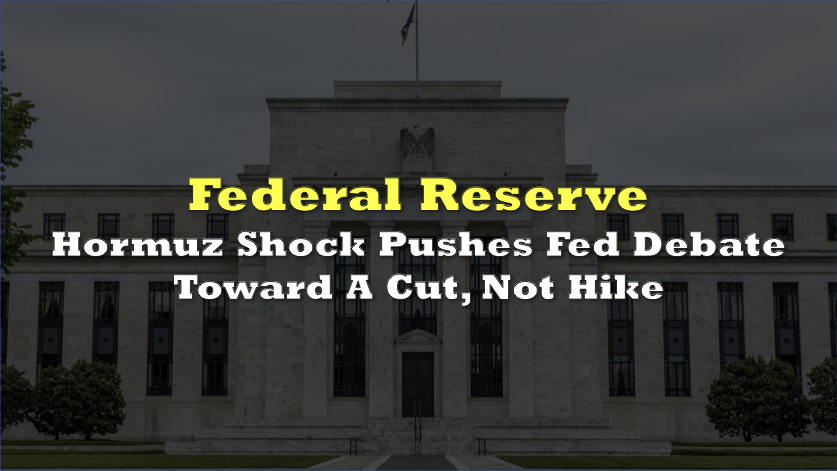

A prolonged Strait of Hormuz disruption is increasingly shaping up as a scenario that could bring the Federal Reserve closer to a rate cut, not a hike, even as oil and broader commodity prices surge.
The Fed is widely expected to leave rates unchanged at 3.50% to 3.75% on Wednesday, while the real debate has shifted to whether markets have overreacted to the inflation shock and underpriced the damage to growth and employment.
The inflation case is easy to see. Brent crude has traded above $100 a barrel, Gulf supply disruptions have intensified, and Middle East oil exports were down at least 60% as Hormuz stayed mostly closed. Roughly a fifth of global oil and LNG flows normally pass through the strait, and the supply hit has already pushed up not just crude but also diesel, jet fuel, metals, and food-linked costs.
Reuters reported US producer prices rose 0.7% month over month in February, above expectations for 0.3%, while annual PPI accelerated to 3.4% from 2.9%. Core PCE for February is estimated at 0.4% month over month for a third straight month and 3.1% year over year, still well above the Fed’s 2% target.
Futures now imply just one 25 basis point cut in 2026, with that move seen in September, versus roughly two cuts priced before the Iran conflict. Two-year Treasury yields have jumped 31 basis points this month to about 3.69%, their biggest monthly rise since October 2024, as traders reassessed how much room the Fed has to ease into an energy shock.
But the growth side of the shock is where the cut thesis starts to build. Hormuz is not just an inflation event. It is also a tax on consumers, a margin squeeze on businesses, and a drag on trade and confidence. An analysis argued markets may be wrong to assume a cleaner hawkish response because the same oil spike that lifts headline inflation can also weaken domestic demand, tighten financial conditions, and magnify labor-market fragility. If the energy shock proves temporary or partially reverses after shipping lanes reopen, the Fed could end up responding more to the slowdown than to the spike.
The labor market is the clearest pressure point. US nonfarm payrolls fell by 92,000 in February against expectations for a gain of 59,000, the unemployment rate rose to 4.4% from 4.3%, and average job growth over the latest three months has slowed to just 6,000. Reuters described it as the sixth monthly job-loss report since early 2025.
That is why economists surveyed by Reuters still expected a first cut in June as of March 12, despite the war-driven inflation risk. Their view was effectively that higher energy prices complicate timing but do not erase the underlying case for easier policy if hiring remains weak and growth slows further.
The Fed is entering the meeting divided between the inflation and employment sides of its dual mandate. Reuters said officials are likely to raise inflation projections while marking down growth and employment forecasts.
Politics also matter at the margin. Jerome Powell’s term as Fed chair ends on May 15, and Kevin Warsh’s nomination remains stalled amid a Justice Department dispute involving Powell and opposition from Senator Thom Tillis.
Information for this story was found via Reuters, ZeroHedge, and the sources and companies mentioned. The author has no securities or affiliations related to the organizations discussed. Not a recommendation to buy or sell. Always do additional research and consult a professional before purchasing a security. The author holds no licenses.