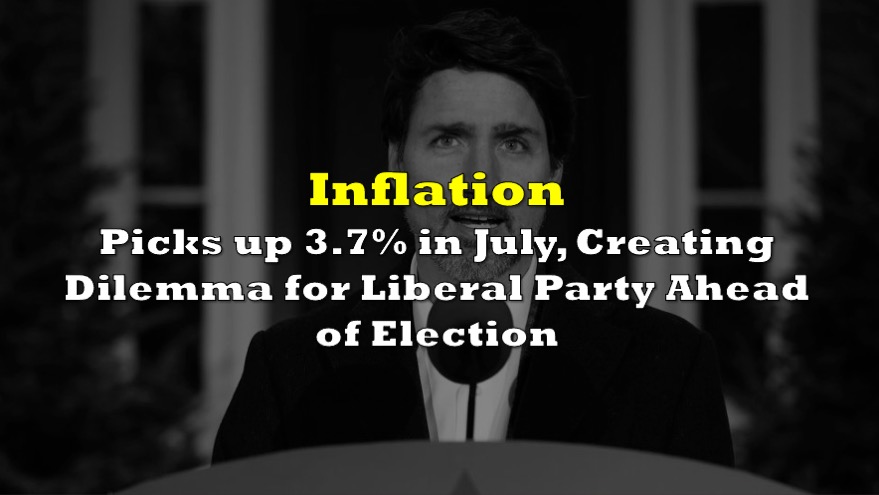

Price pressures across Canada accelerated by the most in nearly a decade, threatening to create an inconvenience for the Liberal party in the upcoming federal election.
According to Statistics Canada, inflation rose another 0.6% in June, and is up 3.7% from year-ago levels, marking the highest reading since 2011. Core inflation, which excludes energy prices, rose by an annual 2.47% last month, the highest since 2009. July’s price acceleration marks the fourth straight month that inflation has exceeded the Bank of Canada’s target range of 1% to 3%, and further intensifying the ‘transitory’ debate among policy makers and economists.

The Bank of Canada’s latest forecasts suggest that inflation has yet to peak, as price pressures are set to hit 3.9% in the third quarter, before easing towards the end of 2021. “The Bank of Canada may be willing to tolerate higher inflation while the economy is still re-opening and recovering from the health shock, but it will respond to more lasting price pressures by reducing monetary accommodation,” explained TD Bank economist James Marple to Bloomberg.
 Sponsored · Silver47 Exploration Inc.
Despite the reassurance from Canada’s central bank, however, the ongoing rise in prices for goods and services comes at an inconvenient time for the Liberal party, which is attempting to win back majority in Parliament come September. Affordability has become a main concern for most Canadians in recent months, and a central argument for the opposition party, which accuses Prime Minister Justin Trudeau of stoking inflation via generous fiscal spending. “The numbers released today make it clear that under Justin Trudeau, Canadians are experiencing a cost of living crisis,” said Conservative Leader Erin O’Toole.
Prices accelerated across six of the eight major components last month, with shelter prices accounting for most of the overall increase in inflation. the homeowners’ replacement cost, which is linked to the price of new homes, rose 13.8% from July 2020— the sharpest increase since October 1987. Conversely, prices for clothing and footwear, tobacco products, recreational cannabis, and alcoholic beverages, decelerated year-over-year in July compared to the previous month.

Information for this briefing was found via Statistics Canada and Bloomberg. The author has no securities or affiliations related to this organization. Not a recommendation to buy or sell. Always do additional research and consult a professional before purchasing a security. The author holds no licenses.