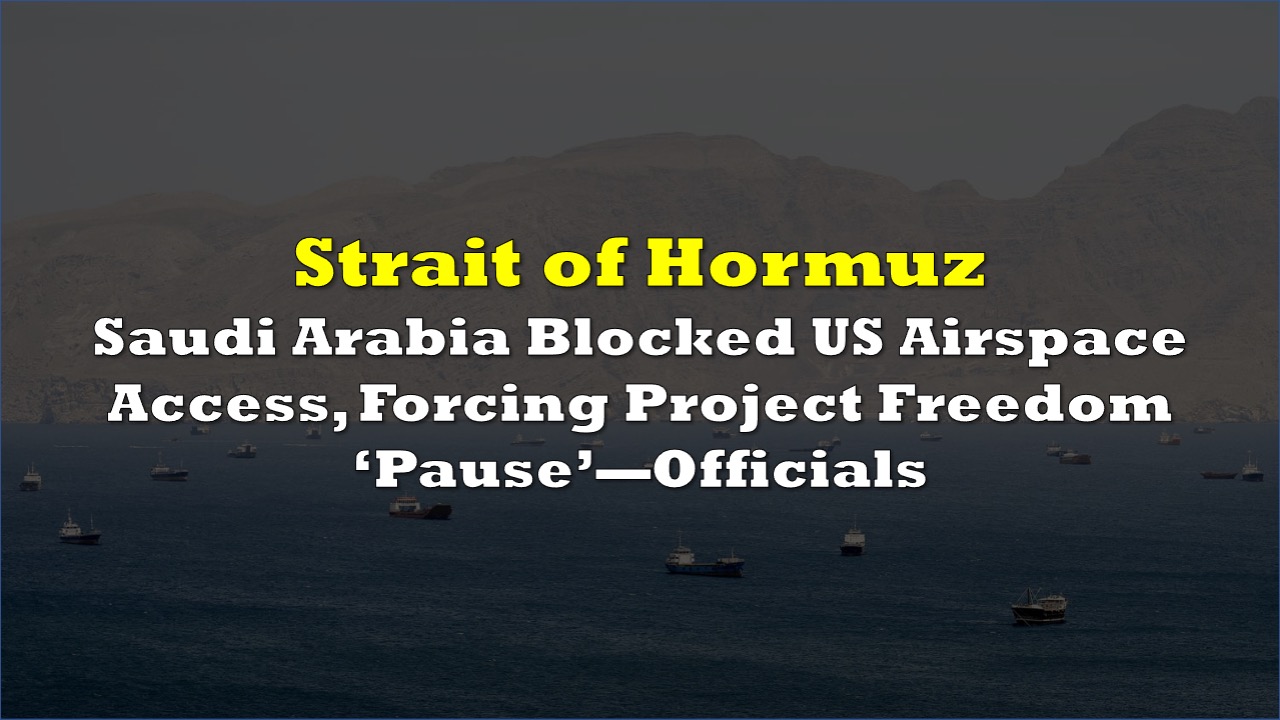

President Donald Trump’s decision to pause Project Freedom was not driven by diplomatic progress with Iran, according to two US officials. Saudi Arabia forced his hand by suspending US military access to a critical airbase and refusing American aircraft through its airspace — making the operation militarily unviable within 36 hours of its launch.
According to the two US officials, the Kingdom withdrew permission for US forces to operate from Prince Sultan Airbase southeast of Riyadh and to fly through Saudi airspace. Fighter jets, refueling tankers, and support aircraft providing the defensive umbrella for the naval escort mission all depended on that access.
The officials said a direct call between Trump and Saudi Crown Prince Mohammed bin Salman failed to resolve the dispute, forcing the White House to stand down the operation to preserve US military access to critical Gulf infrastructure.
 Sponsored · Cambria Gold Mines
Read: TACO Tuesday: Trump Halts Hormuz Escort Mission, Claims Progress on Iran Deal
“Because of geography, you need cooperation from regional partners to utilize their airspace along their borders,” one US official said. “In some cases, there is no other way around.”
Trump announced the operation on social media Sunday without prior coordination, angering Riyadh. Qatar and Oman were also caught off guard. A Middle Eastern diplomat told NBC the US did not coordinate with Oman until after Trump’s announcement.
“The US made an announcement and then coordinated with us,” the diplomat said, adding, “we were not upset or angry.”
 Sponsored · Altamira Gold Corp.
A Saudi source told NBC that Trump and the crown prince “have been in touch regularly” and that the Kingdom was “very supportive of the diplomatic efforts” by Pakistan to broker a deal. Asked whether Project Freedom had caught Saudi leaders by surprise, the source said: “The problem with that premise is that things are happening quickly in real time.”
A White House official insisted “regional allies were notified in advance” — a claim the two US officials disputed, as did the Omani diplomat’s account of being informed after the announcement.
Saudi Arabia and Jordan are critical for basing US aircraft; Kuwait for overflight; Oman for both overflight and naval logistics. Riyadh’s willingness to exercise that leverage against a US military operation — and hold firm even after a direct presidential call — signals a hard limit on Washington’s freedom of action in the Gulf.
With the military option off the table pending Gulf ally realignment, a negotiated settlement is now the primary route to reopening the strait.
Iran is expected to deliver its response on Thursday to the US 14-point memorandum of understanding covering nuclear enrichment, sanctions relief, and the restoration of free Strait of Hormuz transit.
Commercial traffic through the waterway has fallen more than 90% since Operation Epic Fury launched on February 28. Nearly 23,000 sailors on vessels representing 87 countries remain stranded in the Persian Gulf.
Information for this story was found via the sources and companies mentioned. The author has no securities or affiliations related to the organizations discussed. Not a recommendation to buy or sell. Always do additional research and consult a professional before purchasing a security. The author holds no licenses.