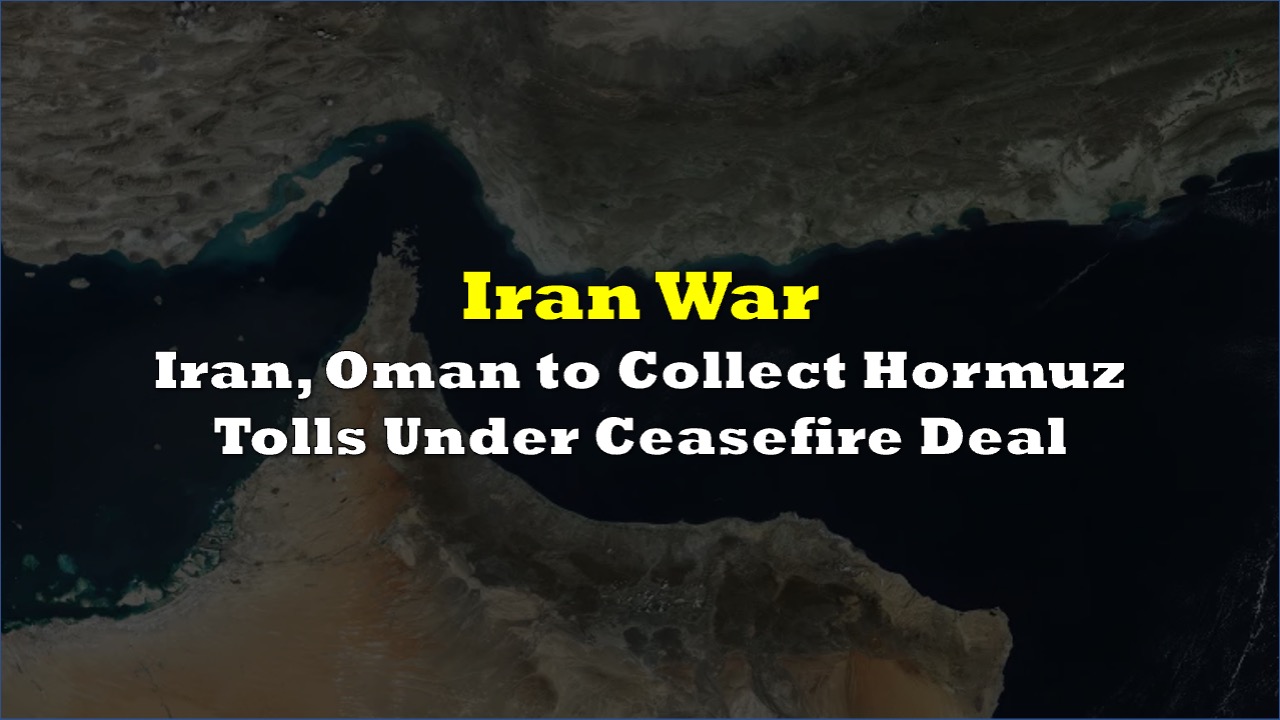

Iran and Oman will charge ships to pass through the Strait of Hormuz under the terms of a two-week ceasefire deal announced Tuesday — cementing a toll regime that the Islamic Revolutionary Guard Corps had been running informally since mid-March and extending it to a waterway that had never previously carried fees.
Iran’s Islamic Revolutionary Guard Corps established the toll regime informally in mid-March, routing vessels through a controlled corridor inside Iranian territorial waters around Larak Island and requiring operators to submit full documentation — including ship ownership details, cargo manifests, crew lists, and final destination — to IRGC-linked intermediaries before receiving clearance. Lloyd’s List Intelligence confirmed at least two vessels paid fees of approximately $2 million per transit, collected in Chinese yuan.
Read: Yuan, Not Dollars: Iran’s Hormuz Toll Booth Picks Its Currency
Iran’s parliament moved to codify the arrangement on March 31, when its National Security and Foreign Policy Committee advanced the Strait of Hormuz Management Plan — legislation that would formalize Iran’s sovereign control over the waterway and denominate transit fees in Iranian rial. The bill still requires a full parliamentary vote, Guardian Council review, and a presidential signature.
Read: Trump Agrees to Two-Week Ceasefire with Iran, Contingent on Strait of Hormuz Reopening
The ceasefire deal, brokered by Pakistani Prime Minister Shehbaz Sharif and announced by President Donald Trump on Tuesday evening, conditions the suspension of US bombing on Iran agreeing to reopen the strait. Under the terms, both Iran and Oman will collect fees from transiting vessels. Iran has said the fees it collects will fund reconstruction efforts following weeks of US and Israeli strikes on its infrastructure.
BREAKING: The two-week ceasefire plan between the Iran and the US allows Iran and Oman to charge fees on ships transiting through the Strait of Hormuz, per CNN.
— The Kobeissi Letter (@KobeissiLetter) April 8, 2026
A regional official said this money would be used for the reconstruction of Iran.
Iran has been recently charging $2…
Iran’s official ceasefire statement described the arrangement as “controlled passage through the Strait of Hormuz coordinated with Iran’s armed forces,” which is not exactly a “complete, immediate, and safe opening,” as Trump demanded. Both governments declared the deal to be on their own terms.
Statement on behalf of the Supreme National Security Council of the Islamic Republic of Iran: pic.twitter.com/cEtBNCLnWT
— Seyed Abbas Araghchi (@araghchi) April 7, 2026
The fees violate international maritime law — but neither Iran nor the US ever ratified UNCLOS, the treaty that prohibits coastal states from charging for transit through international straits. The GCC has called the tolls illegal. No legal proceedings have followed.
So let me get this straight…
— Brian Krassenstein (@krassenstein) April 8, 2026
•$40 billion spent
•300+ Americans wounded
•Over a dozen killed
•Oil prices doubled
•U.S. bases severely damaged
And what do we get?
Iran keeps its uranium.
No nuclear deal.
The Strait of Hormuz still unstable.
And the world sees us as weaker,…
US and Iranian delegations plan to meet in Islamabad on April 10 to negotiate a longer-term settlement.
Information for this story was found via the sources and companies mentioned. The author has no securities or affiliations related to the organizations discussed. Not a recommendation to buy or sell. Always do additional research and consult a professional before purchasing a security. The author holds no licenses.