



As military tensions between Washington and Tehran continue to intensify, Iranian state television has moved beyond battlefield messaging and into the realm of presidential security, broadcasting an extended segment analyzing President Donald Trump’s Secret Service motorcade, travel routines, and frequently used routes in Florida and New York.
Rather than announcing a military development, the program presented itself as an analytical report. According to the Persian-language narration, the production examined Trump’s routine movements between 2024 and 2026 using what it described as “the most complex security protocols.”
The broadcast described the composition of Trump’s protective convoy, including the presidential limousine known as “The Beast,” duplicate vehicles, Chevrolet Suburbans carrying protective personnel, and a Ford F-550 emergency response vehicle. It then shifted to mapping regular travel patterns around Palm Beach.
 Sponsored · Selkirk Copper Mines
Graphics shown during the segment highlighted the approximately 10-minute drive between Palm Beach International Airport and Mar-a-Lago. The narration also identified Trump’s routine travel between Mar-a-Lago and his golf club in West Palm Beach, describing specific roads, bridges, and intersections that it characterized as recurring parts of the convoy’s route.
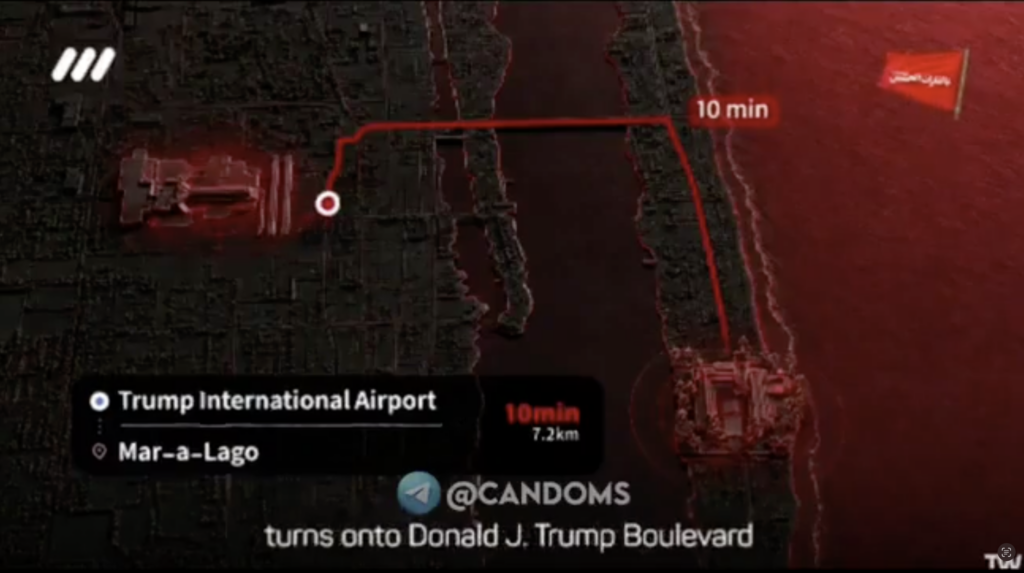
The program then moved to New York, discussing arrivals at LaGuardia Airport and motorcade operations around Trump Tower. Unlike the Florida segment, the narration emphasized extensive physical security measures, including concrete barriers and sand-filled sanitation trucks positioned along Fifth Avenue during presidential visits.
The strategic significance of the broadcast may be less about whether it disclosed previously unknown information and more about the decision by Iranian state media to assemble publicly available observations into a professionally produced security analysis during an active geopolitical confrontation.
Many aspects of presidential motorcade operations have long been observable through public appearances, media coverage, aviation tracking, road closures, and open-source intelligence communities. Security professionals routinely monitor how adversaries aggregate publicly available information rather than relying solely on classified sources.
By presenting those details through official state television, Iranian media transformed scattered public observations into a coherent narrative focused on perceived security vulnerabilities.
The broadcast stopped short of explicitly calling for violence. However, it repeatedly identified what it described as operational “bottlenecks” and contrasted the relative security of different presidential movements.
The so-called bottlenecks include recurring airport-to-residence transfers, bridge crossings that funnel traffic into limited corridors, major intersections along regularly used routes, and the approaches to Trump’s golf club in Florida.
The television segment emerged as the US and Iran remain engaged in an increasingly dangerous confrontation that has expanded well beyond direct military exchanges. Recent days have seen continued US strikes on Iranian targets, Iranian attacks against regional military facilities, threats involving the Strait of Hormuz, and growing concerns over maritime security and global energy supplies.



One Response
DJT probably knew something like this was coming soon, which would explain the fence around the WH and the new “hard stone” helipad. He’s afraid of everyone (starting with Putin). Iran is basically saying they could have (and obviously wouldn’t have) used this information — but recognize that they would be blamed if anyone else did, which I presume is why they made this report in the first place. Trump won’t see it that way, of course.