
A partial collapse at Aeon Mall Kumamoto has turned a powerful earthquake in southern Japan into both a mass-rescue operation and an immediate test of the infrastructure supporting one of the country’s largest semiconductor expansions.
Emergency crews were searching for people trapped inside the shopping centre Tuesday night, while Taiwan Semiconductor Manufacturing Company, Sony Group, and Fujifilm Holdings evacuated employees from facilities across Kumamoto Prefecture.
The earthquake struck at 4:27 p.m. local time on July 28, with its epicentre about 20 kilometres south of Kumamoto City, per Reuters report. Japan’s Meteorological Agency measured it at magnitude 7.1, a depth of 10 kilometres, and the highest possible reading of seven on Japan’s seismic intensity scale.
 Sponsored · Selkirk Copper Mines
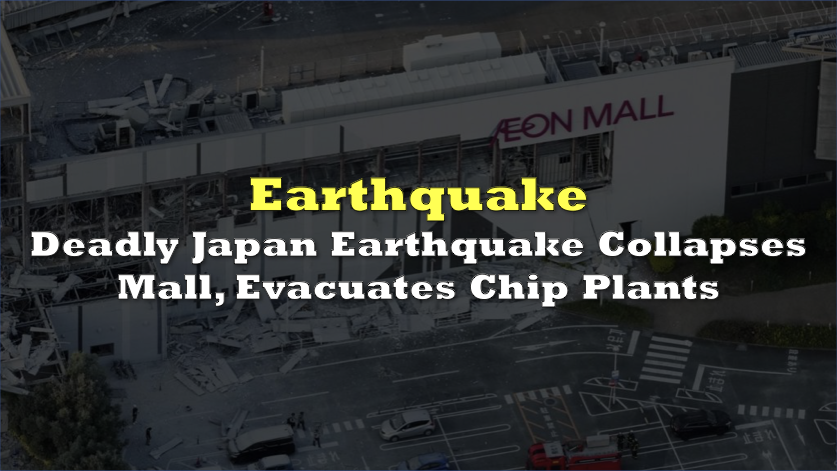
Japan’s Fire and Disaster Management Agency said the second floor of Aeon Mall Kumamoto in Kashima had partially collapsed, leaving many people trapped. Emergency calls also reported an explosion and smoke at the property more than an hour after the initial earthquake. Kyodo News reported that firefighters were conducting rescue operations inside the building.
TBS News DIG reported at 7:50 p.m. that a Kumamoto prefectural official believed there were multiple deaths. Reuters later reported, citing TBS, that police considered “quite a few” people presumed dead.
That assessment had not developed into a confirmed casualty count. Police separately told AFP that they could not confirm whether anyone had died at the mall.
Aeon said employees and customers began evacuating immediately after the earthquake. The company said it had not determined what caused the subsequent explosion. The mall normally contains about 200 specialty stores and parking for approximately 5,000 vehicles, according to Aeon’s property information.
 Sponsored · Cambria Gold Mines
Kumamoto Nichinichi Shimbun reported that more than 60 emergency patients had arrived at Saiseikai Kumamoto Hospital by shortly after 8 p.m., including a patient transported in cardiac arrest.
The earthquake damaged homes, roads, bridges, railways, and sections of Kumamoto Castle’s stone walls. Seventeen homes had collapsed in Hikawa by 8 p.m., according to local authorities cited by TV Asahi.
Around 48,000 households lost electricity, according to Kyushu Electric Power figures reported by Reuters. Mobile services were disrupted by electricity and transmission failures, while Kyushu bullet trains and other railway services were suspended. Kumamoto Airport closed its runway, forcing airlines to divert or cancel flights.
A tsunami advisory covering the Ariake and Yatsushiro seas was lifted within two hours. Japan’s Meteorological Agency said no tsunami was observed. Nuclear regulators reported no abnormalities at three power facilities in the wider region.
Prime Minister Sanae Takaichi ordered government agencies to prioritize rescue operations, provide timely information, and assess damage. About 300,000 residents were instructed to go to evacuation centres, while 3,600 Self-Defense Forces personnel were deployed to support disaster relief.
Chip plants evacuated
TSMC evacuated its Japan Advanced Semiconductor Manufacturing facility as a precaution. Sony and Fujifilm also cleared workers from regional plants, according to Reuters, although neither company immediately disclosed damage or expected production interruptions.
The evacuations place additional scrutiny on Japan’s concentration of semiconductor investment in Kumamoto.
TSMC’s first Kumamoto fabrication plant began volume production at the end of 2024. A second plant is under construction and is planned to manufacture advanced 3-nanometre semiconductors used in artificial intelligence and high-performance computing.
TSMC has said combined investment in the Kumamoto operation will exceed $20 billion. The company initially projected the two facilities would eventually produce more than 100,000 12-inch wafers each month. TSMC’s latest annual reporting says the site is expected to cover technologies ranging from 40 nanometres to 3 nanometres.
The earthquake occurred after the Tokyo Stock Exchange’s 3:30 p.m. close, meaning Japan-listed companies affected by the disaster had no same-day cash-market reaction.
Japan’s Meteorological Agency warned residents to prepare for strong aftershocks and landslides over the coming days. As of late Tuesday, casualty assessments, mall rescue operations, infrastructure inspections, and semiconductor plant checks remained underway.