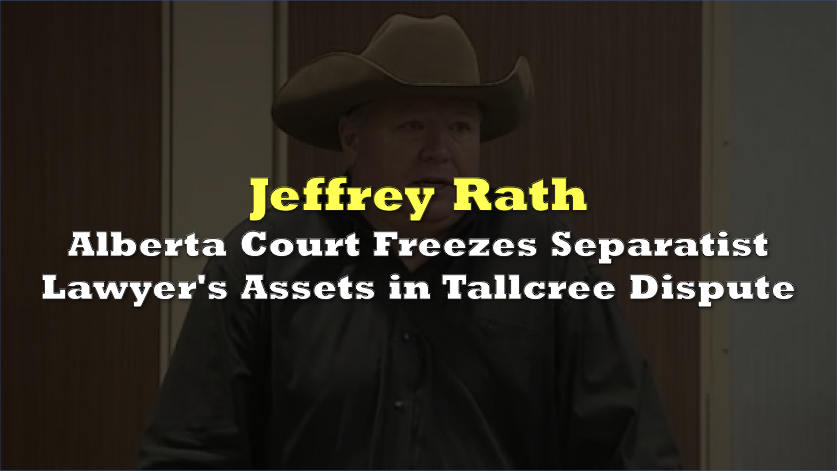

An Alberta judge has restricted lawyer for the separatist movement Jeffrey Rath and his law corporation from dealing with up to $8.52 million in assets, Global News reports, escalating a years-long financial dispute involving the Tallcree First Nation settlement into a direct threat to the lawyer’s personal and corporate balance sheets.
The order is politically notable because Rath has become a leading public advocate for Alberta independence. He serves as a lawyer for Stay Free Alberta, the organization behind the province’s separatist petition campaign, and has regularly spoken publicly on behalf of the movement.
Its more consequential dimension, however, is financial. The Court of King’s Bench of Alberta has imposed a Mareva order, an extraordinary civil remedy intended to prevent assets from being sold, transferred, mortgaged, charged, or otherwise placed beyond the reach of a potential judgment.
 Sponsored · Selkirk Copper Mines
The order does not establish that Rath committed fraud, breached a trust, or improperly transferred funds. It preserves property while the underlying claims are litigated.
Justice Marion pronounced the “interim interim” order in Edmonton in proceedings brought by Chief Rupert Meneen against Jeffrey R.W. Rath Professional Corporation and Rath personally. The professional corporation carries on business as Rath & Company and is identified in the proceeding as a trustee of the Tallcree First Nation Trust.
The order restrains Rath, the corporation, their directors, officers, employees, agents, and anyone acting on their behalf from dealing with exigible property up to $8,518,075. It covers assets located inside or outside Alberta, including money, securities, rights, interests, and other property capable of being transferred for value.
Rath and his corporation were also directed to provide the applicants with information identifying financial institutions and account numbers associated with accounts not exempted by the order.
The order’s exact financial ceiling is significant because it matches a previous judgment involving Rath & Company and Tallcree. Tallcree received approximately $57.6 million from Canada to settle a Treaty 8 agricultural-benefits claim. Rath & Company’s contingency agreement provided for compensation of between 20% and 35%, depending on when the claim was resolved. The firm collected $11,518,075, representing 20% of the settlement.
Tallcree challenged the fee. An Alberta judge eventually reduced Rath’s allowable compensation to $3 million, leaving a difference of $8,518,075. The Alberta Court of Appeal upheld the $3 million result, and the Supreme Court of Canada declined to hear Rath’s further appeal in March 2023.
The restrictions are broad, but not absolute. Client money held in trust and operating accounts used for Rath & Company’s legal practice were excluded. Transactions required in the ordinary course of the firm’s business could continue, although transfers benefiting Rath or his professional corporation were prohibited under the supplied portion of the order.