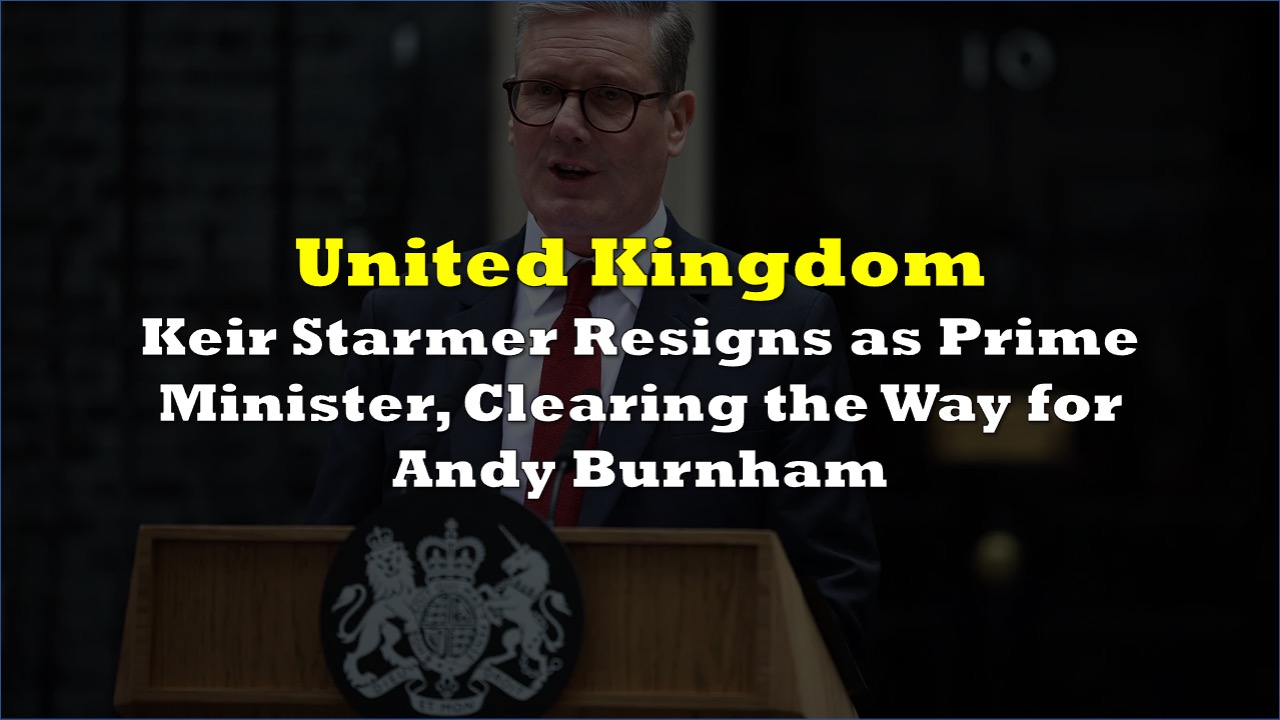

Keir Starmer announced Monday morning outside No. 10 Downing Street that he will resign as Britain’s Prime Minister, ending weeks of mounting pressure from within his own Labour Party and setting the country on course for its sixth prime minister in a decade.
Starmer said he will remain in office until the Labour leadership contest concludes. He asked his party to open nominations on July 9 and ensure a new leader is in place before Parliament returns in September. Starmer became emotional at the close of his remarks, telling the gathered press that leaving “the biggest job in the country” would mean spending more time being a husband to his wife Victoria and a father to his children — his voice breaking as he said it.
The announcement clears the path for Andy Burnham, the former Mayor of Greater Manchester, to succeed him. Burnham — nicknamed “the King of the North” for his forceful advocacy for northern England — won the Makerfield by-election last Thursday with 54.8% of the vote, specifically to mount a leadership challenge. He is the overwhelming favorite, with 35% of the public holding a positive opinion of him compared to Starmer’s 19%. Party insiders have signaled they hope to avoid a competitive race entirely if Burnham is the only viable challenger.
 Sponsored · Selkirk Copper Mines
The resignation brings the curtain down on one of the more striking political collapses in modern British history. Starmer led Labour to a landslide election victory in July 2024 — a 172-seat majority, among the largest for the party in decades — and within two years had become one of Britain’s most unpopular prime ministers, drawing comparisons to Liz Truss.
His net approval had fallen to -46% by November 2025. The accumulated damage was extensive — a stagnant economy, an NHS that resisted reform, a cost-of-living crisis without resolution, and a series of self-inflicted wounds, including his decision to appoint Peter Mandelson, a figure with well-documented ties to Jeffrey Epstein, as the UK’s ambassador to the United States. Starmer removed him from the post after Mandelson’s correspondence with Epstein became public, but the episode lingered.
Related: Starmer’s Government Cracks: First Minister Resigns as Labour MPs Demand He Go
Two cabinet resignations in quick succession proved decisive. Health Secretary Wes Streeting quit last month and issued a stinging assessment of Starmer’s record: “Where we need vision, we have a vacuum,” he said. Defense Secretary John Healey resigned weeks later over a dispute about military funding. By the time Burnham won Makerfield, the internal arithmetic had shifted beyond recovery.
Trump weighed in before the formal announcement, claiming that Starmer “failed badly on two very important subjects — IMMIGRATION AND ENERGY” on Truth Social. “I wish him well!” Starmer’s initially warm relationship with the US president had soured over Britain’s decision to stay out of the Iran war — a position his critics eventually acknowledged showed more courage than they expected.
Also read: Starmer ‘Cannot Yield’: Britain Refuses Hormuz Blockade Despite Trump’s Trade Deal Threat