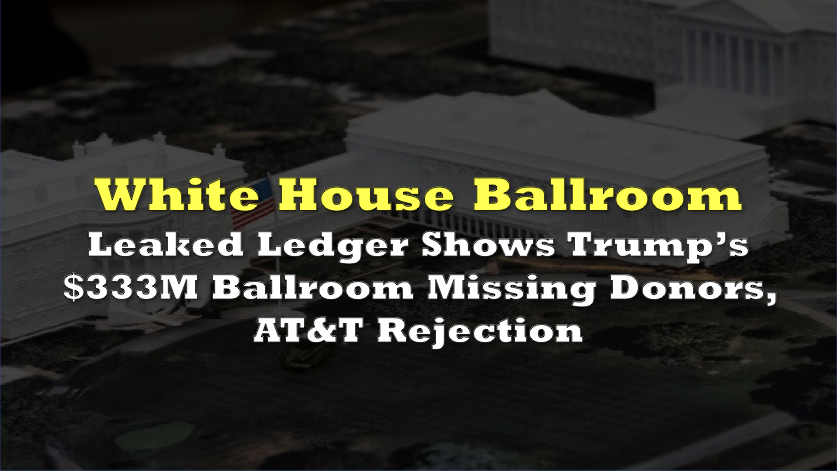

President Donald Trump’s $333 million White House ballroom fundraising total includes a $5 million pledge that AT&T says it never intended to make, exposing a discrepancy in the project’s private financing records as its estimated construction cost has climbed to $600 million.
An internal fundraising spreadsheet obtained by The Washington Post identifies 67 contributions exceeding $10,000 recorded through late September 2026. AT&T’s $5 million entry is the only one classified as “pledged,” while the others are marked “won.”
AT&T spokesperson Megan Ketterer told the outlet that the company appeared on the list by mistake and had no plans to contribute to the Trust for the National Mall, the nonprofit managing donations for the ballroom.
 Sponsored · Selkirk Copper Mines
Supporting documents reviewed by the Post indicate that some donors arranged installment payments that were still outstanding.
The records do not establish how much of the $333 million has been deposited or provide a publicly reconciled accounting of the contributions.
Donor records leave millions unreconciled
The fundraising discrepancies extend beyond AT&T. Three donors previously identified by the White House are missing from the internal spreadsheet obtained by The Post: Hard Rock International, cryptocurrency company Tether America, and modular housing executive Paolo Tiramani.
Tiramani previously said he contributed approximately $10 million in company stock. However, the internal spreadsheet excludes in-kind contributions, although it remains unclear whether that accounts for his omission.
 Sponsored · Cambria Gold Mines
The $333 million recorded by the fundraising operation also remains below Trump’s stated $400 million fundraising target.
The financial picture becomes more complicated when compared with the project’s construction budget. The Post previously reported that the estimated cost of the new East Wing complex, incorporating the ballroom, office facilities, and underground military infrastructure, had increased to approximately $600 million by March.
Separately, The Wall Street Journal reported that the Trust for the National Mall received approximately $320 million in contributions and grants during 2025, up from less than $10 million in 2024.
$77 million linked to anonymity requests
The funding records also reveal that donors associated with at least $77 million in commitments requested anonymity. At least nine contributors sought to keep their involvement confidential, according to documents examined by The Post.
Nvidia was among those requesting confidentiality, despite having publicly acknowledged its involvement in the project. The chipmaker committed $25 million, making it one of the ballroom’s four largest contributors.
The other three largest include Apple, the Adelson family, and telecommunications billionaire Charles Ergen for $25 million each. Together, those four contributors represented $100 million in commitments, or roughly 30% of the reported total.
The ballroom’s financing structure allows donors to remain undisclosed. An agreement between the White House, National Park Service, and Trust for the National Mall, released following litigation by Public Citizen, establishes confidentiality protections for contributors and outlines how privately raised funds are transferred to the government.
Donors have billions at stake in federal business
The disclosures also place the administration’s fundraising arrangements alongside commercial interests that depend on federal decisions. According to The Post’s analysis, companies or executives associated with businesses holding federal contracts during Trump’s second term accounted for approximately half of the recorded contributions.
The donor list includes major technology firms, government contractors, and investors with interests affected by federal regulatory decisions.
Another contributor is Konstantin Sokolov, whose $1 million ballroom donation was reported by The Post. Sokolov was appointed to lead the $201 million US-backed Trans-Caspian Enterprise Fund, which supports investment in Central Asia and the South Caucasus.
A separate Reuters investigation examined his significant private holdings in Armenia, including telecommunications assets and a copper-molybdenum mine acquired from sanctioned Russian bank VTB through a company that obtained US Treasury authorization.
Reuters reported that six ethics specialists raised concerns about potential conflicts involving the investment fund. However, it found no evidence of wrongdoing.
Sokolov’s representative said the fund cannot invest in his businesses, while the State Department said independent audits and conflict-of-interest requirements would apply.
White House spokesperson Davis Ingle defended the fundraising arrangement, saying the donors were helping improve the White House for future generations.
The administration has maintained that private financing limits the burden on taxpayers, although The Post has separately identified taxpayer spending associated with the project.