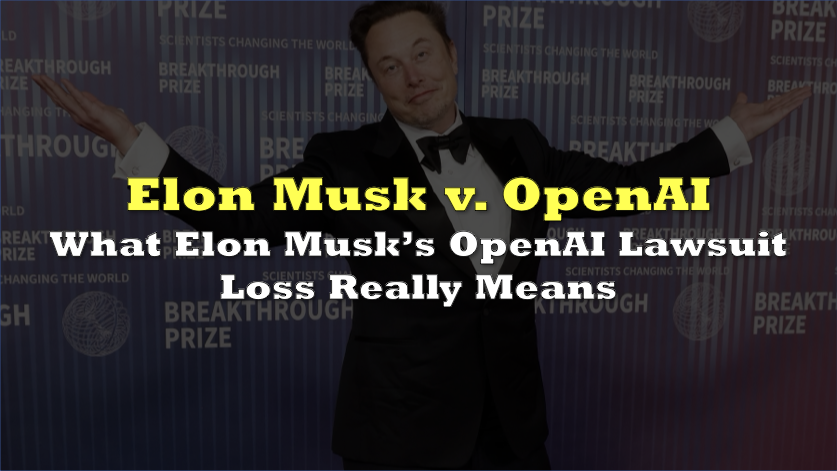

Elon Musk’s defeat against OpenAI does not mean a court endorsed OpenAI’s mission-to-market transformation. It means the person trying to challenge that transformation arrived too late.
That distinction is the real consequence of Monday’s verdict. Jurors were asked to resolve a narrower threshold issue: whether Musk still had time to bring the remaining claims against OpenAI, CEO Sam Altman, president Greg Brockman, and Microsoft. Judge Yvonne Gonzalez Rogers adopted their advisory answer, ending the case at the trial-court level, AP reported.
The result gives OpenAI a major legal reprieve without forcing the company to win the hardest philosophical argument in the case: whether an AI nonprofit founded around public benefit can build a commercial structure powerful enough to court trillion-dollar public-market expectations.
 Sponsored · Selkirk Copper Mines
Reuters reported that the ruling clears a major litigation threat as OpenAI moves toward a possible IPO that could value the company at about $1 trillion.
A deadline case
Musk’s lawsuit treated OpenAI’s commercial turn as a broken donor compact. He alleged that he backed a nonprofit AI project on the understanding that it would develop artificial intelligence for humanity’s benefit, then watched the organization move into a structure tied to commercial returns, Microsoft partnership economics, and executive control.
He is seeking roughly $150 billion in damages from OpenAI and Microsoft, with proceeds directed to OpenAI’s charitable arm, and wants OpenAI returned to nonprofit control, with Altman and Brockman removed as officers and Altman removed from the board.
READ: Musk’s OpenAI Suit Testimony: “Steal A Charity”, “Extinction Risk”, And Other Highlights
 Sponsored · Altamira Gold Corp.
OpenAI’s defense narrowed the battlefield. The company argued that Musk had known enough about its direction years earlier and sued only after launching xAI, his own competing artificial intelligence company.
Adding to the legal wrinkle, the ChatGPT maker said Musk reached out to Brockman shortly prior to the federal trial to check if it is open to settle the case. When he was turned down, he allegedly said, “By the end of this week, you and Sam will be the most hated men in America.”
The verdict answers a procedural question with strategic consequences: Musk’s timing failed before OpenAI’s structure was tested. It only needed to decide whether Musk had missed the three-year window to bring his claims.
Governance asterisk
OpenAI’s legal position improved immediately. Its public-trust problem did not disappear.
The trial forced into public view a dispute that investors usually prefer to keep abstract: whether “mission-first” AI governance can remain credible when the business requires enormous private capital, commercial partners, and eventual liquidity.
Reuters reported that legal experts viewed the verdict as helpful to OpenAI precisely because the company did not have to defeat Musk’s core mission allegations on the merits.
That is the gap Musk will likely keep pressing. AP reported that Musk plans to appeal, with Musk framing the verdict as a timing-based ruling rather than a judgment on the substance of his claims.
The appeal may or may not revive the case. But the market takeaway is already clearer: OpenAI won operational continuity, not a judicial blessing of its evolution.
Information for this briefing was found via the sources and the companies mentioned. The author has no securities or affiliations related to this organization. Not a recommendation to buy or sell. Always do additional research and consult a professional before purchasing a security. The author holds no licenses.