

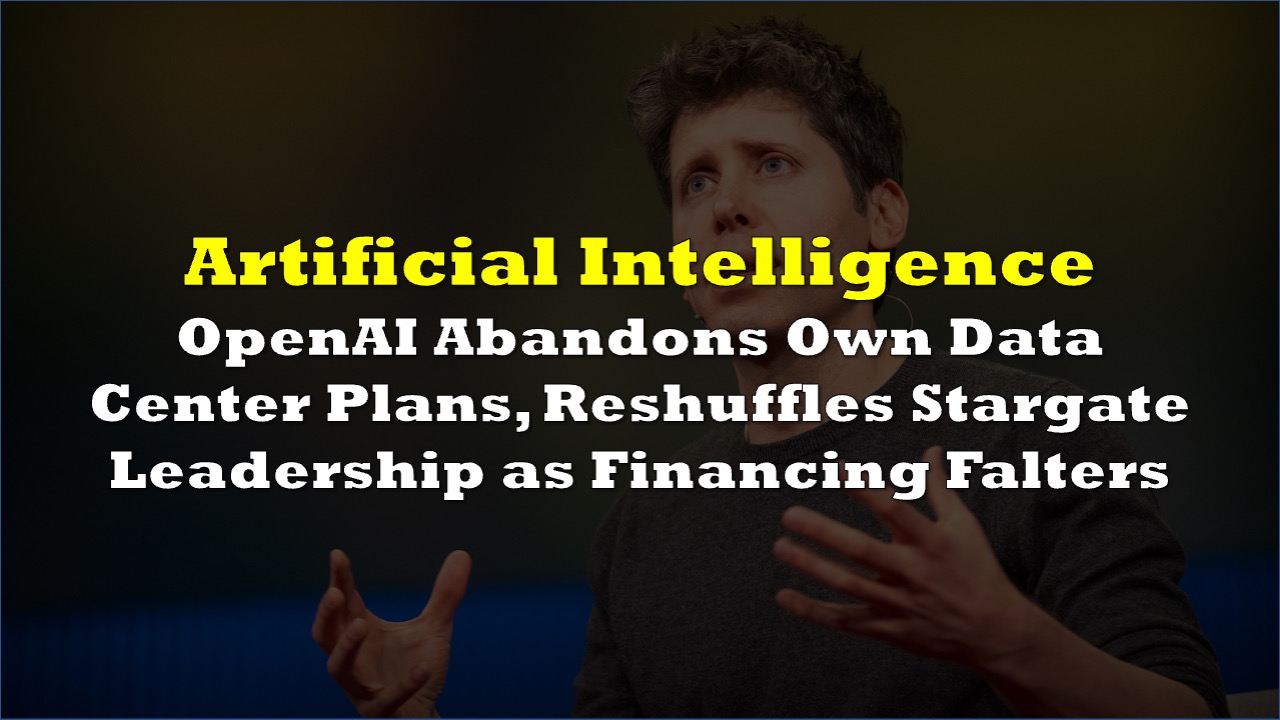

OpenAI has scrapped plans to build and own its data centers, pivoting instead to renting server capacity from major cloud providers, as the company reorganizes the leadership of its flagship Stargate computing initiative amid mounting financing pressure.
This decision, which was first reported by The Information, which cited two people familiar with the changes, is a significant retreat from the trillion-dollar infrastructure ambitions OpenAI and its partners trumpeted when they unveiled Stargate at the White House in January 2025.
Read: Tech Titans Commit $500 Billion To Trump For AI Expansion, But Musk Is Not Convinced
OpenAI’s original vision for Stargate centered on owning its own data centers — a strategy that would have freed the company from long-term dependence on third-party cloud providers like Microsoft Azure, Amazon Web Services, and Google Cloud.
But lenders refused to underwrite massive construction costs for a company yet to turn a profit, forcing OpenAI to abandon the build-it-yourself approach.
The company has since signed capacity agreements with AWS, Google Cloud, AMD, and Cerebras as an alternative to owned infrastructure. OpenAI’s total projected compute spending now stands at roughly $600 billion through 2030 — down sharply from an earlier pledge to spend $1.4 trillion by 2033.
Related: Altman waves off critics on OpenAI’s $1.4T spending commitments
The company also walked away this month from a planned expansion of its flagship Stargate campus in Abilene, Texas, which it had been developing with Oracle and Crusoe Energy.
Sachin Katti, OpenAI’s head of industrial compute, framed the pullback as a deliberate reallocation rather than a retreat. “We considered expanding it further, but ultimately chose to put that additional capacity in other locations,” Katti told Data Center Dynamics. “Today we have more than half a dozen sites under development across multiple states, including the site we’re building with Oracle in Wisconsin, where the first steel beams went up just this week.”
Alongside the strategic pivot, OpenAI has reorganized Stargate’s operations into three distinct groups: one focused on technical design of data centers, a second managing commercial partnerships with cloud providers and chip suppliers, and a third overseeing on-the-ground facility operations. The group leaders previously reported to OpenAI President Greg Brockman.
OpenAI Datacenter plans scrapped.
— Grummz (@Grummz) March 16, 2026
Will be renting datacenters, rather than building them after financing collapse of the Stargate plan.
Now give us back our RAM and GPUs! pic.twitter.com/Vp2WMLTP21
Katti — a former chief technology and AI officer at Intel who joined OpenAI in November 2025 — now leads the reorganized infrastructure teams. Bloomberg reported that Katti spent much of his career in academia before Intel, and describes the pace of AI infrastructure demands as fundamentally mismatched with the physical world’s construction timelines.
“If you think about the physical world, it’s still largely unchanged in terms of how quickly things can get built,” Katti said. “It’s a three-year cycle. But our needs are changing every three months.”
He added that lenders’ conservatism has tempered OpenAI’s ability to build at will. “They don’t want to go into a boom-and-bust cycle. They are very conservative on how they want to invest, and understandably so.”
OpenAI’s previous director of physical infrastructure, Keith Heyde — a vocal proponent of the company’s in-house data center ambitions — quietly departed ahead of the restructuring.
Despite the pivot, OpenAI is not abandoning Stargate as a program. The company said its computing capacity more than tripled in 2025 to roughly 1.9 gigawatts — enough to power more than 1.4 million US homes — and CEO Sam Altman has set a target of eventually building a gigawatt of new AI infrastructure every week.
OpenAI is now redirecting compute toward Nvidia‘s next-generation Vera Rubin chip platform, targeting the first gigawatt of that capacity in the second half of 2026.
By renting from AWS and Google Cloud, OpenAI now competes for AI customers against the same companies supplying its infrastructure.
Information for this story was found via the sources and companies mentioned. The author has no securities or affiliations related to the organizations discussed. Not a recommendation to buy or sell. Always do additional research and consult a professional before purchasing a security. The author holds no licenses.








One Response
…enough power to more than 1.4 million US homes…..yet it is for ChatGPT etc that is badly solving problems such as loneliness, that has been created by all this tech in the first place. When are we going to say no to this?