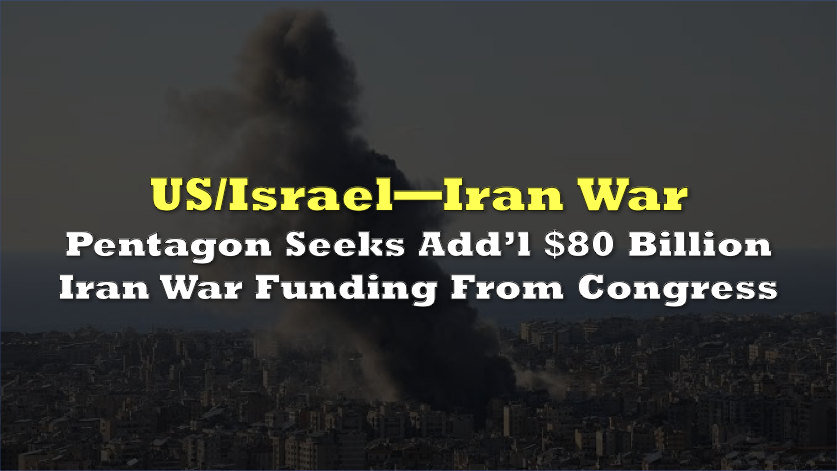

The Pentagon has told lawmakers it needs roughly $80 billion in supplemental funding, according to Wall Street Journal reporting, to help cover the US war against Iran and rebuild stocks of high-end munitions used since the conflict began earlier this year.
The request is not part of the regular defense budget. President Donald Trump is already seeking a record $1.5 trillion fiscal 2027 defense plan. Pentagon budget materials describe the proposal as the largest investment in US military capability in a generation, with more than half of the request tied to weapons, hardware, and modernization.
The Iran bill shows why that may still be insufficient. The war has created an immediate inventory problem that annual budget planning was not built to absorb. Congress is being asked to fund current operations, replace weapons already used, and keep future military plans from being hollowed out by today’s burn rate.
 Sponsored · PTX Metals Inc.
The pressure is concentrated in expensive systems that cannot be quickly replaced. Air and missile defense weapons such as Patriots, THAADs, and SM-3s are central to the reported replenishment need. So are Tomahawk cruise missiles, which have become a visible marker of how fast advanced inventories can shrink in a modern conflict.
CSIS estimates that the United States fired more than 1,000 Tomahawks during the Iran war. The think tank’s analysis says existing orders will help rebuild the inventory, but not fully restore it to prewar levels under current production assumptions. PBS, summarizing the same analysis, reported that a full Tomahawk rebuild could stretch to late 2030.
However, the running price tag of the Iran war is still unclear. AP reported that the new $80 billion figure is well above a previous $29 billion estimate associated with Hegseth.
It also creates a harder question for defense planners. If the regular budget does not fully cover wartime consumption, emergency supplementals may become the mechanism for maintaining readiness after every major operation.
 Sponsored · McLaren Resources Inc.
The White House has pushed defense companies and Pentagon buyers to move faster as missile demand rises. Earlier Reuters reporting said defense executives were expected to meet at the White House as Iran strikes reduced stockpiles. The administration has also leaned on industrial-base tools to speed weapons output.
But speed is not only a question of presidential pressure. Missile production depends on suppliers, testing capacity, skilled labor, explosives, electronics, guidance systems, and long-lead components. Some production lines were sized for peacetime ordering patterns, not sustained large-scale usage across the Middle East, Europe, and the Indo-Pacific.
That gives the supplemental request a second purpose. It would send demand signals to contractors such as RTX, Lockheed Martin, Boeing, and Northrop Grumman, depending on which systems Congress funds. But those signals turn into delivered weapons only after contracts, capacity expansions, and production schedules are in place.
AP reported that some lawmakers are skeptical of the $80 billion figure, especially because many opposed Trump’s decision to go to war with Iran. Republicans are also trying to move a massive defense package through the normal appropriations process and separate party-line funding. Democrats are expected to press for any supplemental package to include non-defense priorities as well. Disaster and agriculture aid have reportedly been discussed as possible additions to make a package easier to pass.
Hegseth has argued that military spending is tied to US economic strength. In a New York Post op-ed, he wrote that defense power supports the conditions needed for prosperity, trade, and stability. That argument gives the administration a broader justification for the money, but it does not remove the budget math.
The Iran war has exposed a gap between how the US funds defense and how quickly modern conflicts consume precision weapons. On top of the $80 billion request, the harder question is whether Congress is buying replacements for one war, or underwriting a new baseline for American military stockpiles.