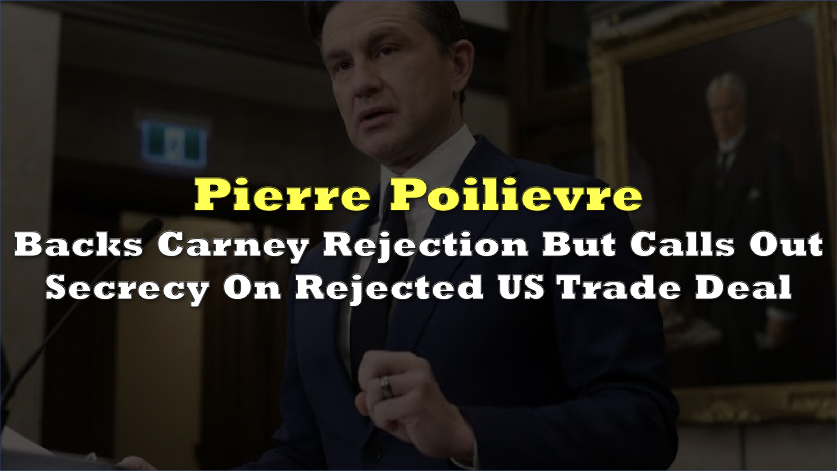

Canada’s next round of retaliatory tariffs is scheduled to begin 13 days before MPs return to the House of Commons, opening a new line of attack for Conservative Leader Pierre Poilievre even as his party supports Prime Minister Mark Carney’s decision to walk away from Washington’s proposed trade deal.
Poilievre is asking Carney to recall Parliament before its scheduled September 21 return and release the US proposal Canada rejected. In a letter sent Sunday reported by The Canadian Press, he argued that while “Canada cannot accept a bad deal” in an apparent approval of Carney’s rejection, Canadians should be able to assess the terms themselves.
“Canadians must see it to judge what options are on the table,” he wrote.
 Sponsored · Selkirk Copper Mines
The US imposed 50% tariffs Saturday on roughly $28 billion of Canadian exports. Carney said Ottawa would respond dollar for dollar, with new Canadian tariffs taking effect September 8 on sectors including steel, dairy, appliances, agricultural equipment, pulp and paper, and electronics.
The government has not yet published the complete list of targeted US products.
Carney has acknowledged the retaliation will have domestic costs, saying Saturday that the measures will “raise costs and reduce choice for Canadians.” His government has also pointed to nearly $25 billion in support provided or committed for businesses and workers affected by the trade dispute.
That creates an unusual opposition position for Poilievre. Conservatives are not arguing that Carney should have accepted the US proposal. The Canadian Press reported that Canada-US relations critic Shuvaloy Majumdar said that the party supports rejecting it but wants the government to disclose what Washington actually offered.
Only parts of those negotiations are public. Carney said the US introduced last-minute conditions that threatened Canada’s ability to independently pursue other trade relationships and sought concessions involving Canadian cultural and French-language protections. He said Canada had been prepared to remove remaining retaliatory tariffs on steel, aluminum, and autos if Washington substantially reduced its own sectoral tariffs.
READ: What Washington Really Demanded Before Canada Walked Away
The Canadian Press reported that US Trade Representative Jamieson Greer separately told The New York Times that Washington had offered tariff relief for Canadian steel and softwood lumber. The complete offer remains undisclosed.
Poilievre is also demanding estimates for how retaliation could affect grocery, gasoline, and other consumer prices, as well as details on Ottawa’s plans for steel, aluminum, lumber, and auto jobs.