

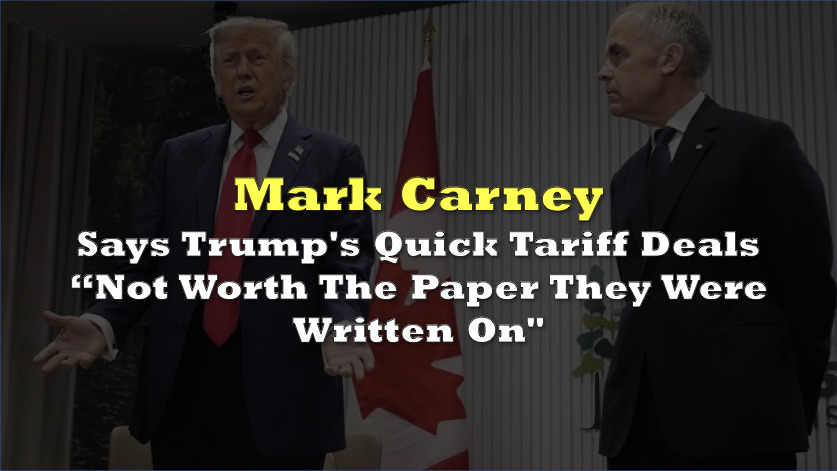

Prime Minister Mark Carney is refusing to chase a narrow US tariff-relief deal, arguing that countries that rushed to sign agreements with President Donald Trump have privately found those deals weaker than advertised.
“A lot of countries rushed into deals with the US. They weren’t really worth the paper they were written on,” Carney told CBC in an interview that aired Monday, saying foreign leaders are “certainly not” happy in private with the terms they accepted. He did not name the countries.
The remark sharpened Canada’s current trade posture: no quick agreement for optics, no “small deal that disadvantages us,” and no major concession simply to secure relief for sectors already under pressure.
 Sponsored · Altamira Gold Corp.
Carney said Canada and the US could settle the dispute quickly if Washington were ready to engage seriously.
“We could sit down this afternoon and hammer the whole thing out over the course of 10 days if the US side… had the bandwidth and the inclination to go through it,” he said. “But it takes two to negotiate it through, and they’re not all the way there.”
Canada’s leverage starts with the 2020 CUSMA, signed during Trump’s first administration. Unlike many trading partners hit by Trump’s tariff regime, most Canadian goods still enter the US tariff-free under CUSMA. Reuters reported last week that Canada’s chief US trade negotiator, Janice Charette, described the July 1 review as a “checkpoint,” not a hard deadline, while saying not all issues may be resolved by then.
That exemption matters because Canada is a major US supplier of oil, fertilizer, metals, lumber and other raw materials. Tariffs on those goods risk raising American input costs, particularly in energy, construction, farming and manufacturing.
 Sponsored · Selkirk Copper Mines
But Canada is still exposed where Trump’s sectoral tariffs hit hardest: autos, steel, aluminum and lumber.
Those sectors are not marginal. Canada’s auto industry is deeply integrated with US supply chains, with parts and finished vehicles crossing the border repeatedly. Steel and aluminum tariffs raise costs for manufacturers on both sides. Lumber duties directly affect Canadian producers while feeding into US housing costs.
The talks are now running into a second layer of conflict. US Trade Representative Jamieson Greer recently warned Canada could face “enforcement action” over Canadian provinces pulling U.S. alcohol from government-run liquor stores in retaliation for US tariffs. Bloomberg reported that Ontario and Quebec remain key holdouts, together representing about 60% of Canada’s population.
Commerce Secretary Howard Lutnick has also criticized Canadian limits on dairy imports, reviving one of Washington’s longest-running complaints against Ottawa. Carney responded by saying the US does not get to dictate the terms of the CUSMA review and that Canada has its own trade irritants to raise.
Carney’s side is also pointing to concessions already made. Canada removed its digital services tax after Trump’s request, while Ottawa has argued that US tariffs violate the 2020 trade pact. Last week, Carney called Canada “not a supplicant” and said Ottawa would not allow Washington to dictate the review process.
The larger problem is that public progress has been thin since October, when Trump terminated negotiations after Ontario aired an anti-tariff television ad quoting former US President Ronald Reagan. At that time, Carney was reportedly ready to resume talks after Trump halted them over the ad, which the Reagan Foundation said was misleading and used without permission.
The final decision, Carney said, rests with Trump. “He’s the decision-maker, full stop, on these issues and all other issues,” he told CBC.
Information for this story was found via National Post and the sources and companies mentioned. The author has no securities or affiliations related to the organizations discussed. Not a recommendation to buy or sell. Always do additional research and consult a professional before purchasing a security. The author holds no licenses.




2 Responses
It doesn’t rest with President Trump. He is the final decision maker for the USA, not Canada. Most Canadians are not stupid. We are hearing what he is offering from his side of the border, but nothing coming from Canada’s government. We are at a lost to what Canada is negotiating about. You can’t be saying tariffs are not good and it’s bad for the country but yet you are using tariffs. Remove all Canada’s tariffs and go reciprocal. Get business people to do business with him and step aside. The major problem with leaders having failure with the deals is a lack of business experience. You make a deal and you work it and make adjustments to your money management. Too much corruption in governments which is the cause of failures.
Truly wish we pursued a few strong Crown corporations like when we did PetroCan. How did we lose that? Never mind we know. Would help now supporting recent events eg: recent sovereignty fund since it now has to borrow 25 billion??