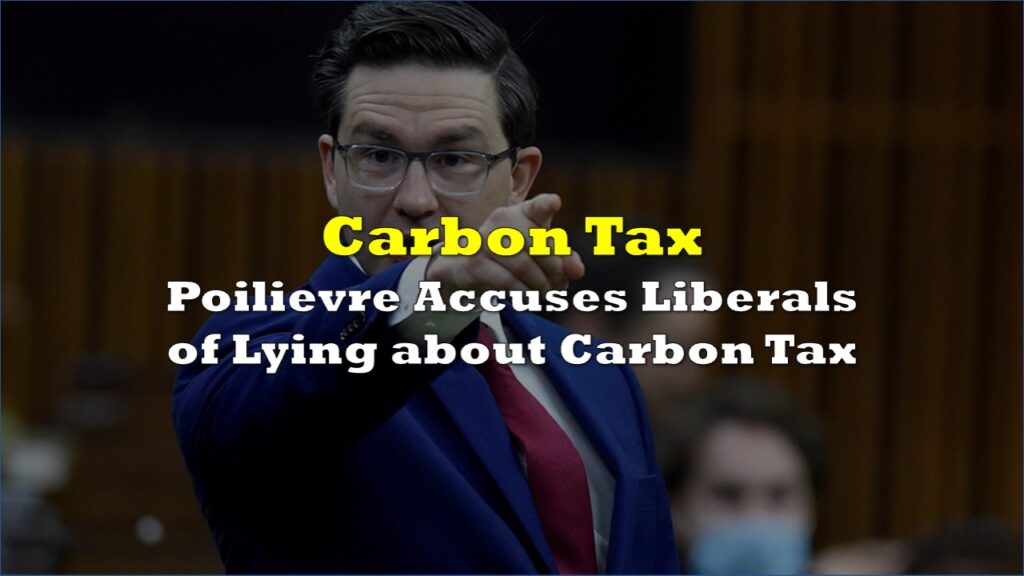

Leader of the Opposition Pierre Poilievre blasted the Liberal leadership over farm production costs, accusing Prime Minister Mark Carney’s government of making it more expensive to grow, ship, and store food.
His proposed answer was to scrap the industrial carbon tax and remove taxes from gas and groceries.
That argument begins from a real pressure point. Spring seeding forces farmers to spend before they earn, and fuel and fertilizer are among the costs that can quickly turn a planting season into a margin problem.
 Sponsored · Selkirk Copper Mines
However, the potentially weaker part is the tax shorthand. Ottawa has already ended the federal consumer fuel charge, effective April 1, 2025, while keeping the industrial carbon-pricing system for large emitters. For the Conservatives, this may mean that this will still trickle down to the farm-cost stack via indirect pass-through costs and input inflation.
In addition, Ottawa suspended the federal fuel excise tax on gasoline and diesel from April 20, 2026, to September 7, 2026. The government said the measure would cut regular gasoline costs by 10 cents per litre and diesel by 4 cents per litre.
So Poilievre is closest to the truth when he is describing farm-cost pressure. He is on weaker ground when the argument compresses different taxes, pass-through costs, and input markets into one Liberal-made affordability story.
On the Carney side, this side of the coin has the opposite problem. Western Producer’s report points to a strong single-week export print: 315,600 tonnes moved in the week ended May 3, making it the strongest week of the current crop year.
 Sponsored · Cambria Gold Mines
Liberal supporters frame this feat as an indirect result of Canada’s deal with China earlier this year to ease restrictions on Canadian canola products provided Ottawa relaxes tariffs on Chinese electric vehicles.
That number does not prove that canola farmers are broadly out of trouble. The same report put crop-year canola exports at 6.5 million tonnes, still about 1.3 million tonnes below the year-earlier pace. The gap has improved since March 1, when it stood at 1.7 million tonnes, but improvement is not the same as full recovery.
As of March 31, canola exports were down 25.1% to 5.1 million tonnes, while total canola stocks rose 27.4% to 10.0 million tonnes, as per Statistics Canada numbers. Domestic use helped absorb supply, rising 6.1% to 8.5 million tonnes, largely because of crushing demand.
The canola export improvement followed tariff relief, but that does not automatically mean the trade problem has disappeared or that farmer margins have been repaired. Tariff reductions can reopen movement. They do not instantly undo prior lost volume, weaker timing, larger stocks, or input costs already incurred.
Both sides are telling partial truths. Poilievre is right that farmers face cost pressure, but his framing blurs the tax mechanics. Carney’s defenders are right that canola exports showed a meaningful weekly rebound, but they are stretching one export signal into a broader proof of success.
In reality, Canada’s farm economy is carrying two realities at once: producers are still managing a cost squeeze, and canola exports are recovering from a trade shock that has not fully washed out of the numbers.
Information for this story was found via the sources and companies mentioned. The author has no securities or affiliations related to the organizations discussed. Not a recommendation to buy or sell. Always do additional research and consult a professional before purchasing a security. The author holds no licenses.