
Rackla Metals (TSXV: RAK) has released assays from the first four diamond drill holes of its 2026 program at the Lentung tungsten project in the Northwest Territories. Each hole returned broad, near surface tungsten intervals that line up with drilling Union Carbide completed more than 40 years ago.
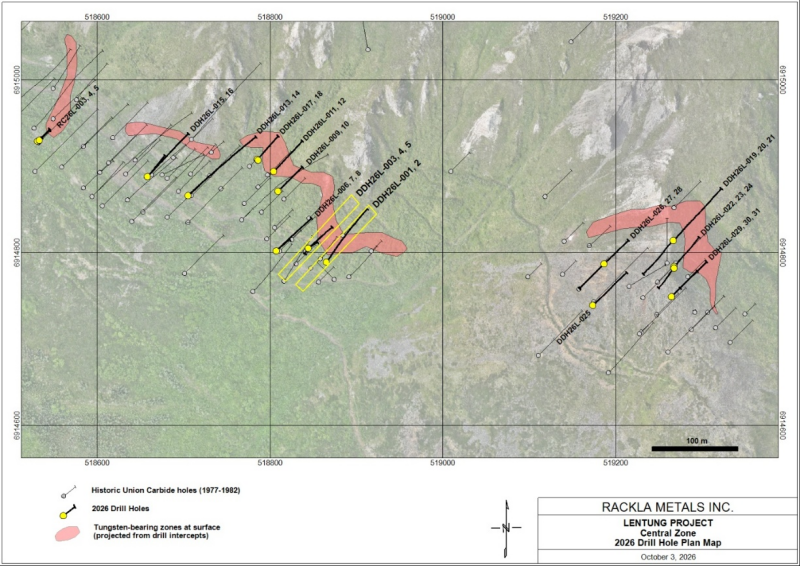
All four holes targeted the Central Zone and hit mineralization where the historical data predicted. Highlight results include:
- DDH26L-001: 1.72% tungsten trioxide and 0.14% copper over 20.35 metres from a depth of 11 metres
- DDH26L-002: 2.28% tungsten trioxide and 0.09% copper over 17.95 metres from a depth of 32 metres
- DDH26L-003: 1.67% tungsten trioxide and 0.06% copper over 17.90 metres from a depth of 23 metres
- DDH26L-004: 0.90% tungsten trioxide and 0.02% copper over 20.50 metres from a depth of 37 metres
The results matter because of what Rackla is trying to prove. Union Carbide drilled 26,900 metres at Lentung between 1977 and 1982 and outlined a historical resource that does not comply with National Instrument 43-101. Rackla wants to verify that dataset and fold it into a modern Mineral Resource estimate.
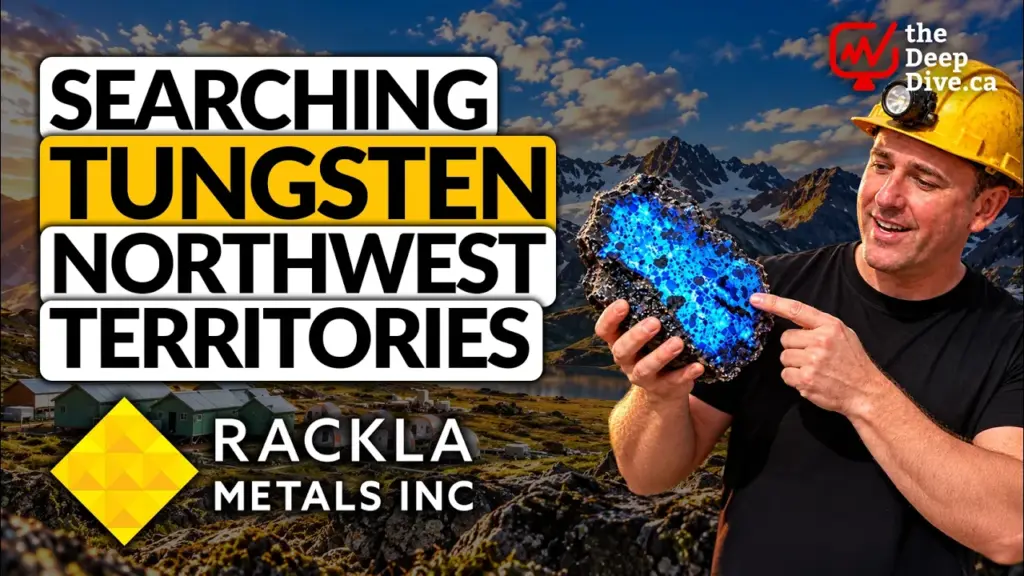
“We understand from the historic drilling that was done by Union Carbide, we’re trying to repeat that drilling and confirm the resource that they had, and we’re off to an excellent start,” Chief Executive Simon Ridgway said in an interview with Mining.com.au. “With a blue light we can see the tungsten in the core. So when we started putting the first hole in, we could see that we’re hitting the zone right where they predicted it should be.”
Scheelite, the main tungsten mineral at Lentung, fluoresces under short wave ultraviolet light, which gives the crew a read on mineralization before assays come back. Rackla said several intercepts ran past the limits Union Carbide drew using its 0.6% tungsten trioxide cut-off. The zone outcrops at surface and dips shallowly with the hillside, and the Central Zone has been tested over about 600 metres of strike so far.
Ridgway said the crew is cutting broad tungsten intervals in nearly every hole based on what the core shows under ultraviolet light.
“Hopefully the grades keep [being] in this 1 to 2% range, which, for an open pit prospect, is excellent,” he said.
The company’s release makes a bolder claim, saying Lentung hosts grades more typical of underground tungsten mines. That comparison will need a compliant resource and economic work to back it up.
Rackla is also looking beyond the historical footprint. Ridgway said geophysical surveys completed this season outlined new targets for 2027.
“It looks like it’s one large batholith, and not so much a series of intrusive bodies, which really has got the geologists very excited,” he said. “We’re seeing a lot of strong mag anomalies.”
He noted that the anomalies come from pyrrhotite, which accompanies scheelite but not in every case. So far, he said, drilling has found the two together about 95% of the time.
Not everything worked this season. Rackla tried reverse circulation drilling as a cheaper infill method, but groundwater inflows across 5 holes raised sample quality concerns, and the rig was demobilized. Diamond drilling held up well in the same ground.
Rackla expects to report assays from the rest of the program, along with results from re-sampled historical core, over the next 2 to 3 months. Ridgway said he expects to release results about every 1 to 2 weeks.
“We’ve been looking at this property for the last year deciding where to drill first, and obviously we picked the right spot,” he said. “We’ve got a lot of good results and we have a lot more coming.”
Rackla Metals last traded at $0.285 on the TSX Venture.