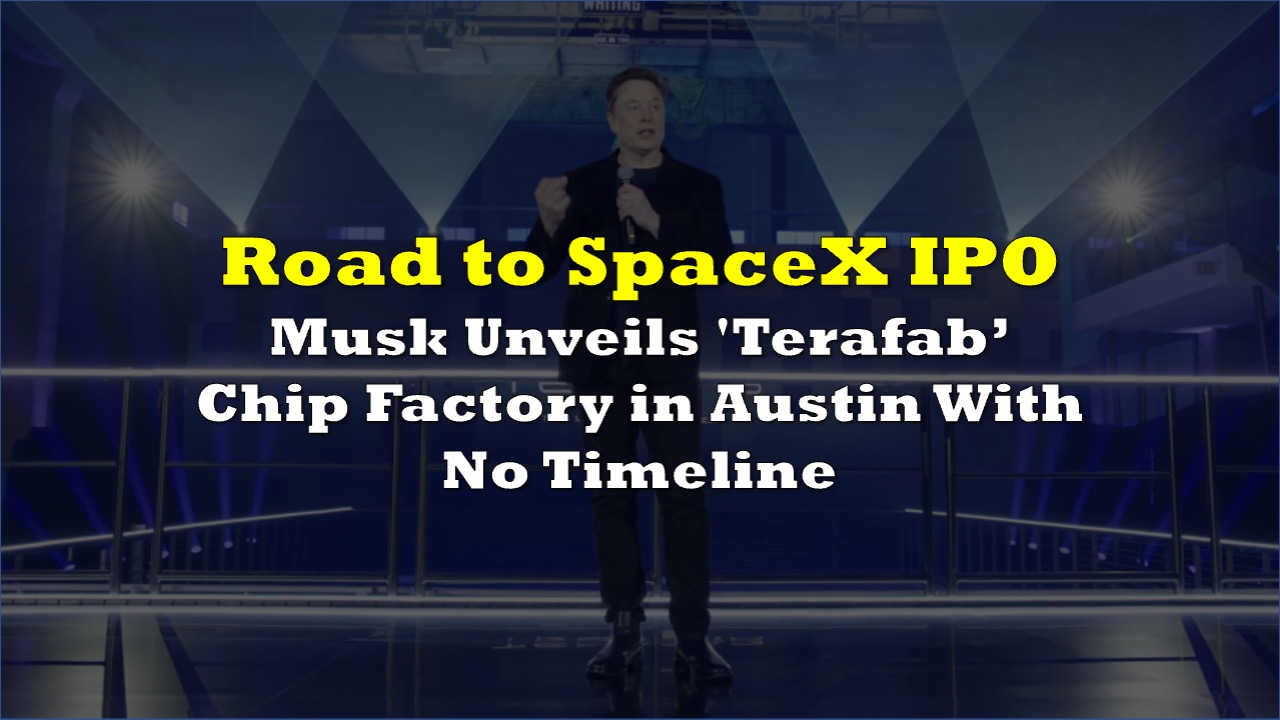

Elon Musk announced plans on March 21 for what he calls the largest chip manufacturing facility ever built, unveiling “Terafab” — a joint venture between Tesla, SpaceX, and xAI — at a light-drenched event at the Seaholm Historic Power Plant in downtown Austin.
Texas Governor Greg Abbott sat in the audience. Musk gave no construction timeline.
Terafab targets one terawatt of AI computing output per year, roughly 50 times current global production. The facility will rise on the north campus of Giga Texas, adjacent to Tesla’s existing Austin manufacturing base, bringing chip design, fabrication, and memory production under a single roof in Austin.
Musk estimates the project will cost between $20 billion and $25 billion. Tesla’s CFO confirmed at the event that the figure does not yet appear in Tesla’s 2026 capital expenditure plan, which already exceeds $20 billion.
“We either build the Terafab or we don’t have the chips, and we need the chips, so we build the Terafab,” Musk said.
The facility will produce two chip families: a terrestrial inference chip powering Tesla’s Full Self-Driving system, its Cybercab robotaxi program, and its Optimus humanoid robots; and the D3, a radiation-hardened processor built for space. Musk said 80% of the facility’s compute output will flow toward space applications. Tesla targets small-batch production of its fifth-generation AI chip, AI5, for late 2026, with volume production in 2027.
The announcement lands as SpaceX — which absorbed xAI in an all-stock deal in February — prepares for what would rank among the largest initial public offerings in US history.
Read: Musk Folds xAI Into SpaceX In A $1.25T Deal Ahead Of IPO Push
Bloomberg reports the company is targeting a valuation of approximately $1.5 trillion and aims to raise more than $30 billion, with a listing possibly arriving as early as June 2026.
Musk has confirmed those reports as “accurate.” Terafab’s promise of orbital data center chips and a space compute constellation hands SpaceX a compelling infrastructure narrative heading into that roadshow.
Musk has no background in semiconductor manufacturing, a field that TSMC and Samsung have each spent decades and hundreds of billions of dollars building. The billionaire is also notorious for announcing ambitious targets he later misses.
That pattern stretches back years. In 2016, Musk predicted Tesla vehicles would achieve full self-driving capability within two years — a milestone Tesla has yet to hit.
Related: Federal Probe Opens Into Tesla’s Full Self-Driving Technology
In 2019, he promised operational robotaxis by 2020; a limited Austin service launched in June 2025, still requiring safety drivers.
Read: Tesla Executives Knew Robotaxi Claims Were Overstated, Documents Show
Tesla unveiled the Cybertruck that same year with a targeted 2021 production date and did not ship until late 2023. Neuralink’s human trials, which Musk promised for 2020, did not begin until 2024. Also, remember Optimus, the humanoid robot?
SpaceX has separately asked the Federal Communications Commission for authorization to launch up to one million satellites into low Earth orbit as part of an orbital data center network. Musk frames Terafab as the chip supply chain for that constellation.
“The current output of AI compute is roughly 20 gigawatts per year,” Musk said at the launch event. “All of the rest of the output from Earth is about 2% of what we need.”
Governor Abbott, posting on X after the event, called it “an extraordinary event” and said Musk’s vision for Texas was “powerful.”
Information for this story was found via the sources and companies mentioned. The author has no securities or affiliations related to the organizations discussed. Not a recommendation to buy or sell. Always do additional research and consult a professional before purchasing a security. The author holds no licenses.