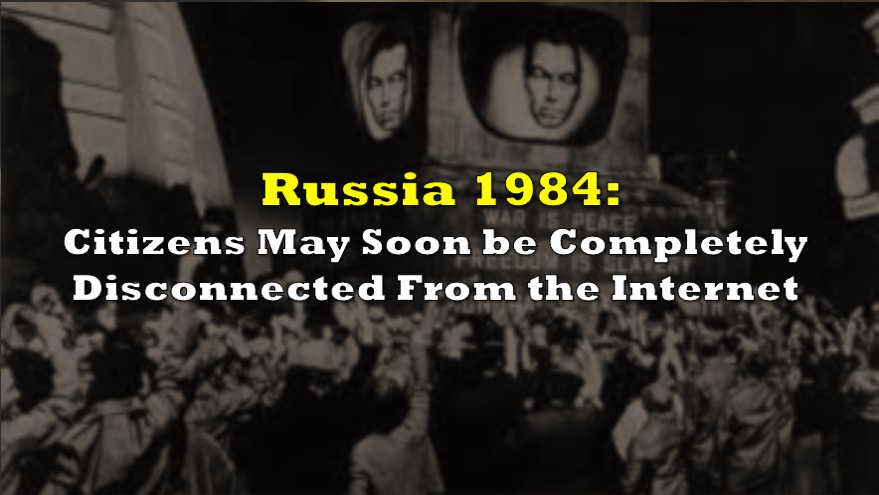

With major Western communications and technology companies withdrawing their services from Russia – and subsequent censorship of independent media by Moscow – the country’s citizens may soon face a bleak future ahead: one that does not involve a global connection to the internet.
Last week, Russia’s media regulator blocked access to a number of western social media and news websites including Facebook and Twitter, as well as Russian-speaking versions of RadioFreeEurope, the BBC, and Deutsche Welle. The move was a tit-for-tat response to the West’s crackdown on alleged Russian propaganda, by diminishing access to state-funded RT News and Sputnik.
By Friday, Moscow really turned up the crackdown on Western information, and enacted a new “fake news” law that can imprison anyone for 15 years if they spread false information about Russia’s military operation in Ukraine. So, without dedicating an extra second to hesitation, a cascade of tech companies and news sites axed their services in Russia, because you can’t jail us if we quit!
However, amidst all of that is a much larger, more inherent problem: with Russia and the West going head-to-head with the fight against alleged disinformation, ordinary Russian citizens may soon find themselves cut off from internet access altogether. Indeed, a new, dystopian iron curtain is being assembled, as pro-western social media services sever ties with Russian clients, while Moscow moves to isolate the country from outside opinions.
 Sponsored · Cambria Gold Mines
Joining the list of Russia boycotts is US telecom company Cogent Communications, which on Friday said it will cut internet service to its Russian customers. “It was a tough decision,” said CEO David Schaeffer, defending the move because he didn’t want the company’s services to be used for “outbound cyber attacks or disinformation.” Washington-based Cogent is part of a broader network that facilitates the flow of data through the internet, and is the second-biggest operator in Russia.

Ukraine, for its part, has been urging other US internet companies to follow suit and also cut ties with Russia, in an effort to expel maximum pressure on Moscow. But, Kyiv’s belief that by cutting President Vladimir Putin’s access to western communication technology will somehow stop the spread of pro-Russian propaganda and inadvertently halt the offensive in Ukraine may be flawed.
Long before Russia launched its military attack on Ukraine, Moscow was already experimenting a scenario in which the country becomes completely independent from the global internet. Back in November 2019, Putin signed a controversial “sovereign internet” law that, in the event of a foreign cyber attack, Moscow could reroute web traffic through state-controlled infrastructure, establish a domestic system of domain names, and essentially run internet independent of the World Wide Web.
The theory was put to practice in July 2021, when Russia temporarily disconnected itself from the global internet using all of the country’s telecom firms. “The purpose of the tests is to determine the ability of the ‘Runet’ to work in case of external distortions, blocks and other threats,” said an individual familiar with the matter, as cited by the RBC Daily at the time.
Now, it appears that the Kremlin is revisiting the theory, and is allegedly preparing to slash its connection to the World Wide Web as early as March 11, according to government documents obtained by decentralized hacktivist Anonymous. “Russia is preparing to disconnect from the global internet, limiting access to information for the Russian people,” the group warned in a twitter post.
But, with all of those events in mind, the internet censorship from both the West and inside of Russia is increasingly beginning to look like an apocalyptic iron curtain once again. Ordinary Russians will soon find it significantly more difficult to observe an independent take on the crisis unfolding in Ukraine— and across the rest of the world, for that matter. In a broader sense, the tit-for-tat suppression measures will bring the country one step closer to the day where social and news networks will display a largely inwardly-skewed reality, and a weakened — if not completely severed — connection to the outside world.
Welcome to 1984?
Information for this briefing was found via the sources mentioned. The author has no securities or affiliations related to this organization. Not a recommendation to buy or sell. Always do additional research and consult a professional before purchasing a security. The author holds no licenses.