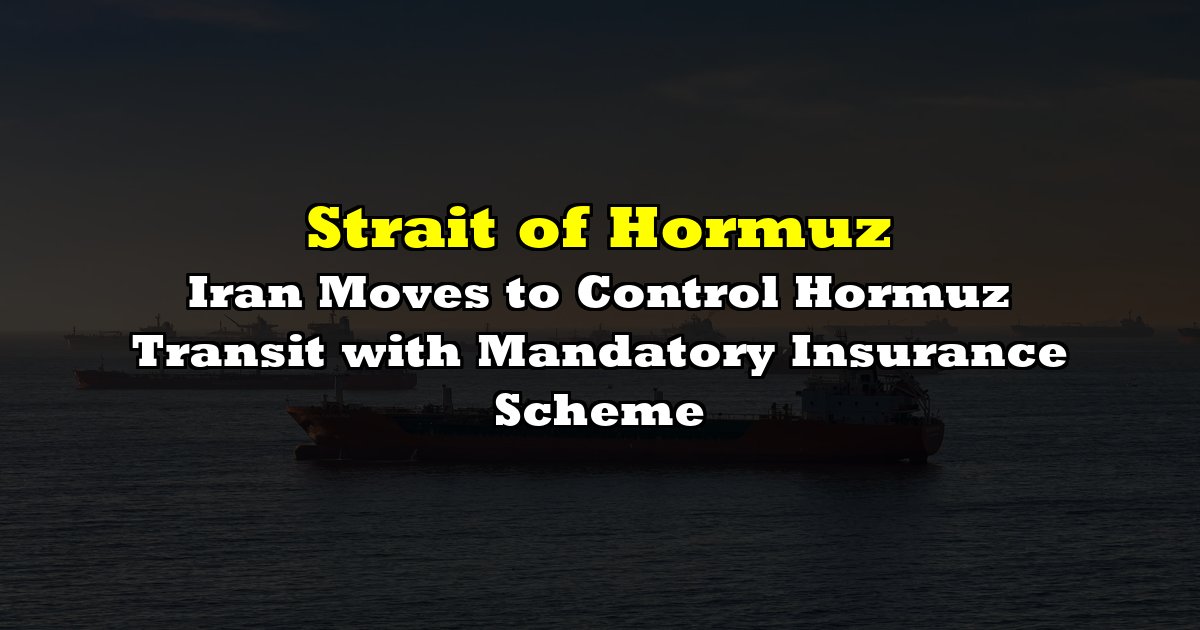

Iran’s newly created Persian Gulf Strait Authority has imposed mandatory insurance requirements on all vessels transiting the Strait of Hormuz, demanding that ships carry a coverage policy approved by Tehran before receiving a passage permit.
The insurance carries no charge during an initial 60-day window, but Tehran has explicitly reserved the right to introduce fees once that period expires, alarming shipowners, Gulf states, and the International Maritime Organization.
Transit applications must be submitted at least 48 hours before a vessel reaches the strait, and no ship may pass without a valid PGSA-issued permit. The authority has declared itself the sole body authorized to process those applications.
The rules create immediate friction with a recently signed US-Iran Memorandum of Understanding that guarantees “safe passage of commercial vessels with no charge” for 60 days, with Iran and Oman tasked with negotiating a longer-term framework. The insurance requirement is technically cost-free within that window, but the explicit threat of future fees has drawn swift pushback.
 Sponsored · Cambria Gold Mines
International Maritime Organization secretary-general Arsenio Dominguez, who confirmed receipt of the PGSA document, has warned that any move to normalize such charges could undermine transit norms at critical chokepoints across the globe, from the Bosphorus to the Malacca Strait.
Iran is also insisting that vessels use a northern channel near Larak Island, barring use of the southern corridor near the Omani coast that the US Navy has been helping protect.
“Any deviation from or use of alternative routes is strictly prohibited and will be treated as a violation,” the PGSA document states, with non-compliance potentially triggering permit revocation and further legal action.
Early reactions from tanker owners suggest the new framework has little credibility with the vessels currently operating in the region. On Friday, reports emerged of warning shots fired near the strait, which later ceased, leaving vessels unanswered when they queried via radio whether the passage was open. The incidents briefly raised doubts about whether the recently signed MOU was already unraveling.
Information for this story was found via the sources and companies mentioned. The author has no securities or affiliations related to the organizations discussed. Not a recommendation to buy or sell. Always do additional research and consult a professional before purchasing a security. The author holds no licenses.