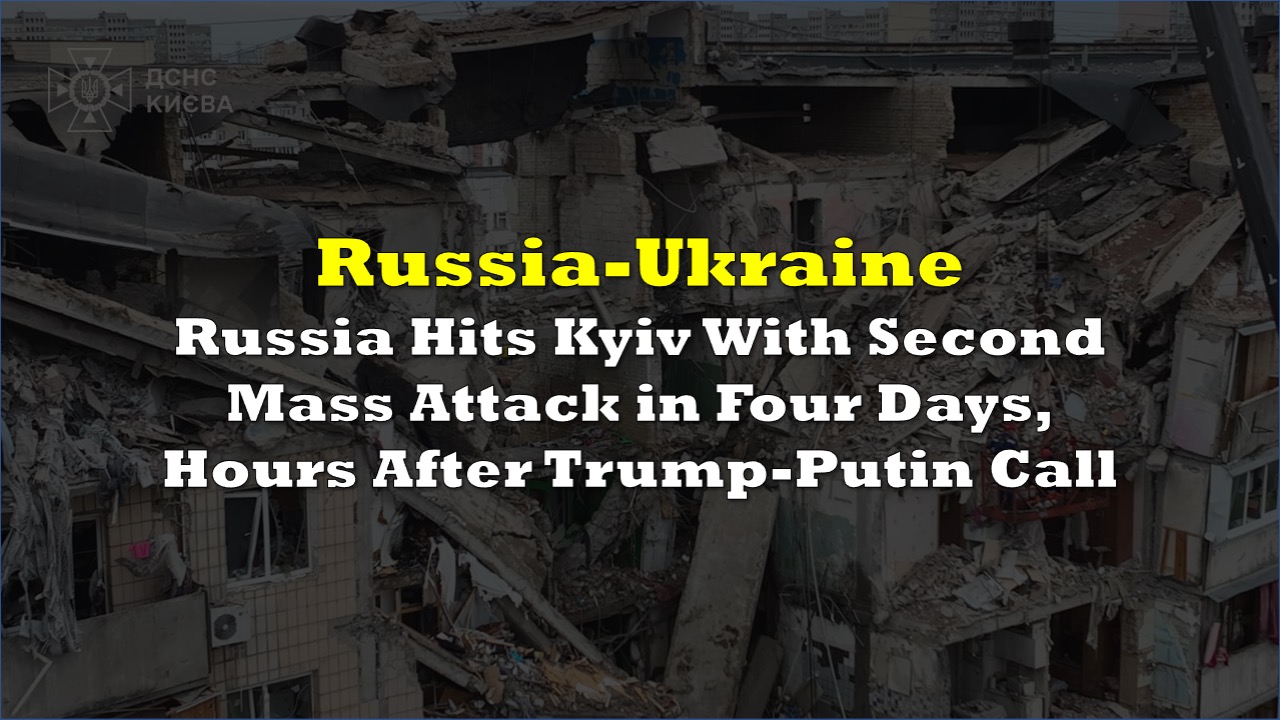

Russia launched a second large-scale missile and drone barrage against Kyiv early Monday, killing at least 14 people in the city and three more in the surrounding region, with dozens wounded, according to city officials cited by CNN, just days after a deadlier assault on the capital left 30 dead.
Several residential buildings were struck, including a building in the Podilskyi district where a missile destroyed the top floors, and more than 600 residents were evacuated from the nearby town of Vyshneve over fears of a secondary detonation.
The attack came less than 48 hours after President Trump held a nearly 90-minute phone call with Russian President Vladimir Putin on July 4, during which Trump again offered to help end the war, according to Kremlin aide Yuri Ushakov, who described the call as “businesslike and quite constructive.” Ushakov said Putin used the call to brief Trump on the battlefield situation and accused Kyiv and its European allies of “terrorism against civilians,” a claim Russia has used to justify its own strikes on Ukrainian cities.
Monday’s assault also came hours after Zelenskyy had already warned of an incoming large-scale strike, part of a pattern in which Ukrainian officials have increasingly been able to anticipate major bombardments hours in advance. The strikes also reached beyond the capital, injuring 15 more in the surrounding Kyiv region, while the Black Sea port of Odesa was hit as well. Poland briefly scrambled fighter jets as a precaution.
Just four days before, Moscow launched its deadliest attack on Kyiv so far this year, when Russian missiles and drones killed at least 30 people and damaged more than 130 residential buildings across the city, according to Zelenskyy.
 Sponsored · Selkirk Copper Mines
Read: Russia Hits Kyiv With Overnight Missile and Drone Barrage, Residential Building Collapses
A single missile destroyed 64 apartments in a nine-story building, leaving a gaping hole across six floors. Russia’s Defense Ministry described that strike as retaliation for Ukrainian attacks on oil refineries and energy infrastructure, a claim undercut by the extensive damage to civilian residential areas rather than military-industrial sites.
Ukraine’s Air Force said it downed the large majority of the missiles and drones fired in Thursday’s attack, but Defense Minister Mykhailo Fedorov said Russia is leaning more heavily on ballistic missiles specifically because Ukraine faces a shortage of Patriot interceptors capable of stopping them.
Newer weapons in Russia’s arsenal, including jet-powered Geran-4 drones capable of speeds up to 500 kilometers per hour, are also complicating Ukraine’s ability to intercept incoming strikes.
The renewed bombardment comes just ahead of a NATO summit in Turkey on July 7 and 8, where Trump is expected to meet Zelenskyy in person after also speaking with him by phone on July 4.
Ukraine has continued striking back at Russian energy infrastructure in the meantime, hitting an oil refinery in Russia’s Nizhny Novgorod region, a railway bridge in occupied Luhansk, and an oil terminal near St. Petersburg, part of what Zelenskyy has described as a sustained 40-day campaign targeting Russian refineries amid the country’s fuel shortages.