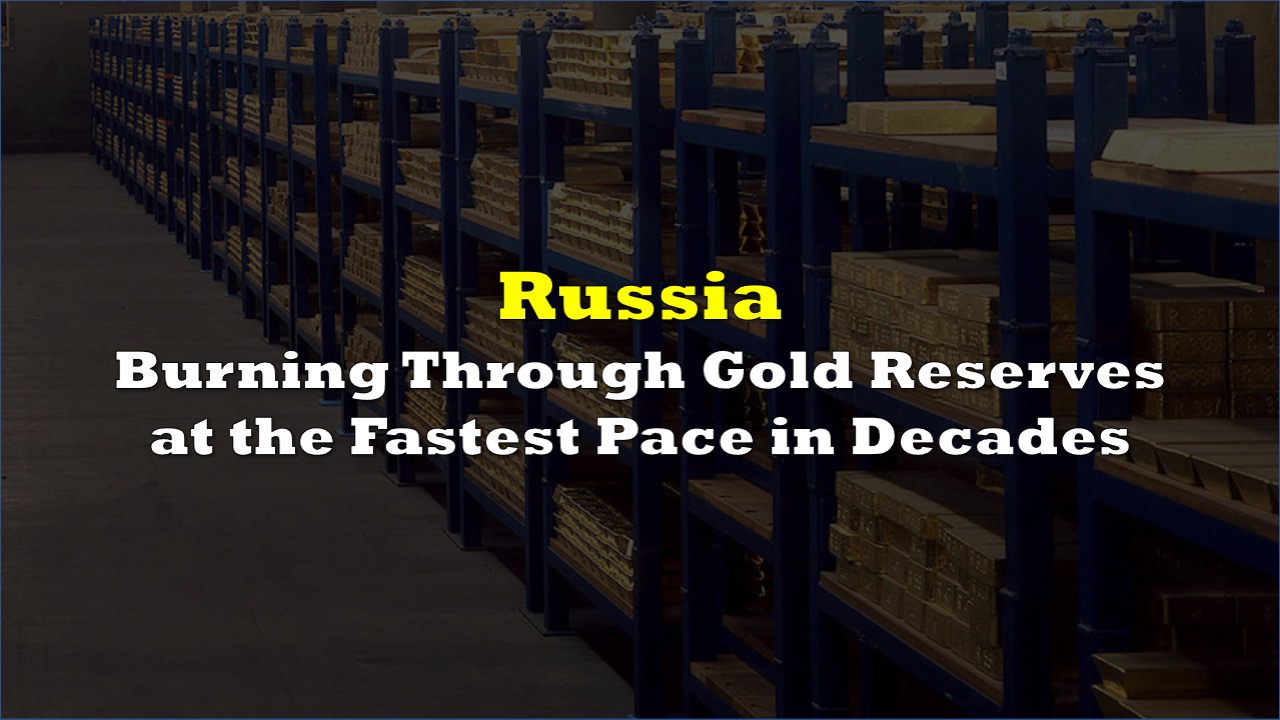

Russia’s central bank sold roughly 44 metric tonnes of gold in the first half of 2026, its steepest six-month drawdown in at least 25 years, as Moscow scrambles to plug a widening hole in its war-strained budget.
Central Bank of Russia data put reserves at 2,283 tonnes as of July 1, a level the country hasn’t sat below since early 2020, marking six straight months of decline. Freedom Global analyst Vladimir Chernov said Russian banks likely bought most of the metal through the exchange and over-the-counter markets, since sanctions have cut the central bank off from foreign gold markets entirely.
Total official reserve assets fell to $720.4 billion by the end of June, down from $747.4 billion in May, while foreign currency reserves stayed roughly flat. By comparison, Russia’s biggest prior monthly sale on record, in 2002, moved 41.5 tonnes in a single month, a scale this year’s pace has now matched over just six months.
 Sponsored · Cambria Gold Mines
The pressure traces back to a sharp fall in energy income. The average price of Urals crude dropped to around $39 a barrel in December, well below the $59 the 2026 budget assumed, and Alfa Bank chief economist Natalia Orlova tied the widening discount on Russian crude directly to that shortfall.
Oil and gas revenue for 2025 came in at $108.4 billion, the weakest showing since 2020 and roughly $32.3 billion under the Finance Ministry’s original projections. Gazprombank estimates put the resulting 2025 budget deficit at around $77.4 billion, though the ministry hadn’t published final figures as of that report.
Russia’s separate National Welfare Fund, the rainy-day account built up from years of oil windfalls, tells a similar story with its own numbers. The fund held $113.5 billion in liquid assets before the 2022 invasion, including 405.7 metric tons of gold.
As of July 1, the fund’s gold holdings had fallen to 141.1 tonnes and its liquid assets to $46.4 billion, according to Finance Ministry data reported by TASS, meaning the government has sold off roughly two-thirds of the fund’s original gold stockpile since the invasion. To manage the shortfall, the Finance Ministry began selling yuan and gold from the fund at 12.8 billion rubles a day in mid-January, a faster daily pace than even the peak of the Covid-era selloff.
Russia still holds one of the largest sovereign gold stockpiles in the world, worth an estimated $299 billion at current prices, so it isn’t close to running out. But economists don’t expect the pressure to ease soon.
Related: Ukrainian Drone Strikes on Black Sea Tankers Threaten Europe’s Kazakh Oil Lifeline
Dmitry Polevoy estimated 2026’s revenue shortfall could run $14.2 to $18.1 billion beyond what the Finance Ministry has budgeted for, while analysts at MMI put the gap as high as $32.3 to $38.7 billion, a figure large enough to drain most of what’s left in the fund’s liquid reserves. The government is targeting a reduced deficit equal to 1.6% of GDP this year, but Polevoy thinks the real number will be closer to 2.6% or 2.7%.