
Samsung Electronics crossed the $1 trillion market-capitalization mark on Wednesday, becoming only the second Asian company after Taiwan Semiconductor Manufacturing Co. to reach the threshold as investors piled into AI-linked semiconductor stocks.
Reuters reported Samsung’s market value hit about 1,500 trillion won, or roughly $1.03 trillion, in early Seoul trading, while Korea JoongAng Daily reported a later value of about 1.54 quadrillion won, or $1.06 trillion, as the rally extended.
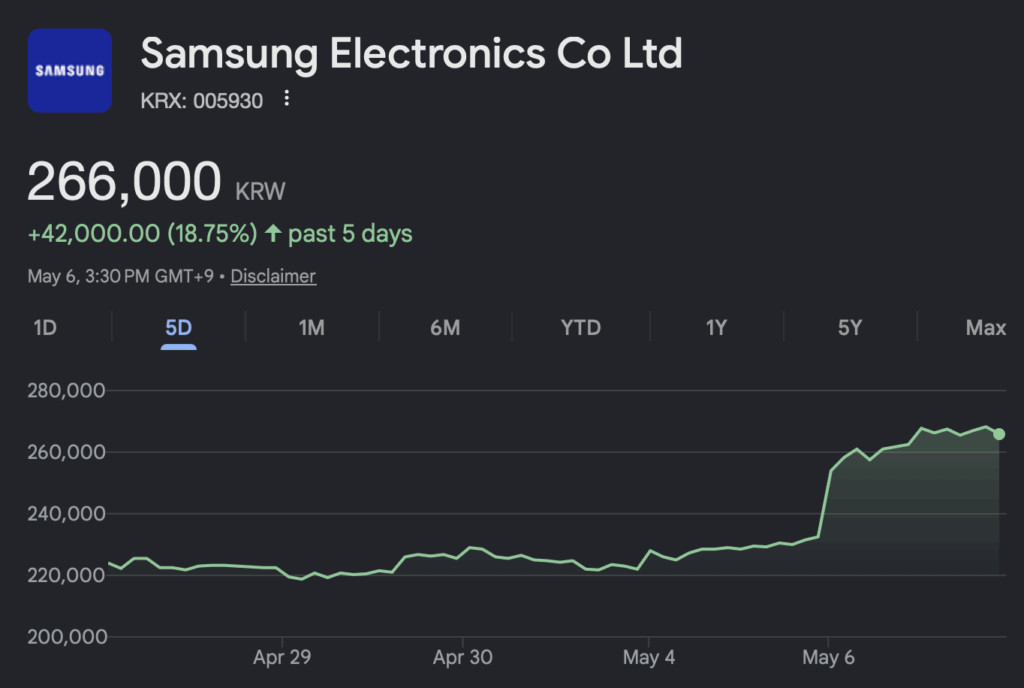
The milestone puts Samsung in rare company, but not as the first Asian firm to cross $1 trillion. Reuters and the Wall Street Journal both identify TSMC as the first Asian company to reach the level, making Samsung the second.
 Sponsored · Selkirk Copper Mines
Korea JoongAng Daily reported Samsung became one of 13 companies worldwide to hold such a valuation and climbed to 11th place globally by market value, overtaking Berkshire Hathaway and Walmart.
AI boom
The rally was tied directly to the AI hardware trade as it followed a surge in US AI-related stocks, while demand for Samsung’s memory chips drove the valuation jump.
Samsung’s latest earnings added fuel to the rerating. The firm’s Q1 2026 operating profit reached a record 57.2 trillion won, with the chip division contributing 53.7 trillion won, or 94% of total operating profit.
Reuters reported smartphone profit fell 35% and display profit dropped 20%, with higher component costs pressuring both divisions. That makes the $1 trillion valuation a concentrated bet on memory pricing, AI data-center demand, and Samsung’s ability to keep monetizing tight chip supply.
Samsung has also warned that chip shortages could worsen by 2027 as demand rises and production-expansion capacity remains limited. Reuters said the company has signed multi-year supply contracts and increased capital expenditure plans, particularly around high-bandwidth memory chips, where Samsung is trying to compete more directly with SK Hynix.
The Kospi topped 7,000 for the first time on May 6 and closed at 7,384.56. Samsung and SK Hynix, which rose 10.6%, now account for 44% of the index’s total value, turning South Korea’s benchmark into an even more explicit AI semiconductor proxy.
Reuters reported foreign investors bought a record 3.1 trillion won, or $2.13 billion, of Korean shares, while the won strengthened by as much as 1.7% against the dollar. US chip momentum also helped, with AMD shares rising 12% on strong data-center chip forecasts.
Information for this story was found via the sources and companies mentioned. The author has no securities or affiliations related to the organizations discussed. Not a recommendation to buy or sell. Always do additional research and consult a professional before purchasing a security. The author holds no licenses