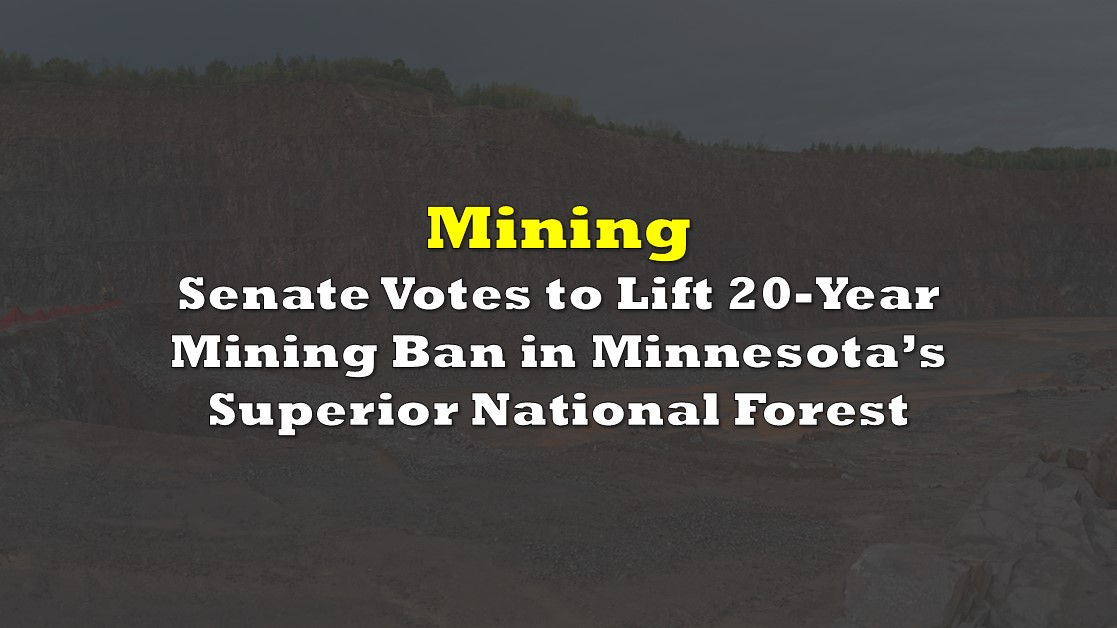

The U.S. Senate voted 50-49 on April 16, to overturn a 20-year mining ban imposed by the Biden administration on 225,504 acres of Minnesota’s Superior National Forest, sending the resolution to President Donald Trump for his expected signature. This decision paves the way for Twin Metals, a subsidiary of Chile-based Antofagasta, to pursue copper, nickel, and other precious metal extraction near the Boundary Waters Canoe Area Wilderness.
The resolution, initially passed by the House on January 21, 2026, leverages the Congressional Review Act to reverse the 2023 ban, which aimed to protect the watershed and pristine wilderness stretching 240 kilometers along Minnesota’s border with Canada, about 160 kilometers southwest of Thunder Bay, Ontario.
Rep. Pete Stauber (R-Minn.), who sponsored the legislation, hailed the Senate’s decision as a victory for Minnesota’s 8th Congressional District, declaring on X, “Mining is our past, our present, and our future – and the future looks bright!”
 Sponsored · Selkirk Copper Mines
Twin Metals, which has sought to develop the site for decades, views the vote as a pivotal step. “The Twin Metals team looks forward to a robust discussion and engagement with our communities through any future regulatory processes,” said Kathy Graul, a company spokeswoman. The project, targeting the mineral-rich Duluth Complex, promises hundreds of union jobs, over 1,000 spinoff positions, and tax revenue for struggling northeastern Minnesota communities, according to a 2019 operational plan.
Opposition remains fierce. Conservationists warn that mining could devastate one of America’s last untouched wild areas, known for its crystalline lakes and vast pine forests. Minnesota Senators Amy Klobuchar and Tina Smith condemned the move, with Smith stating, “You can support mining, but that does not mean you support every mine in every place.”
Environmental groups like the Sierra Club and Save the Boundary Waters echoed these concerns, labeling the decision a dangerous precedent for public lands nationwide. Athan Manuel, director of the Sierra Club’s land protection program, argued that the Boundary Waters should remain a haven for recreation, not exploitation.
If signed into law, the resolution will allow the Trump administration to reissue mining leases to Twin Metals, following a 2017 legal opinion reinstatement last fall and Minnesota regulators’ approval of exploratory plans in December 2025. Any mining activity will still require environmental reviews and permits.
The project’s next steps hinge on federal oversight, with Twin Metals’ ongoing appeal of a 2023 lawsuit dismissal adding legal complexity. For now, the Senate’s narrow vote marks a tangible shift, aligning with Trump’s push to boost domestic mineral production since declaring an energy emergency in January 2025.
Information for this story was found via the sources and companies mentioned. The author has no securities or affiliations related to the organizations discussed. Not a recommendation to buy or sell. Always do additional research and consult a professional before purchasing a security. The author holds no licenses.