

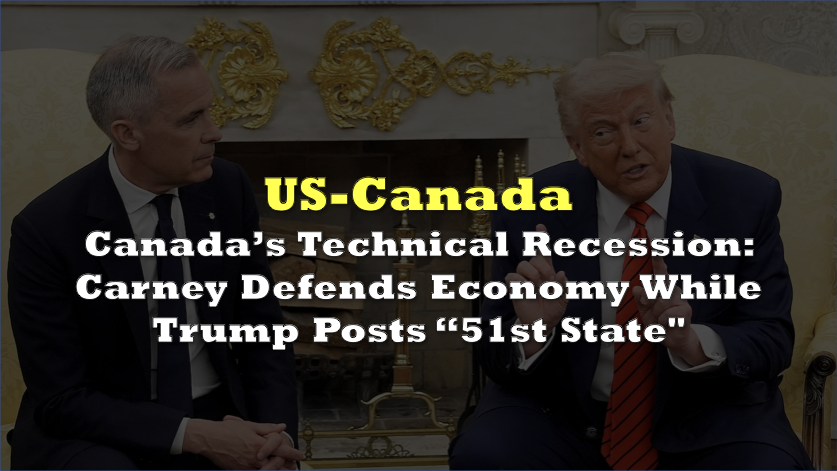

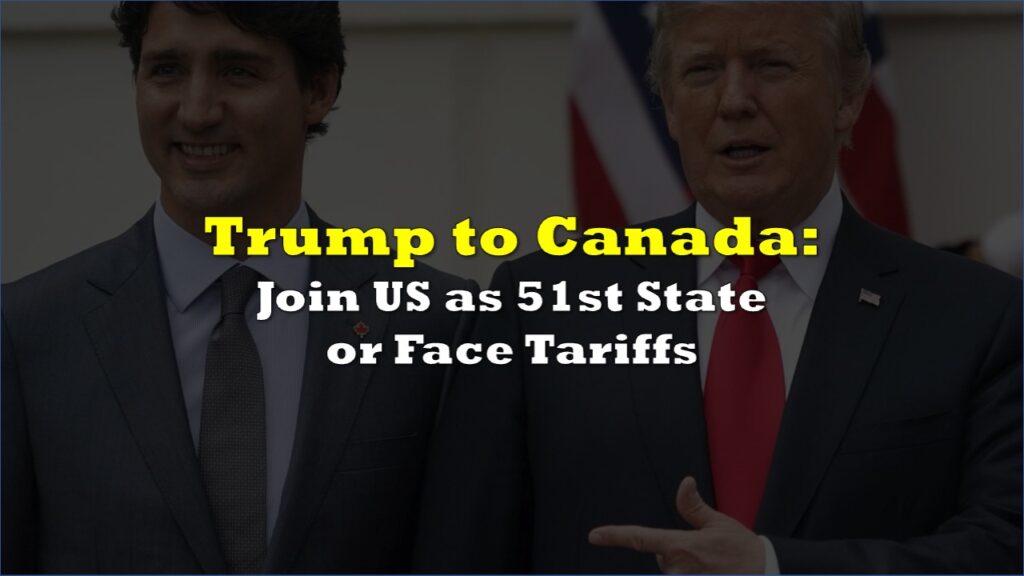
President Donald Trump revived his “51st State!” taunt after Bloomberg framed Canada’s latest GDP data as the country’s first technical recession since 2020. The one-line post turned a narrow statistical argument into a sovereignty fight, giving Washington’s loudest annexation rhetoric a fresh economic hook.
Canada’s economy is weak, but not weak in a way that produces a clean political script. Reuters reported that GDP fell at an annualized 0.1% pace in the first quarter after a revised 1.0% decline in the fourth quarter, enough to trigger the two-quarter shorthand for a technical recession.
On a non-annualized basis, GDP was flat in Q1 after a 0.2% decline in Q4. That split is exactly why the label is politically useful and economically messy.
 Sponsored · Cambria Gold Mines
READ: Is Canada In Recession?
Speaking in Ottawa on Tuesday, Prime Minister Mark Carney acknowledged softness in the economy but framed it as part of a transition. Reuters reported that Carney attributed some of the drag to deliberate federal choices, including reining in immigration and government spending.
CTV News reported that Carney avoided the word “recession” when asked directly about the economy. Instead, he said his government was laying the foundations for a “stronger, more resilient, more independent Canadian economy,” citing major investments, changes to federal operations, major projects, and new trade agreements.
Trump’s post attacks the same political promise from the opposite direction. While Carney is trying to sell short-term unevenness as the cost of independence, Trump is using the recession headline to imply vulnerability.
 Sponsored · McLaren Resources Inc.
The Bank of Canada’s position narrows the gap between those narratives. Senior Deputy Governor Carolyn Rogers told a parliamentary committee that the GDP data met one recession definition, but she warned against treating a single indicator as the whole diagnosis. Reuters reported that Rogers also pointed to an advance estimate showing a likely 0.4% GDP rebound in April.
The domestic political reaction moved fast. Conservative Leader Pierre Poilievre pushed for an emergency debate on the economy after the technical recession report, according to Global News, but it was denied by the Speaker of the House on Monday afternoon.
Ontario Premier Doug Ford answered Trump more directly. In a post sharing the Trump-linked screenshot, Ford wrote that Canada “will never be the 51st state” and is “not for sale.” He also argued that Ontario’s April labor market was far stronger than the U.S. on a population-adjusted basis.
Ford’s job numbers gave him a counterpunch. Statistics Canada said Ontario employment rose by roughly 42,000 in April, even as national employment fell 18,000 and Canada’s unemployment rate rose to 6.9%. The US added 115,000 nonfarm jobs in April, according to the Bureau of Labor Statistics, making Ford’s 680% comparison dependent on his population-adjusted calculation.
For Carney, the risk is that “technical recession” becomes shorthand for policy failure before April and May data can clarify whether Q1 was a trough or the start of something broader. For Trump, the point is simpler: a negative headline can be turned into a geopolitical insult in five words or fewer.
The official recession threshold in Canada is broader than the two-quarter shortcut. The C.D. Howe Institute’s Business Cycle Council looks for a downturn that is pronounced, persistent, and pervasive, not merely a second negative annualized GDP reading. No current official recession declaration was found.
Information for this story was found via the sources and companies mentioned. The author has no securities or affiliations related to the organizations discussed. Not a recommendation to buy or sell. Always do additional research and consult a professional before purchasing a security. The author holds no licenses.




One Response
The official recession threshold in Canada is broader than the two-quarter shortcut. The C.D. Howe Institute’s Business Cycle Council looks for a downturn that is pronounced, persistent, and pervasive, not merely a second negative annualized GDP reading. No current official recession declaration was found.
If anyone read to the end…..I am sure Skippy never does, nor does he want to. Headlines are best for him, as they are for Trump. Who needs all that analysis and words? Chill out boys. We are not in a recession. The World economy is almost in one thanks to we all know who, but meanwhile our leader is out leveraging his advantages with other nations and building out and within in the interim. Patience everyone. This is but a mere blip. We’ll see who make which country greater again. My bet is on us…..not them. Trump has already had to back off on his tariffs on metals – they are hurting his own economy….like we didn’t all see that coming….