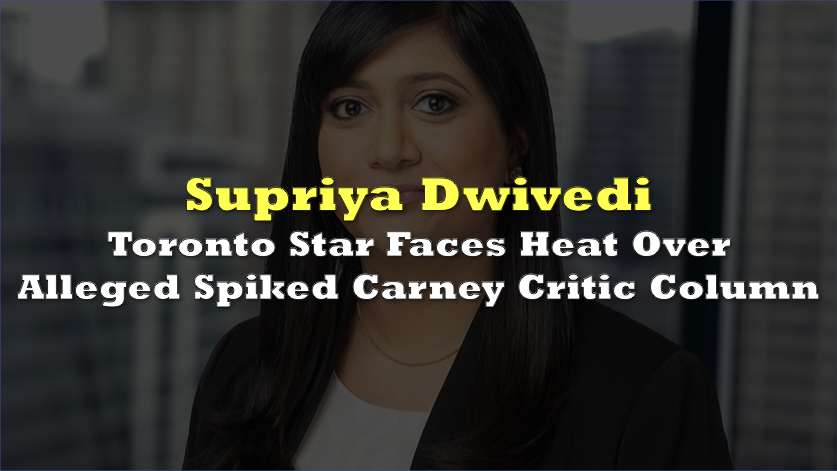

Supriya Dwivedi, a political commentator and former Liberal staffer, said on X that an editor at the Star told her the paper was pulling her column for the week. In a later post, she said the column had been approved and then “spiked” because of a tweet criticizing what she described as wrong reporting by the newspaper.
In a Real Talk podcast episode description, Dwivedi has reportedly linked the alleged decision to her criticism of a Star report about Prime Minister Mark Carney and Nate Erskine-Smith, even after the paper later issued a correction.
The dispute became politically combustible as Dwivedi’s recent commentary sits close to several live political fault lines for Carney’s government: India, foreign interference, privacy, and contested speech legislation.
 Sponsored · Altamira Gold Corp.
National Newswatch’s archive shows Dwivedi has been publishing across Canadian political issues, including columns on Bill C-22, surveillance pricing, Manitoba politics, and earlier Toronto Star work on Carney.
The India file is especially loaded. Carney invited Modi to the June 15-17, 2025 G7 summit in Kananaskis, Alberta, arguing that India’s economic weight made its presence relevant to the summit’s agenda. AP reported that the invitation came despite continued strain over the 2023 killing of Sikh separatist leader Hardeep Singh Nijjar in British Columbia.
Reuters later reported that a CSIS report identified India as a perpetrator of foreign interference in Canada and said transnational repression was central to India’s activity in the country. India has denied involvement in Nijjar’s killing.
The Dwivedi controversy also landed weeks after Sylvain Charlebois, known as The Food Professor, said La Presse suspended his long-running column. Charlebois said the column had run for 25 years and more than 1,000 unpaid pieces before being suspended following his social-media comments about Canada’s media landscape, government support for media, and possible effects on editorial independence.
Charlebois has now publicly linked his case to Dwivedi’s, calling the situation “deeply concerning.”
The Star may have had ordinary editorial reasons. Editors can reject columns, enforce standards, and protect newsroom reporting from outside pressure, including pressure from their own columnists.
But the optics are radioactive because the alleged sequence is simple enough to travel: a columnist criticizes the paper and a column disappears. In 2026 media economics, that is not a private workflow issue. It is a reputational event.
Information for this story was found via the sources and companies mentioned. The author has no securities or affiliations related to the organizations discussed. Not a recommendation to buy or sell. Always do additional research and consult a professional before purchasing a security. The author holds no licenses.