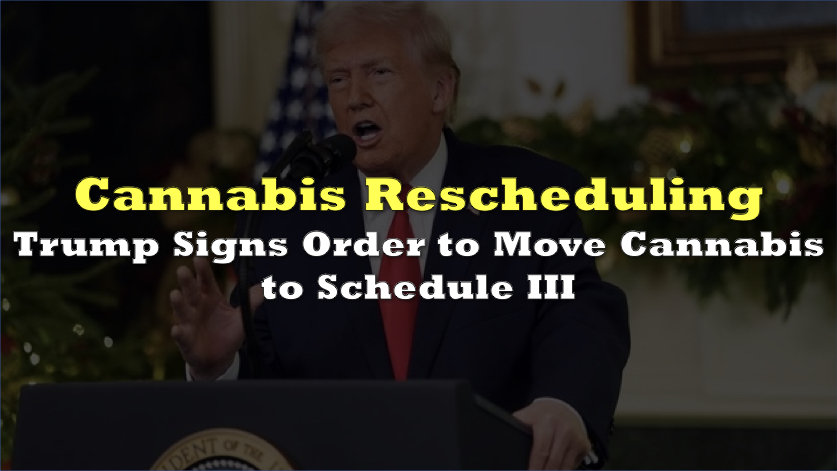

President Donald Trump signed an executive order Thursday to push marijuana from Schedule I toward Schedule III, a federal classification shift the White House framed as a research and medical-evidence play.
Cannabis is currently listed as a Schedule I drug, the most restrictive federal category that includes heroin and LSD, while Schedule III is a lower-control category that includes certain prescription drugs such as Tylenol with codeine, reflecting a formal federal recognition of potential medical use.
A senior administration official said the order is “focused on increasing medical research for medical marijuana and CBD,” adding the primary goal is a “commonsense approach” that improves research to better inform patients and doctors.
U.S. President Donald J. Trump has signed an Executive Order reclassifying marijuana from a Schedule I Controlled-Substance, in the same category at heroin and bath salts, to a Schedule lll Controlled-Substance, on the level as many prescription drugs such as ketamine,… pic.twitter.com/ynNaU0SbUD
— OSINTdefender (@sentdefender) December 18, 2025
The order directs Attorney General Pam Bondi to “take all necessary steps” to complete the Schedule III rescheduling rulemaking process “in the most expeditious manner.”
“Nearly one in four US adults have chronic pain and more than one in three US seniors” plus “six of 10 people” who use medical marijuana report doing so to manage pain, according to the senior official.
Officials also flagged a medication-safety gap for older patients: only 56% of seniors using medical marijuana have ever discussed it with their doctor, which the official described as a “big gap” in care quality given polypharmacy risk and potential interactions with other medications or supplements.
The order’s policy pitch, per the White House, is barrier removal for science and guidance, with officials saying the president has heard both about potential benefits and about the lack of research needed to build medical guidelines, especially when patients use these products without clinician input.
It bears necessity to highlight that marijuana remains illegal to possess under federal law and that anyone possessing it “would be in violation of the CSA” and “remain subject to arrest,” with any change to federal law requiring congressional approval.
The White House also positioned the order as campaign follow-through, citing Trump’s 2024 trail support for research into medical benefits and opposition to arrest or incarceration for small amounts for personal use, while emphasizing the order itself does not legalize marijuana.
Some online summaries described the order as immediately “reclassifying” marijuana to Schedule III, but the executive order text focuses on expediting completion of the rescheduling rulemaking process, implying the administrative steps still matter for final status.
Information for this briefing was found via ABC News and the sources mentioned. The author has no securities or affiliations related to this organization. Not a recommendation to buy or sell. Always do additional research and consult a professional before purchasing a security. The author holds no licenses.