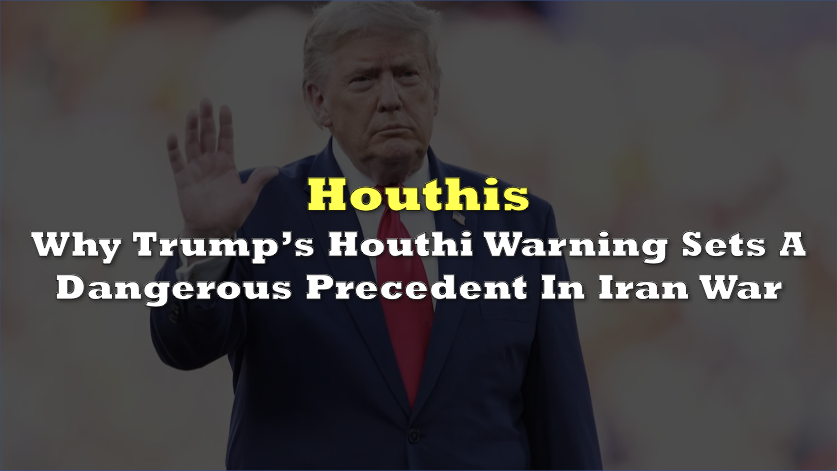

President Donald Trump has converted a Houthi claim about attacks on two Saudi oil tankers into a standing threat to punish Iran, despite unresolved questions about whether both vessels were hit and whether Tehran directed the operation.
Trump said the US would “hold Iran responsible” if the Houthis attacked again because the Yemeni group was an Iranian “Surrogate and/or Proxy.” He added that “major military punishment will be inflicted upon Iran.”
The Houthis said they targeted the Saudi-flagged tankers Encelia and Layla using ballistic missiles, cruise missiles, and drones as part of their newly declared blockade against Saudi Arabia.
 Sponsored · Cambria Gold Mines
Saudi state media confirmed that an attack caused a fire on the bow of the Encelia. All crew members were safe, and authorities secured the vessel, according to the Saudi Press Agency. The UK Maritime Trade Operations agency separately received a report of a tanker struck by an unknown projectile in the same area.
No corresponding confirmation emerged for the Layla. Reuters said the second attack remained unverified. The Houthis’ additional claim that they forced about 10 ships to retreat was also not independently confirmed.
Trump’s statement therefore presented two attacks as established when the available evidence confirmed only one.
However, it is noteworthy to acknowledge that Iran’s material support for the Houthis is extensively documented. Tehran has helped the group acquire missiles, drones, training, and other capabilities that have strengthened its ability to threaten regional shipping.
 Sponsored · Selkirk Copper Mines
But that relationship does not establish that Iran controls every Houthi operation.
The Associated Press described the Houthis as armed and significantly influenced by Iran, but independent of Iran’s supreme leader. A Congressional Research Service report similarly said Iranian support may influence some Houthi decisions while noting that Houthi leaders can act independently and against Iranian preferences.
International standards also distinguish support from control. Article 8 of the United Nations International Law Commission’s state-responsibility framework attributes a group’s conduct to a state when the group acts on that state’s instructions or under its direction or control during the specific conduct.
That does not prove Iran was uninvolved. Tehran may bear responsibility for supplying capabilities used by the Houthis, and US intelligence may possess information that has not been made public. But neither establishes that Iran ordered these particular tanker attacks.
Trump also said the Houthis had “acted very responsibly” after the US bombing campaign and were only now “starting up again.”
The public record is different. Oman brokered a May 6, 2025, ceasefire under which the US and the Houthis agreed not to target each other, including US vessels in the Red Sea and Bab el-Mandeb Strait. The Houthis subsequently said their attacks against Israel and Israel-linked shipping were not covered by the agreement.
Two months later, the Houthis reportedly attacked and sank the commercial vessels Magic Seas and Eternity C. Four people aboard the Eternity C were reported killed, while surviving crew members were taken into Houthi custody and released months later.
Trump’s description is defensible only if “responsibly” means the Houthis generally refrained from directly targeting American vessels. It is inaccurate as a description of their conduct toward commercial shipping.
The Houthis said their Saudi blockade responded to restrictions on Yemen and a recent Saudi attack on Sanaa’s airport. That stated motive does not justify attacks on civilian shipping or rule out Iranian involvement but it does show that the Houthis have their own conflict with Riyadh and their own reasons for selecting Saudi targets.
READ: Houthis Target Saudi Arabia’s Critical Red Sea Oil Route With Embargo
Trump’s error was not describing the Houthis as Iranian-supported. It was treating Iranian support as conclusive proof of command, presenting an unconfirmed second attack as fact, and describing the group’s post-ceasefire record as a year of responsible behavior.
The resulting policy is straightforward but evidentially weak. Another Houthi attack would be treated as an Iranian attack, whether or not Washington demonstrates that Tehran ordered it.