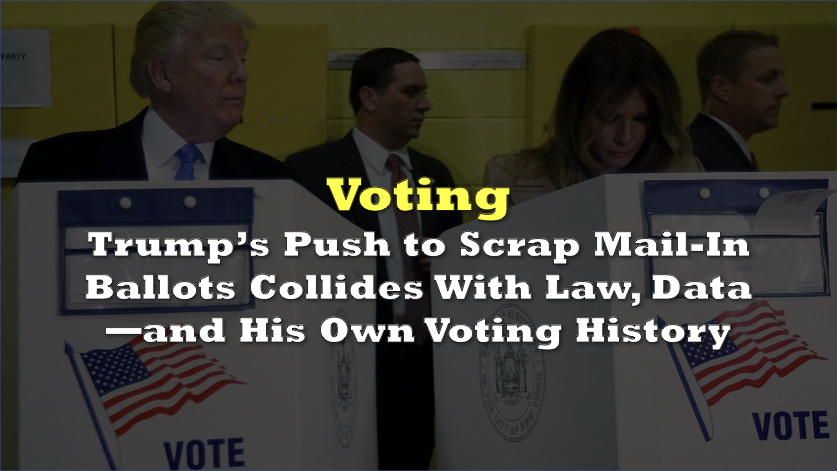
The White House is arguing that President Donald Trump’s use of a mail ballot is consistent with his campaign to restrict mail voting, even as his administration asks the Supreme Court to revive federal rules that would give the government a larger role in determining which voters can receive ballots through the Postal Service.
The distinction offered centers on exceptions contained in legislation Trump wants Congress to enact, rather than the Florida rules under which Trump actually voted.
Reuters reported that White House spokeswoman Olivia Wales defended Trump after Politico reported Monday, citing local voting records, that the president had voted by mail in Florida’s August 18 Republican primary.
 Sponsored · Selkirk Copper Mines
“As President Trump has said, the SAVE America Act has commonsense exceptions for Americans to use mail-in ballots for illness, disability, military, or travel – but universal mail-in voting should not be allowed because it’s highly susceptible to fraud,” Wales said.
She added that Trump remains a Palm Beach resident but “obviously primarily lives at the White House in Washington, D.C.”
Trump did not need one of those proposed federal exceptions to vote by mail in Florida. Under Florida’s current vote-by-mail rules, a voter can request a ballot directly from the county supervisor of elections. State law does not condition ordinary mail-ballot eligibility on illness, disability, military service, or travel.
The exceptions cited by Wales instead come from the SAVE America Act, a broader voting bill backed by Trump. The White House describes the proposal as allowing no mail ballots except for illness, disability, military service, or travel.
The legislation has passed the House but has stalled in the Senate, according to the Associated Press.
At the same time, Trump’s Justice Department is pursuing a separate route to tighten mail voting before the November 3 midterm elections. Earlier this month, the administration asked the Supreme Court to intervene after US District Judge Indira Talwani blocked nationwide enforcement of Postal Service provisions contained in Trump’s March 31 executive order.
The executive order directs the Department of Homeland Security to create state-level lists of citizens eligible to vote and instructs the Postal Service to develop a system under which mail ballots would be transmitted only for voters enrolled on state-specific participation lists. It also calls for unique ballot-envelope identifiers and additional USPS standards.
Judge Talwani ruled that the executive branch lacks authority to regulate elections in that manner. The administration argues that challenges to the order are premature and that plaintiffs have not yet suffered concrete harm. The Justice Department is asking the Supreme Court to lift the restrictions imposed by the lower court before the midterms.