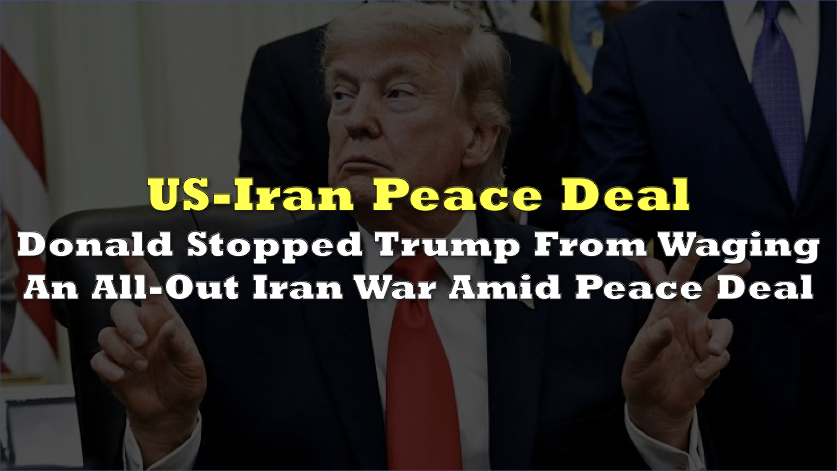

President Donald Trump reportedly weighed an all-out expansion of the war with Iran after a fragile peace framework was already in place. Thankfully, he was stopped by himself.
That is the political irony at the center of Washington’s latest Iran turn. Trump reviewed broader military options with Defense Secretary Pete Hegseth and Joint Chiefs Chairman Gen. Dan Caine, according to The Wall Street Journal, but chose not to restart full-scale strikes for now. Instead, he opted to preserve talks aimed at limiting Iran’s nuclear program, even if those talks run past an August 18 deadline.
The decision does not mark a clean shift from war to peace. It shows Trump trying to hold two incompatible instincts together: the desire to punish Iran with force and the need to keep a diplomatic process alive long enough to claim leverage worked.
 Sponsored · Selkirk Copper Mines
The reported restraint was not driven by trust in Tehran. It was driven by the risk that a larger US campaign would make the peace framework impossible to sustain.
The talks are already unstable. Reuters reported that Iran said it would not meet directly with US envoys Jared Kushner and Steve Witkoff in Doha, clouding prospects for the broader peace framework and nuclear negotiations. Tehran said it wanted ceasefire terms addressed first and continued to assert its position over Strait of Hormuz transit arrangements.
That public rejection contrasts with Washington’s account. Vice President JD Vance said Iran’s denial of Doha talks was a “Persian negotiating tactic,” according to Anadolu, and said technical talks were underway despite Tehran’s public statements.
Either way, a full-scale US assault would likely collapse the ambiguity that keeps both sides at the table. Trump’s pause was therefore not a softening as much as a choice to keep the pressure architecture intact.
 Sponsored · Altamira Gold Corp.
Limited strikes, not full war
Trump has not ruled out force. The Journal reported that he remains satisfied for now with one-off strikes when Iran violates the memorandum of understanding, rather than widening the conflict into a full campaign.
The US has already used force after the peace framework, but in contained bursts rather than a broader operation designed to break Iran’s military capacity. US strikes continued for a second day after Congress told Trump to seek approval or end the war, raising new questions over war-powers limits and whether “limited” retaliation is becoming a workaround for sustained conflict.
That distinction is the administration’s current tightrope. Limited strikes let Trump project retaliation without admitting the peace deal has failed. Full-scale strikes would send the opposite message: that the framework signed to contain the conflict had become irrelevant almost immediately.
The military pause also preserves a financial pressure tool. The New York Post reported, citing a US official, that Iran has not received $6 billion in frozen assets and will not receive the funds unless Tehran meets milestones under the agreement. The reported structure would release money incrementally, through vendors, and only for humanitarian purposes.
The Guardian also reported that indirect US-Iran discussions over at least $6 billion in Iranian assets were set to resume in Doha, alongside disputes over the Strait of Hormuz and regional security.
Spooking the markets
The uncertainty is already moving beyond diplomacy. Reuters reported that Gulf markets ended mixed as investors weighed uncertainty over Doha talks, with regional exchanges reacting to the possibility that negotiations could stall or conflict could widen.
That market reaction shows why Trump’s self-restraint has consequences beyond Washington. The Iran file now touches oil flows, Gulf equities, shipping risk, inflation pressure, and US election-year politics.
The Strait of Hormuz remains the strategic chokepoint in the background. Reuters reported that Iran’s position on transit arrangements and ceasefire terms remains a sticking point, while US officials have pushed for restrictions on Iranian toll collection and control over shipping routes.
A full-scale war would likely turn those unresolved disputes into immediate market shocks. Continuing talks keeps the risk alive, but delays the detonation.
For now, Trump has stopped Trump from blowing up Trump’s Iran track. Peak Trump-era geopolitics, somehow both circular and consequential.