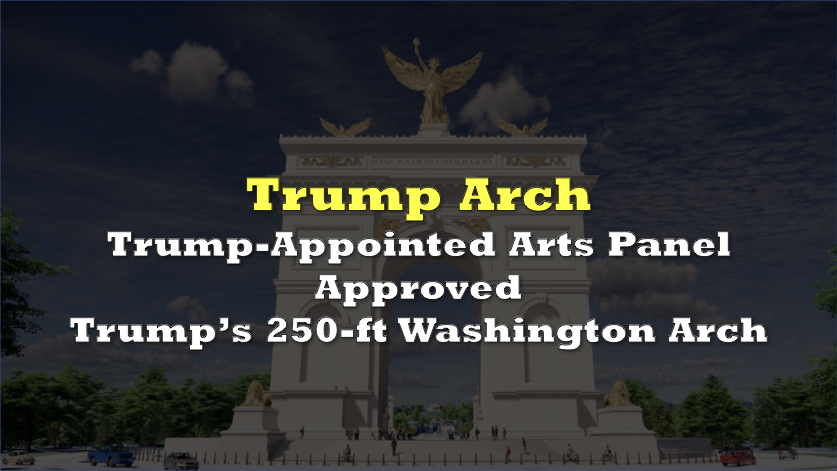

A Trump-appointed federal arts panel has moved President Donald Trump’s proposed 250-foot Washington arch forward, giving the project institutional momentum while leaving its most important questions unanswered: who can authorize it, who pays for it, and whether a new presidential monument can be inserted into one of the capital’s most sensitive ceremonial corridors.
The US Commission of Fine Arts approved the design Thursday for the proposed triumphal arch near Memorial Circle, according to AP. The site sits at the western edge of Washington’s monumental core, near the Lincoln Memorial and the route toward Arlington National Cemetery.
The commission’s current membership gives the vote an added political edge. Its website lists seven sitting members, all appointed by Trump in January 2026. The body’s role is officially aesthetic and advisory, but its approval can help turn a concept into a government-backed proposal with momentum.
 Sponsored · Altamira Gold Corp.
The project entered the commission’s records in April as an Interior Department submission for a “new monumental arch” at Memorial Circle on the George Washington Memorial Parkway. That earlier listing shows the proposal has been moving through formal design channels for weeks, even as its broader authorization remains contested.
The arch is not a small commemorative marker. AP reported that the approved version would stand 250 feet from base to torch and include a torch-bearing figure, an observation deck, gilded eagles, and gold-lettered inscriptions. Elements from earlier versions, including lions and an underground pedestrian passage, were removed before Thursday’s approval.
That design makes the project partly a monument and partly a tourist platform. A 360-degree viewing deck would turn the structure into a destination rather than only a symbolic gateway, raising the stakes for a location already shaped by military memory, presidential memorials, and protected sightlines.
The location is why the opposition has moved beyond taste. Critics have argued that the arch could interfere with historic views between the Lincoln Memorial area and Arlington House. AP reported that veterans and a historian have filed a federal lawsuit seeking to stop the project.
Public comments have also run heavily against the proposal. NPR reported after the April concept review that nearly 1,000 comments had been submitted and that almost all opposed the arch. The objections focused on scale, setting, process, and whether the structure belongs in that part of Washington at all.
The administration has tied the arch to a broader effort to remake Washington before the US’ 250th anniversary in July 2026. Trump and Interior Secretary Doug Burgum have defended the idea by pointing to other world capitals with grand triumphal structures, arguing that Washington lacks a comparable architectural statement.
That argument turns the arch into more than a design proposal. It becomes part of a deadline-driven branding project for the capital, one that compresses aesthetics, nationalism, tourism, and executive power into a single structure.
The legal risk is that symbolic urgency does not erase process. The commission’s approval can support the design record, but it does not answer whether Congress, preservation agencies, park authorities, courts, or additional federal review processes can still slow or block construction.
Information for this story was found via the sources and companies mentioned. The author has no securities or affiliations related to the organizations discussed. Not a recommendation to buy or sell. Always do additional research and consult a professional before purchasing a security. The author holds no licenses.