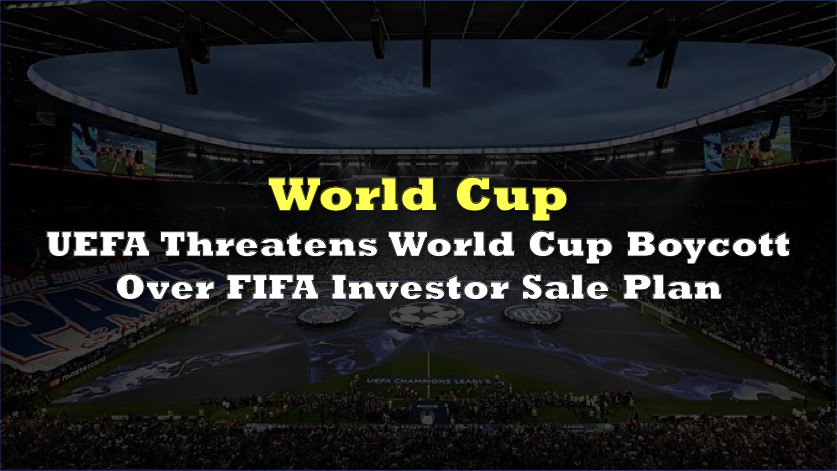

UEFA’s 55 national associations have unanimously backed a conditional boycott of FIFA competitions, creating the possibility that Spain and Portugal could remain official hosts of the 2030 World Cup while refusing to send teams to the tournament.
European associations agreed to boycott FIFA events if President Gianni Infantino proceeds with plans to place FIFA’s tournament operations and commercial rights inside a partly investor-owned company, according to The Guardian.
The 2030 World Cup is scheduled to be primarily hosted by Spain, Portugal, and Morocco. Argentina, Paraguay, and Uruguay will stage one opening centenary match each.
 Sponsored · Selkirk Copper Mines
FIFA formally appointed the six countries in December 2024. Spain, Portugal, Morocco, Argentina, Paraguay, and Uruguay are automatically qualified, according to FIFA’s tournament guide.
Spain and Portugal are among UEFA’s 55 associations. A boycott would therefore create an unprecedented split between FIFA’s tournament contracts and the participation decisions of two principal hosts.
Morocco, a member of the Confederation of African Football, would not be covered by UEFA’s decision. The three South American centenary hosts would also remain outside the European boycott.
UEFA’s position would nevertheless remove the continent’s leading national teams and disrupt the qualification process for the 16 World Cup places allocated to Europe.
 Sponsored · Silver47 Exploration Inc.
The dispute centers on FIFA Forward Enterprise, a proposed subsidiary that would manage the commercial and operational business attached to the World Cup and FIFA’s other tournaments. FIFA plans to value the company at $20 billion and raise as much as $4.2 billion by selling minority stakes of up to 20% to outside investors.
READ: What Exactly Is FIFA Selling To Private Investors?
The organization would retain majority ownership, board control, and authority over competition rules and formats. Private shareholders would receive an economic interest in revenue from broadcasting, sponsorships, ticketing, licensing, hospitality, and tournament delivery.
FIFA has paired the investor proposal with a major increase in funding for its 211 member associations. Its plan includes up to $20 million in one-time infrastructure and development funding per association, alongside an increase in regular four-year distributions. Combined allocations could reach as much as $40 million for participating associations during the next cycle.
The global sports association has asked member associations to respond to the proposal by September 19, according to Reuters.
UEFA has characterized the funding structure and deadline as pressure on national associations to approve a transaction that was developed without adequate consultation. The member associations reportedly agreed that they would not participate in FIFA competitions unless the proposal is withdrawn and FIFA provides binding assurances against similar privatization efforts.
The boycott therefore targets the asset base underpinning FIFA’s valuation. A World Cup without UEFA members would exclude countries including England, France, Germany, Italy, Spain, Portugal, and the Netherlands. Those teams account for many of the tournament’s largest broadcast markets, commercial partners, and most recognizable players.
The resistance is also spreading beyond Europe. Asian Football Confederation President Sheikh Salman bin Ebrahim Al-Khalifa told the region’s 47 associations that FIFA’s failure to consult the AFC was “totally unacceptable,” according to a letter reviewed by Reuters.
He urged AFC members not to decide on the proposal until FIFA follows established governance procedures and holds further discussions.
Joshua Kushner’s permanent-capital firm Thrive Eternal is expected to lead the investor group. JPMorgan is advising FIFA on the proposed transaction.
FIFA has argued that investors would hold only minority, non-controlling positions and would have no role in sporting governance.