

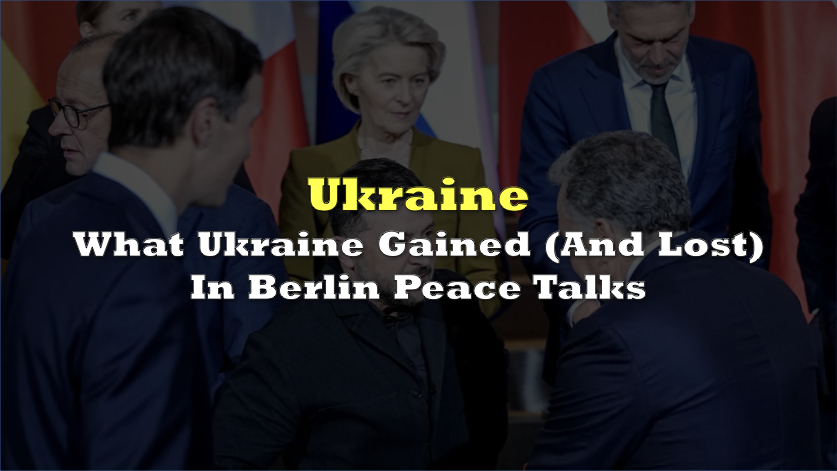

Ukraine gained something tangible in Berlin: a more defined Western security framework that implicitly replaces NATO membership, while the territorial file stayed stuck and Russia’s buy-in remained unproven.
European leaders publicly itemized a proposed guarantee stack after the Berlin meetings, including a European-led “multinational force” tasked with supporting Ukraine’s army and defending its skies and seas.
The package also included a “legally binding commitment” from the UK and other European states to take measures to restore peace and security if Ukraine is attacked again, alongside support for Ukraine’s EU accession track.
On force structure, the European statement anchored Ukraine’s peacetime military at 800,000 troops, directly countering Russia’s demand for a far deeper reduction and giving Kyiv a measurable red line it did not previously have written into a shared Western position. 
The US side discussed a US-led “ceasefire monitoring and verification mechanism” to provide early warning of any future attack, and US officials described the proposed guarantees as “very strong” and modeled on NATO’s Article 5 concept.
NATO off-ramp
Ukrainian president Volodymyr Zelensky signaled a major policy shift by offering to give up Ukraine’s NATO aspiration as a compromise in exchange for strong guarantees, explicitly framing the trade as a substitute for Article 5 protection that some partners would not grant via NATO membership.
In negotiation terms, this concession is a chip Ukraine can spend without formally ceding territory, while testing whether the US and Europe will price that chip with enforceable commitments rather than political statements.
Reconstruction and economic support were on the table, including the possibility of using frozen Russian sovereign assets held in Europe. 
EU countries were also described as heading toward a vote on a plan involving €90 billion of frozen Russian assets held via a Belgium-based institution, but with stated divisions and legal concerns that still constrain how quickly that leverage can be converted into cash for Kyiv.
No peace yet
Even as US negotiators said they were “90%” of the way to a deal, Berlin did not resolve what happens to occupied Ukrainian territory, with US ideas floating “economic free zones” in contested areas and Kyiv rejecting any construct that implies recognition of Russian control.
Zelensky reiterated Ukraine would not recognize occupied territory as Russian and pushed back on “economic free zones” under Russian control.
Russia’s acceptance remains uncertain, particularly around troops from NATO countries on Ukrainian soil, a point the Kremlin has previously treated as a red line and that still lacks any demonstrated Russian sign-off in the Berlin sequence.
Information for this story was found via The Guardian, CNBC, BBC, and the sources and companies mentioned. The author has no securities or affiliations related to the organizations discussed. Not a recommendation to buy or sell. Always do additional research and consult a professional before purchasing a security. The author holds no licenses.


One Response
The WEST needs to arm UKRAINE TO THE TEETH so UKRAINE can finish RUSSIA OFF
such that the WESTERN World ORDER CAN PREVAIL…FINALLY AGAIN