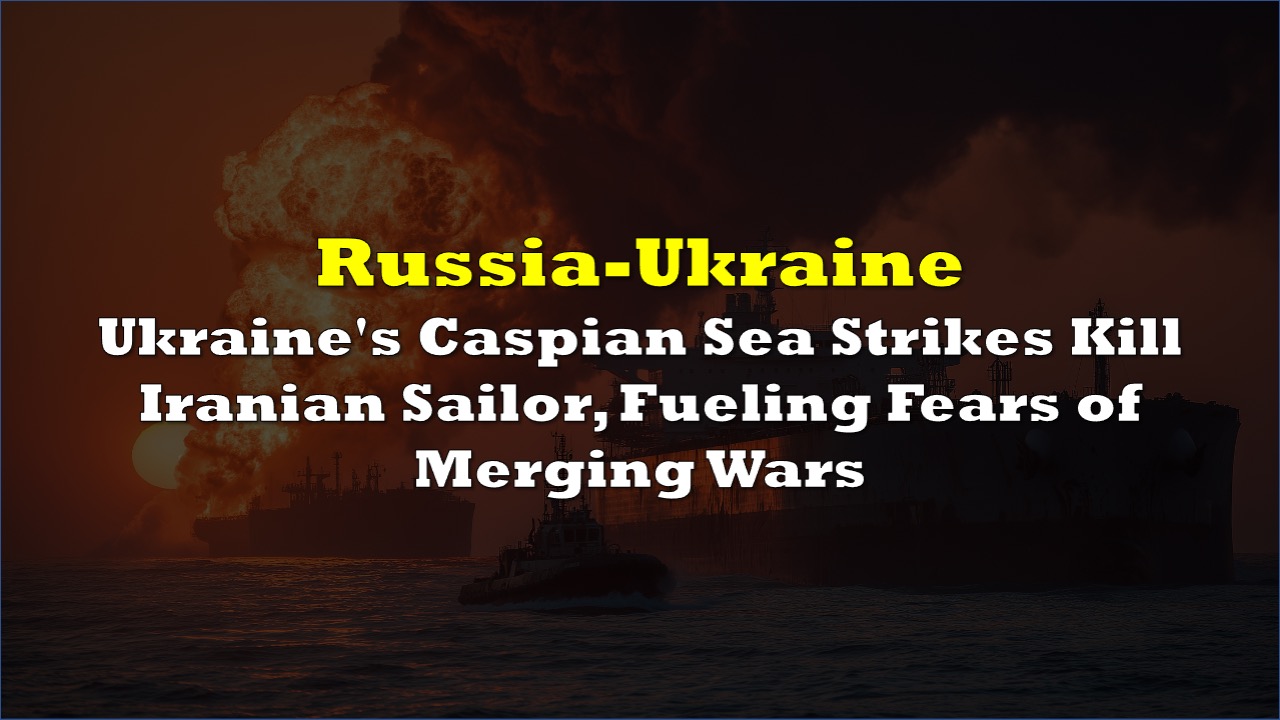

A Ukrainian strike on Caspian Sea shipping has killed an Iranian sailor and drawn a formal protest from Tehran, raising fresh questions about whether the war in Ukraine and the US-Israel conflict with Iran are starting to converge.
Ukraine’s security service, the SBU, said forces struck several vessels overnight on July 25, including the cargo ships Port Olya 2 and Begey, a Project 12418 Molniya-class missile boat, and an oil platform operated by Russian producer Lukoil. The agency described the two cargo ships as sanctioned vessels used to move military cargo between Russia and Iran, and President Volodymyr Zelensky wrote on X that the operation achieved strong results against them and a Russian warship.
Iran’s Foreign Ministry gave a different account, saying the strike hit an Iranian-flagged commercial vessel, killing one sailor and injuring another. Tehran summoned Ukraine’s chargé d’affaires in protest, and Foreign Minister Abbas Araghchi called it a UN Charter violation “at Israel’s behest.”
Ukraine’s target list names Russian-flagged vessels, while Iran describes an Iranian-flagged ship with an Iranian crew, and neither government has released the name, flag or registration number of the vessel where the death occurred. The Kyiv Independent has said it cannot verify Iran’s account of the incident.
 Sponsored · Cambria Gold Mines
The sharpest warnings of retaliation aren’t coming from Iran’s government. A pro-Iranian Telegram channel, Middle East Spectator, circulated a map claiming all of Ukraine sits within range of Iran’s Khorramshahr-4 ballistic missile, messaging that hasn’t been corroborated by any official Iranian source.
Iran does have a demonstrated ability to strike far beyond its borders — in March, it fired ballistic missiles from the Khorramshahr-4/Kheibar family at the US-UK base on Diego Garcia, roughly 4,000 kilometers away, though one missile failed and another was intercepted. Whether Tehran is actually weighing a strike on Ukraine, rather than letting sympathetic channels imply one, remains unclear.
Iran also has a track record of retaliating directly against perceived attackers, having struck Kurdish opposition factions in northern Iraq repeatedly and hit targets inside Pakistan in 2024. But nothing in Tehran’s public statements so far has gone beyond diplomatic protest and a vague warning that it will defend its national interests.
Related: Russia Quietly Sets the Stage for a New Mobilization Wave
Zelensky separately accused Russia of feeding Iran satellite surveillance of US and Gulf military sites to help plan and assess Iranian strikes, saying Russian satellites monitored four air bases on July 19 and 20 alone and that Kyiv would share the intelligence with its partners. He offered no public evidence, and neither Russia nor Iran has responded. Trump said days earlier that Russia and China would not supply arms to Iran, though that addressed weapons rather than intelligence sharing.
Wall Street Journal correspondent Yaroslav Trofimov summed up the moment by writing that “the two wars have officially merged.” The strike took place as the US-Israel bombing campaign against Iran sits in a pause following thirteen consecutive nights of renewed strikes, and as Ukraine continues hitting Russian energy and military infrastructure with long-range drones.